Category: Uncategorized

  • The Taste of Agreement – Why Old Factory Pu’er Can’t Be Your Baseline

    The Taste of Agreement – Why Old Factory Pu’er Can’t Be Your Baseline

    Honestly, I’ve been looking for a topic worth an article for quite some time now. For the past few weeks my Instagram feed has once again been clogged with photos of old factory cakes and boutique brands whose teas easily cost more than a gastroscopy.

    As I write this it is Sunday, and even though I don’t particularly care, somewhere in the nave of the church inside my head a patriarchal voice keeps echoing, suggesting that, just this once, I should not be as caustic, or, how shall we say, corrosive toward other people’s ideas.

    I still haven’t decided whether to listen to it.

    In any case, I often hear people refer to pre-2005 teas, or generally anything produced before the Pu’er speculative bubble burst, as a sort of baseline, a ground zero from which to build one’s knowledge. They are often accessible; sometimes you can find 15- to 20-year-old material at relatively reasonable prices, even if occasionally it feels like drinking a decoction of your own sweaty shirt, baptized by the humidity of Taiwan’s western coast. And this is the first principle of my disagreement. A logistical criterion (access) is often mistaken for an epistemic one (understanding quality). The fact that something is accessible does not make it instructive; it only makes it easy to build a theory around it.

    Act I: the baseline.
    A “baseline” serves to calibrate sensitivity, language, and critical measure; it should therefore be built on samples that clearly represent key variables (raw material, processing, storage style), not on what the market makes convenient to buy in terms of quantity and price. One still hears the fairy tale that sheng from the 90s and up to 2005 were intrinsically sublime, but this is not always true, often it is simply mediocre tea swallowed at great expense, only to discover that it is worth little more than a drunken lost bet, and its chaqi will not save you from the terrible judgment of the Sabbath.

    For clarity: chaqi exists, even if it lacks a clear and unified scientific explanation, but it cannot be what motivates a purchase. Tea discourse often turns mystical, full of “energy” and “vibrations”, frequently because a shared vocabulary for describing quality is missing. Chaqi may be a real, even if subjective, experience, but used as an argument it is often an easy escape hatch. As proof, it amounts at best to a personal impression elevated to a criterion.

    00s factory teas mainly teach an industrial profile: standardization, blending, productive compromise. It is one of the worlds of Pu’er, but not the qualitative world of Pu’er in any absolute sense. That alone is enough to produce a distorted baseline. You grow accustomed to the “factory taste” as a norm and judge everything else as deviation.

    Act II: storage.
    We know quite a lot about storage in general principles, very little about real reproducibility, and almost nothing about comparability between storage environments when data are lacking. There are physical principles, but also an absurd number of uncontrollable variables and complexities, and the whole discussion often dissolves into a broth of anecdotes and mysticism. Whenever I hear conversations about storage invoking names like Kunming, Taiwan, Malaysia, and Hong Kong, I feel as though I am witnessing an Allan Kaprow performance: no one understands what is happening, but everyone has been sufficiently involved that no one can criticize it.

    Storage undeniably influences a Pu’er’s development and quality over time, one need not summon a climate physicist to admit this. Yet its impact is decisive even after only three years. At 17–20 years or more, especially with wetter storage, many differences in raw material and processing compress into a potentially generic profile. This always happens, it is biochemistry, though this does not mean all aged Pu’er tastes the same. Storage is excellent for understanding style and for objectifying a general aromatic dimension, but weak as a baseline for intrinsic quality.

    Act III: aging.
    I come from the world of wine. Twelve years ago, before I began studying what Pu’er actually was, that’s where my free time went, along with a credit card financed by badly paid jobs. Among the initiates of the Bacchus sect one thing is clear: aging is not simply getting old, and aging “without collapse” is not the same as aging “with depth.” The same, frankly, applies to Pu’er.

    Seeing vendors raise the price of unsold Pu’er after a single year already gives me gastritis. But when people identify “aging success” as merely avoiding decay, I feel certain dendritic networks in my brain quietly die. Aging, in the sense of maturation, cannot mean only that bitterness softens and edges round off. Aging is not mere attenuation. Quality, in its dynamic and evolving sense, implies aromatic layering, structure, intensity, huigan, persistence, and a clean transformation not excessively dictated by storage.

    Act IV: prices.
    Tea was once conceived to be stored, not immediately consumed. Even my goat Violette understands this. And Violette knows that if the grass was poor when cut, aged grass remains poor grass. Watching her, one easily understands that the essence of mediocre things is marked in a subtle, almost existential way.

    For years, until roughly 2010–2012, the Pu’er market priced time itself. Primitive, but effective. Now high prices follow expectations of material and origin, desirability, trust, social value, intentions, and all the things Tony Blair might have said to sweeten a policy for his electorate. In short: narrative.

    I have never spent fortunes on old cakes. Not out of moral superiority, but suspicion. Or perhaps because I am not spiritually elevated enough to perceive what the fetishists of granny Pu’er claim to see. I see the risk of fakes, uncertain origin, possible smells of basements sublet for ransom kidnappings, people in windowless humid rooms swapping wrappers while smoking, selling rubbish for four-figure sums, and speculation about batch reputation formed long before the moment of consumption yet already determining the purchase price. A book on the economization of modern art would explain half the Pu’er market.

    In some cases 80s–90s cakes have been among the most meaningful Pu’er I have ever tasted. More often, however, they have earned me a night on the couch and a bitterness in the mouth, the kind reserved for layoffs and extortion, lasting until morning.

    Act V: historical-economic context.
    During the bubble, observers noted raw-material shortages and flows of maocha from border regions into Yunnan, with consequences for average quality and perceived authenticity. Combined with heavy herbicides and chemical fertilization spreading, drastic pruning, and new low-altitude, high-density plantations expanding since the 80s, it is reasonable to conclude that the Pu’er boom pushed toward compromises in material quality and left a large quantity of mediocre tea that has now reached us. This was not mysterious; it was the predictable behavior of a market convinced it had found an eternally appreciating good.

    Factories are logistical machines. When demand rises and high-grade material is scarce, sourcing widens and more ordinary leaf is used. The result is not necessarily bad tea, but tea designed to be reliable, purposeful, not memorable for a few thousand obsessives like me. This baseline represents a supply-chain compromise, not a qualitative summit.

    Look around: a great deal of old Pu’er still circulates, even in Europe, at crazy prices. Ask when you last heard someone speak negatively about those exact teas. Never. Either people lie, or they submit to the mechanisms already described here, or here. In perhaps 20% of cases the tea is genuinely good.

    And here lies the curious point: often we are not drinking what survived because it was the best, but what survived because it was abundant or left aside in who knows what conditions. Or widely counterfeited.

    Act VI: the disciples.
    Other people’s opinions are initially valuable and eventually dangerous. Understanding quality requires experience directed toward objective judgment, not passive adherence to an ideology. Accumulating recommended tastings is not enough. Today the idea of quality in Pu’er resembles a permanent biennale: much celebration, occasional sterile condemnation, and little critical sense. Direct experience is replaced by informal hierarchies, mediated tastings, questionable reviews, preferences learned before tasting. It is not deliberate deception but cognitive economy: easier to recognize a judgment than to form one. Thus a community of interpreters emerges rather than drinkers, a voyeuristic party rather than a participatory community.

    Act VII: philosophy.
    Early in my Pu’er journey, drinking old teas often irritated me. As soon as one session ended something better appeared: rarer, more expensive, a batch from the cellar of some semi-mythical Mr. Someone had to be tried. The hyper-specialized vendors were like dealers in a 1970s novel, not selling a product but the possibility of never stopping.

    It reminded me how, when I was younger, I had a vague idea that my sentimental education might be the result of a permanent structural dissatisfaction typical of the young middle class, a bohemian depression, vaguely Marxist at its origin, the kind felt by those who know they might not truly have it but choose to appropriate it anyway as a social role. A collective suffering based on the impossibility of reaching the next level, something to be simply accepted. Pu’er was exactly the same: happiness and remorse, desire and correction, like a nun who ardently longs for carnal sin and then runs to confession.

    There was certainly repeatability and reliability in each cake, but reliability is not always positive when it becomes leveling. Small productions often vary within the same batch; that variation is the character of craftmanship, not a conscious and unconditional pardon of flaws, but an acceptance of random error and the human element. I had believed that, at least in a product like Pu’er, originally laden with symbols, people were not seeking serial reproducibility and technical anonymity. Factory Pu’er reduces uncertainty, avoids surprises, and allows a judgment consistent with what has already been said. It does not become a baseline because it explains Pu’er, but because it stabilizes the drinker’s experience. Yet there are those who consciously desire exactly this, and even appreciate it. Another shot fired at the memory of Walter Benjamin.

    To escape the warm amniotic comfort of sterile criticism, a possibility exists: constructing a baseline “by matrix” and not by category. One learns nothing from merely drinking “good” teas. One learns only by comparing comparable ones.

    Pu’er is a system of four macro-variables: material, processing, storage, and time. Evaluate them all at once and draw conclusions, it is like reading tarot, not tasting tea. A baseline built on old factory cakes fuses all variables. Excellent for consumption, poor for understanding.

    Taste relatively green-processed samples from different regions of the same year. Try modern “honged” or “oolonged” shengs meant for early drinking: they act as reagents, revealing what happens when processing dominates leaf. Then compare teas from the same vendor or producer, stored similarly for 5–8 years and again for 12–20. Only then you will begin to see what time actually does. At least three of the four parameters should remain fixed.

    Okay, it is not romantic, no mountain sages, no mythic wrappers, no secret Malaysian cellars guarded by tigers. But the differences become legible.

    And here the strange thing happens: once you see the variables separately, much of Pu’er’s narrative evaporates, not because it was false, but because it was not knowledge. It was the socialization of taste.

  • For Personal Reasons – Brew & Blossom Aged Zhangping Shuixian

    For Personal Reasons – Brew & Blossom Aged Zhangping Shuixian

    I realize immediately it isn’t a question of time.
    Time is a polite, almost political excuse; its supposed lack is like fastening a little tie before going to church on Sunday, a superfluous ornament, yet institutionally acceptable, a way of dressing up a lie for a setting you can’t quite tolerate.

    The truth is that writing, now, has ceased to be a gesture, a rite, and has become a habit without interlocutors. A vestigial movement of a vice you’ve already abandoned: like holding an unlit cigarette between your fingers, like swirling an empty glass that once contained God knows what, or sitting at the table of the same restaurant, occupying two chairs when you are, in fact, waiting for no one.

    You post on Instagram and nothing happens , not silence, precisely nothing, and writing stops resembling an act and turns into a routine without recipients, a small private war against the flattening of content and against a stupid algorithm.

    So what remain are unfinished texts, disjointed sentences, in the manner of This Charming Man, except you’re playing the unfortunate version of Morrissey. You tell yourself you write for the pleasure of lining up a few words; you persuade yourself it is the simple necessity of not forgetting, that what exists in your head requires existence outside it.

    In the end, though, writing resembles one of those bars open even on weekdays until four in the morning, frequented by a handful of wrecks, survivors of their own idiocies and victims of their urge to keep defying gravity for no apparent reason, staggering past rows of unoccupied tables under a milky light that pierces their retinas.

    Then, somehow, something significant arrives, disconcerting though invisible to the casual passerby. A tea, a drink, but not just any. This Aged Zhangpin Shuixian does not provoke theatrically impressed reactions or servile compliments. It doesn’t strike you; it holds you. Deep without heaviness, complex to the point of improbability yet ordered, not an abyss, rather a long, poorly lit corridor that seems endless and quietly compels you to walk it to the end.

    In the wet leaves appears toasted hazelnut, not the sugared caricature of contemporary patisseries, but a severe, almost dry one; then dried flowers, rosewood, and the scent of an old library: a olfactory bouquet of an apartment from the nineteenth century, where someone has stopped receiving visitors but not retreating into erudition. Then orange blossom, oats, raisins, an echo of cranberry and hibiscus liquor.

    On the palate everything arranges itself coherently, more enveloping, sweeter, yet never ingratiating. Dried orchid, butter, gingerbread, hazelnut cream, a memory of vin jaune. It’s the sip you would drink while pretending to reread The Catcher in the Rye to impress a former college flame. The texture is soft and continuous, with balanced sweetness and a clear minerality present from the attack through the swallow.

    The aromatic intensity is not excessive, yet the persistence is stubborn and lasting. Its refinement is almost unexpected. The floral substance typical of these oolongs remains, but softened by time and integrated into a composed, adult roast, devoid of any roaster’s narcissism.

    When you encounter a tea like this, you understand that words may return. Not for Instagram, not for the numbers, not to chase an audience that has become hypothetical, not to write yet another clinical, sterile review no one cares about, but because some things demand to be said, and when that happens, writing is no longer content production. It is company. It is a necessary act.

  • Temporary Relief, Applied Correctly – Seven Essence Autumn 2024 Darjeeling Serenade

    Temporary Relief, Applied Correctly – Seven Essence Autumn 2024 Darjeeling Serenade

    Well, you see, when I first started drinking tea I never thought it would become such an important part of my life. I suppose no one ever expects it at the beginning, but I certainly didn’t imagine that something with such a high percentage of water could bring relief to my cirrhotic, worn-out soul, born of a guttural Tom Waits scream and stitched onto me by a drunk tailor.

    It’s not something I dwell on very often. My life, like most lives I know, leaves little room for sustained introspection or ascetic reveries, the sort where you retrace your existence with your bare collarbones pressed into cold marble. The last few times I found myself flat on my back, it certainly wasn’t in pursuit of insight. If anything, with me sprawled out like that, the room seemed to shed what little claim it had to respectability.

    Every so often, though, something breaks through the ambient noise, something that jump-starts circulation in my tingling brain and brings me back to the keyboard while I’m drinking something unexpectedly pleasurable, wearing that faint, unmistakable smile of post-coital satisfaction, the kind you hope no one is paying close attention to.

    Tea, for me, isn’t meditation. It’s maintenance. A necessary distinction, especially once you’ve stopped believing in revelations and settled instead for remaining operational. And this isn’t simply tea. It’s the return of the impulse to move my hands across a keyboard, a reminder of where everything began, when writing hadn’t yet adopted the tone of therapy and was merely a byproduct of staying awake longer than everyone else.

    It’s a reminder of my therapist’s office, Bauhaus in style, where amid excesses of glassy functionalism and metallic geometries, the photographs of Jung, her bony hands protruding from the cuffs of her usual wool sweater, beyond the teak surface of that Danish desk, I can feel entitled to sink into my moment, which, in that case, meant the cognac-leather backrest of her Wassily Chair B3. Marcel Breuer did just as fine a job with that chair for my mental well-being. I liked that room; it was furnished as if someone had decided that psychologically misaligned, too, deserved a proper frame, not just polypropylene crap, particleboard, and poly-laminate assembled in some windowless warehouse while singing the praises of aesthetic surrender.

    In its own way, Serenade does the same thing.

    It’s a frosted batch, from the autumn of 2024 if memory serves, a sweet, sugared liquid that never quite tips into cloying. Aromas of saffron, powder, antique rose. As I inhale the damp leaves, I’m taken back to my mother’s bottle of Baccarat Rouge, two-thirds empty, sitting on her nightstand, the kind of object that disappears alongside the unspoken understanding that something is slowly, quietly ending.

    On the palate, those Kurkdjian-adjacent notes return, flanked by hints of jam and honey, followed by an aromatic excess of sandalwood and musk, a depth that arrives late and lingers with the elastic persistence of its own sweet afterimage. It’s a tea that allows anyone access to ecstasy without going into debt: a quietly subversive form of wealth, a luxury that doesn’t improve your standing in the world, but makes it temporarily more inhabitable.

  • The Cup That Didn’t Need Your Approval – Viet Sun Tủa Chùa Spring 2024

    The Cup That Didn’t Need Your Approval – Viet Sun Tủa Chùa Spring 2024

    We all know it: social networks always leave too much room for sensationalism. There’s endless space for anyone obsessed with sanctifying new brands and glorifying mind-blowing teas that promise an experience somewhere between spiritual awakening and a methamphetamine binge. A permanent pop-up of disposable enthusiasm. It’s the amusement park where anyone can feel like a prophet for a day, canonizing the newest square meter of the most remote village, where snakes, tigers, and giant beetles supposedly lurk ready to attack the tea pickers, only them, of course, not people practicing any other profession, before moving on without even bothering to stub out their cigarette in the ashtray of final verdicts.

    Everything seems to shine, everything seems harmless, everything promises miracles, at least until you realize it was only a reflection, not the source. That’s life.

    It has happened to me too: speaking too highly, too soon.
    But there is one terrain, one terroir, on which I’m not willing to make the slightest concession: Tủa Chùa.

    From a mountainous rear area near the Điện Biên Phủ valley, where in 1954 the decisive battle that ended French colonial rule was fought, this region has become an enclave capable of producing surprisingly accomplished Pu’er teas. Many areas once considered marginal and reactionary, such as Tủa Thàng, turned into revolutionary bases, as they combined geographic isolation with strong social cohesion. The karst plateau, with its steep mountains and paths invisible to outsiders, offered natural refuge to high-ranking officials of the Việt Minh. They took shelter in the homes of Hmong villages, protected by the population’s collective silence.

    The inhabitants knew the land intimately, guiding men, weapons, and messages along unmarked routes, avoiding French patrols and keeping the mountain areas connected to the Điện Biên valley. All of this unfolded in conditions of extreme poverty, yet they provided food, places to rest, and intelligence on enemy movements, accepting extraordinarily high risks. In those mountains, silence was a form of resistance, and the geography itself seemed to have taken sides.

    Now, back to the tea.

    If I had to explain to someone what true mineral, botanical, ancestral excellence means, if I had to make them understand what these trees are capable of, and why Vietnam today not only looks Yunnan straight in the eye but openly challenges its borders, I wouldn’t hesitate for a second. I’d pour them this tea. No preamble, no rhetorical acrobatics, no captions.

    The way this tea is evolving is sublime, truly the kind of harvest you get once every five years.

    I’m sorry to say it won’t deliver the tragic depth of Marina Abramović’s gaze, the high priestess of emotional intensity descending upon us mortals to elevate us by staring into our eyes like a corneal topographer.

    What it will give you is a perfect sip.

    This is a sheng with an almost exasperated intensity, like an overexposed photograph that somehow works. It lingers on orchid notes, though not like Jingmai, those notes seem wrapped in a dense, almost brooding forest aroma, the kind currently fashionable to flaunt when talking about Guafengzhai, but here they feel more arrogant, they slide under your skin with a needle’s quiet, deliberate precision, an elegance that’s both unsettling and strangely pleasant.

    On the palate it’s viscous, medium-bitter, with barely perceptible astringency. The huigan is quick, floral, so persistent it feels more like a reforming than a return.

    This isn’t a tea for fragrance addicts or niche perfume obsessives.

    The qi is the real point here.

    It’s a tea for those who recognize the exact moment when something slips in and changes you.

    You don’t keep drinking it just for the aroma, you do it because a part of you has already been pulled in, and now it wants to know what will happen if you keep filling the cup.

  • Why Are We Still Pretending Darjeeling Doesn’t Matter? – Seven Essence Darjeeling Ouroboros 2025

    Why Are We Still Pretending Darjeeling Doesn’t Matter? – Seven Essence Darjeeling Ouroboros 2025

    There are several reasons why I sometimes disappear and stop writing. A loss of imagination, a lack of interesting teas, and other times it’s simply my own bad habits sabotaging every functioning neuron like a broker gambling with other people’s money. And then there are a couple of reasons no one would care about anyway.

    But through all of this, I never stop reading.

    Still, I never seem to read enough about Darjeeling, about what happens up there, about its teas.

    I’ve always been a fanatic of the outcast and a chronic sentimentalist when it comes to shadowy corners, yet I can’t quite explain how, after twenty years of transformation, twenty years since Darjeeling was a caricature of itself, a withered tea ground into particles so fine they resembled the jaundiced, depressing version of the world’s most famous nose white powder. But now that this terroir is producing something extraordinary, even radical, it remains buried under a silence so thick it’s hard not to suspect that plenty of people prefer it that way.

    I mean, at this point Darjeeling has become like one of those old guitar shops where you walk in thinking you’ll just take a quick look and end up realizing that every instrument in the room has more personality than you do.
    And now they’ve even taken to crafting a flawless Yabukita, without kidnapping any Japanese makers or resorting to those “minor cultural seizures” the British used to call foreign policy when they royally screwed things up with China.

    Some time ago I met an art dealer who spent his days among some of humanity’s most astonishing paintings, only to return to an apartment with exposed meters, peeling plaster, cracks running across the walls like badly healed scars, and rugs riddled with cigarette burns. It was a hole carved out in the middle of urban chaos, the kind of place he’d only been able to afford back when interest rates were frozen. But to him, it was home. His emotional bunker. The private stage for his domestic follies.

    Ouroboros, this Yabukita first flush, is more or less the same thing for me. A reset button, the kind you press only when you’ve officially run out of patience.

    The aroma of the wet leaves recalls the soft, dim sensuality that must have permeated the ridotti of nineteenth-century Venice, where the creaking parquet served as an unintentional soundtrack to the backstage vocal warm-ups, and the scent of stage makeup sold to actors and singers mingled with the smell of sex and the dusty, threadbare drapes.

    It’s a tea processed like an oolong, a futurist tea built on juxtapositions and clashes, where notes of moss, damask rose, and face powder emerge as if a performer had just walked past you, brushing against your shoulder, not by accident but with deliberate slowness. Then mango, verbena, polished wood, and tuberose shift in tangled succession.

    As the sip moves forward, the intensity rises like a cab driver who refuses to acknowledge the existence of brakes; the mango grows richer with floral shades of geranium and violet, leaving a film of sugary sweetness on the palate and an obstinately long aromatic persistence.

    It’s a tea that grabs you by the collar and drags you right back to the exact point where you stopped feeling alive, but with a new perspective.

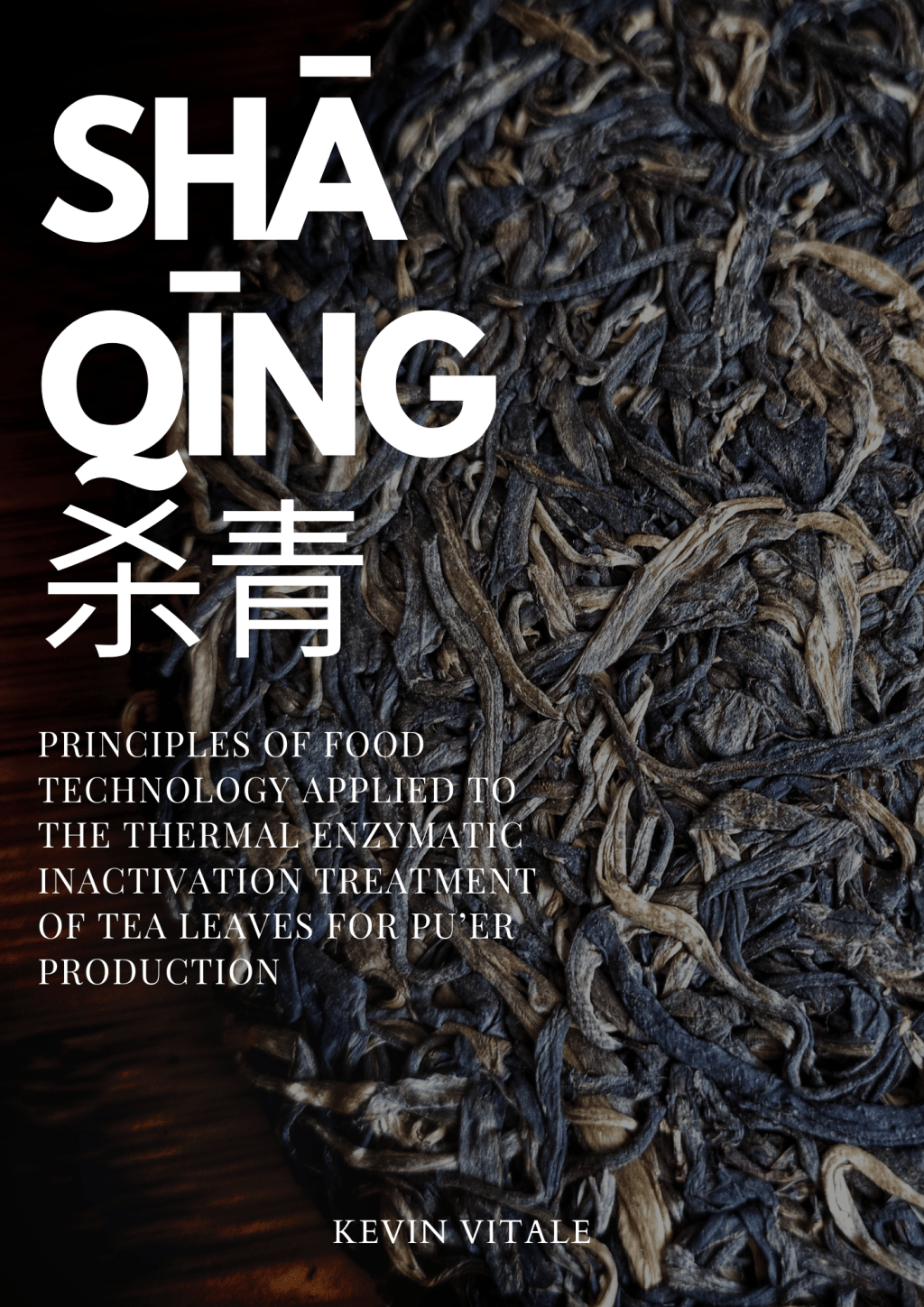
  • Shāqīng: My New EBook Is Out Now (English & Italian)

    Shāqīng: My New EBook Is Out Now (English & Italian)

    Hello everyone!

    With this post, I would like to share the result of a project that has accompanied me over the past few months: a publication born from the desire to present, in an ordered and comprehensible form, the most significant insights I have gathered about the world of fermented teas.

    More than a year ago, I began collecting material for a book that would include a wide range of information concerning the engineering, microbiology, and biochemistry of fermented teas. Given the complexity of the project, and unsure whether it would ever see the light of day, I decided to publish a preview dedicated exclusively to shaqing.

    There are not many publications capable of addressing tea processing with clarity and rigor; even fewer do so in a way that is accessible and free from economic barriers. This work attempts, at least in part, to fill that gap by offering a starting point for understanding the complexity of production processes, particularly those of Pu’er and fermented teas.

    I have always believed that knowledge, to be genuine, must be offered without ostentation; that it should serve as a space for connection rather than exclusion. For this reason, I wanted this excerpt to be freely available.

    It is a gesture of gratitude toward those who have stood by me, toward those who are no longer with us, toward all who have contributed to the creation of this work, and naturally toward tea itself and the people whom, thanks to it, I have been fortunate enough to meet.

    If you choose to read it, I hope you will find within these pages not only information, but also a measure of the care and passion I have tried to pour into them, and that you may feel inspired to share it with as many people as possible.

    In the end, as often happens with traditions that endure, what truly matters is not merely knowledge itself, but the community that forms around it.

    Below you will find the downloadable file, available in both Italian and English.

    Cheers, my friends, and happy reading!


    Kevin Vitale – Shaqing Principles ENGLISH

    Kevin Vitale – Shaqing Principi ITALIANO

  • On How Hard It Is to Make a Good Black Tea – Sipping Viet Sun’s Lào Cai Deep Forest Black Spring 2025

    On How Hard It Is to Make a Good Black Tea – Sipping Viet Sun’s Lào Cai Deep Forest Black Spring 2025

    I sometimes think we take far too much for granted just how complicated it is to make a truly good tea, especially a good black tea.
    It’s treated as a Pavlovian reflex, a gesture made without thought, like pouring yourself another glass of prosecco when the guests’ conversation has already descended into collective complaint.

    We grow used to the idea of that same black tea we’ve known since childhood, the one we dip into hot water, pressing it against the bottom of the cup with a spoon as though drowning an enemy soldier, then lifting it out in an act of sheer mercy, waiting for answers that will never come.
    But how difficult is it, really, to make a tea that isn’t just another instrument of urban survival, like the burnt acid coffee of a NOLA diner where Truman Capote used to sleep off his drunk?

    Crafting an excellent black tea can be a perilous act, a poorly calculated risk, a climatic roulette.
    The best terroirs, in Yunnan, Vietnam, and Thailand, where the best Dianhong and wild black teas are born, are surreal, high-mountain subtropical zones with humidity often above 80% and violent diurnal temperature shifts.
    Many varieties from these regions, particularly the wild non-sinensis sinensis types, bear large, waxy leaves with thicker cell walls requiring greater mechanical force to rupture.
    And in cold, damp environments such as Lào Cai, leaf plasticity itself changes with temperature, creating irregular breaks that result in uneven oxidation.

    During withering and oxidation, intracellular water regulates enzymatic kinetics and oxygen diffusion; therefore, the microstructure of the leaf, guided by the degree of mechanical rolling and the residual moisture content, controls the access of O₂ to phenolic substrates. In large, thick-cuticle leaves, diffusion is limited, and mechanical rolling, by potentially breaking cells unevenly, can create micro-anoxic zones that produce grassy notes alongside over-oxidized regions responsible for bitter flavors.

    To make matters worse, these varieties exhibit a polyphenol oxidase activity significantly higher than that of sinensis sinensis cultivars, sometimes two to three times greater.
    This causes a much faster initial rate of oxidation and a greater release of heat, since these reactions are strongly exothermic.
    The result is a local rise in temperature within the leaf pile and extreme sensitivity to even the slightest thermal or oxygen fluctuations.
    A gradient of merely ±5 °C between surface and core can produce differences of 20–30% in the local oxidation rate, turning the process into a blind sprint toward excess.

    The pronounced diurnal temperature range triggers metabolic oscillations, leading to unstable enzymatic activity. Add to that the high humidity and the coincidence of the rainy season during harvest and processing, and the withering can drag on for hours and hours. Moreover, even the final natural drying can prove impossible and storage can turn into a logistical nightmare.
    All this leads to the constant risk of unwanted chromatic heterogeneity, partial over-oxidation, and distorted aromatic profiles, dominated by earthy and metallic tones, mouthfeel stripped of viscosity, and a finish that is absent, unpleasantly vegetal-oxidized, laced with the taste of missed opportunity and lost money.

    And yet, this Lào Cai Deep Forest 2025 by Viet Sun tells another story.
    Its wet leaves smell of a kind of wildness that would even coax a smile from Eduardo Kohn, of forest berries, amber, and guava.
    The olfactory profile deepens through the corroded cortex of a nostalgic old Tory: leather and forgotten colonial furniture, oak aged Pedro Ximénez, and the memory of a wilted rose.

    On the palate, it is soft, seductive, with a sugarcane sweetness and flavors of wild berries, dried flowers, and dehydrated cherry.
    It’s a difficult tea, one whose making requires traversing a desert of problems, an act of resistance against mechanization itself.
    But perhaps that is the price to pay for something potentially extraordinary.

    Kerouac once wrote that “problems are the general definition of the things in which God exists.”
    And here, God is probably caked with mud, smokes Saigon Red, and occasionally takes refuge in the hands of those who still believe in difficulty.

  • After the Metaphors – Viet Sun Cao Bồ Tall Trees Spring 2025

    After the Metaphors – Viet Sun Cao Bồ Tall Trees Spring 2025

    Usually, I would write about a place, a land, the wind disturbing the fragile balance of the hats of farmers bent by time and sciatica. I would use rhetorical tightrope acts that might seem almost contrived to some, or romantic and evocative to others.
    But this time I won’t do any of that, no recycled sensations, no stories about the battles in the Tây Côn Lĩnh mountains or about how this tea recalls that Eastern peace we like to import in small doses into our European afternoons, that peace found in watching Maggie Cheung walk under the rain while time slows down, when everyone holds their breath, diaphragm tensed, as absolutely nothing happens. Things that usually grant every tea a kind of added grandeur, a metropolitan dignity sweetened with a touch of neo-rural nostalgia.

    I’m not John O’Hara, and I don’t think people care to see every banal gesture described as a moral battlefield.
    So, this is a sheng. We’ve more or less all arrived there. And if I stopped here, I’d already be more honest than most of contemporary gastronomic documentary.

    But I believe this is one of those few Pu’er teas that doesn’t need me, or my words, or anyone else’s, to be understood. Roland Barthes saw in photography two fundamental aesthetic elements: the studium, the set of information one needs to know, and the punctum, the element that wounds, that seizes attention and couldn’t care less about the rest, about its translation into prose; it just arrives, contracted like a beast.

    It’s in its wet leaves, tremendously fruity and earthy at once, in that quarrel between magnolia, orchid, dandelion root, and Tellicherry pepper that the punctum arises. Barthes would say it’s in that absurd moment of unconditional pleasure that meaning breaks and truth seeps through, like a development flaw on a film roll.

    This ancient tall trees tea it’s a bomb wrapped in silk drapes, almost nervously delicate and at the same time powerful. It’s a sip of terroir served at a hundred degrees; it has everything that remains when you strip away the narrative.
    The texture is medium-soft; it tastes of pepper and wildflowers, white grapes, juniper, it tastes like that childhood photo with the grain too visible, the one you wish you had but that someone is now romanticizing somewhere on Netflix.

    The qi leaves you with a strange calm, almost clinical. The huigan is excellent; the bitterness is low, the astringency absent. The persistence is long, the sip seems to linger there, clinging to the squamous epithelium of your throat like a gentle remorse.

  • Dark Alleys, Bright Lies. Seven Essence Spring 2025 Darjeeling Petrichor

    Dark Alleys, Bright Lies. Seven Essence Spring 2025 Darjeeling Petrichor

    You never thought you’d find yourself at this hour of the morning in a place like this, and you wish you could appear to yourself less out of place than you actually are. You got there after immense vestibular struggles, tearing your jacket at the shoulder that had christened the walls of the whole 3rd Avenue, walls that were essential for you to keep an upright stance, while thinking about what it would be like to sit with your nose pressed against the condensation on the window, as outside the city swarmed in the intricate anthill of the metropolis’s underground.

    The hours slip away like scraps of time in the incessant rain, the night overcomes the inertia of time, and in that instant two o’clock turns implacably into five. The smell of water on asphalt enters through the door, filling your lungs. Within those four walls, where people seem intent on parading the abandonment of beauty as an ideal, human matter appears left in its larval, suffering state. And yet you decide, finally, to chase the storm. You leave that refuge of castoffs with cautious agility, pushing past the wreckage of bodies. The merciless daylight has not yet pierced you, but you sense that, if you dare to lift your gaze, you would discover the kind of sky Buñuel would have loved to film: bare, raw, condemning.

    The scent of petrichor comes as a diagnosis, a primordial odor of drowned cities and funerals. You fancy yourself a walk-on in Mastroianni’s La Dolce Vita, except there is no Anita Ekberg to redeem you, only empty taxis, memories soured by undigested alcohol, no vintage Italian cars, only graffiti, puddles shimmering metallic green, and a man clutching a handrail like Christ in Grünewald’s Crucifixion.

    And this Seven Essence tea, a 2025 Darjeeling first flush, is a confession of hidden memory, an echo from your compromised hippocampus able to grant grace even to one of these formless nights. It recalls the mineral scent of rock, buildings washed by a midsummer tropical rain, the dark humid nights spent cradling a glass; it carries that note of cake and caramelized fruit reminiscent of your mother’s tarte tatin at six in the morning, when you returned home sheepishly, with many good intentions and little balance. In this situation, the P312 cultivar seems to proclaim with satisfaction that nature manages to create grand works without pomp or excess. In its tones of aged wood and oat hay, echoes of moss and jasmine rise, preparing you for a perfect sip. one of those that seem to set things right, becoming a medical prescription for your attempt at redemption.

    This tea is a window onto the beyond, a buttery tincture, sweet and herbaceous, the liquefaction of a Salgado photograph with its exasperated structure. The sip is lushly viscous, the sweetness on the finish borders on obsessive, its complexity remarkable, and the persistence so strong that it makes you forget your last dinner in a seedy diner. But now that note of petrichor offers a way out of the city you had once chosen as the stage for your aspirations, a bandage on the broken promise of art that was meant to illuminate mankind, but which to your eyes now seems reduced to rancid ketchup and congealed mayonnaise.

  • Bought It for the Feed. Paid for the Myth?

    Bought It for the Feed. Paid for the Myth?

    When a person starts consuming a lot of tea, and at the same time begins spending significant amounts of money, creating those situations where every online purchase takes on, in their mind, the aura of a bid at Christie’s for a Rubens painting, sooner or later, the people around them will pose the classic question:
    “That 20-year-old tea, aged, stale, with a questionable aroma to many, costing $3 per gram, is it really worth that much?”

    As I wrote in a previous article, we are all touched by the rough hand of “the psychopolitics of consumption.” Whether we like to admit it or not, price becomes a revealer of a kind of pseudo-truth, colonizing our sensations and emotions to the point that we start believing that the object bearing that price tag is somehow from a higher reality, a vehicle of a superior sensory condition.

    In recent years, I’ve noticed a certain invasion of the market by cakes from producers like Xi Zi Hao, Bao Hong Yin Ji, Chen Yuan Hao, and all these boutique brands you’ll see featured in at least two or three posts a day on your Instagram feed. These aren’t brands that appeared yesterday, to be clear, but lately there seems to be a kind of viral obsession around them, adorned with a certain propensity for sensationalism.

    During a tea session I attended a few days ago, many people expressed an almost frantic desire to purchase cakes from these brands, like Bingdao and Bohetang from these brands, which often sell for at least $1,500-2,000 per cake. The central discussions weren’t about their quality, but rather about how to access them: where to find the best deals, how to split the tea, as if divvying up the pages of a first edition King James Bible. At a certain point, that room full of tense faces had turned into a kind of collective purgatory, where everyone was trying to convince themselves they had enough credit to justify the expense and finally ascend. In that moment, we all could’ve been perfect subjects for an Eve Arnold photo series titled Misery and Desperation.

    Now, setting aside this acute exposure syndrome toward certain brands, many were convinced that these teas would be a kind of revelation, finally pulling back the curtain on some mystical conspiracy, offering access to the long-hidden “truth of gushu”. These Pu’er teas are expected to be two or three times better than anything previously experienced, but at ten times the price. Throw in some old Red and Green Mark cakes, and you can add another zero to the figure.

    So, is it really worth it? Judging by this ratio, apparently not. But if we followed this logic consistently, we’d never do anything but embalm ourselves while waiting for the final sunset.

    So my answer would be: it depends on your income. If you’re not wealthy, live in a place where inflation is sky-high, and the price of a cake equals a month’s salary, then maybe you should think twice. For that same amount, I could buy an 1800s ceramic piece, plan a vacation, purchase an incredibly satisfying tea, and get my girlfriend a gift, all at once. The point is: while there are plenty of mediocre teas out there, there are also vendors offering both aged and fresh teas at human prices with truly excellent quality. A lot has changed in the past 10 years.

    Why do I say this? Because over the past decade, I’ve simply come to understand that buying tea shouldn’t be a personal financial shipwreck.

    It’s true that, like many other things, tea is subject to imitation behaviors. Many chase after a brand like starving wolves, simply because someone deemed “credible” for whatever reason says it’s good. The risk of confusing what we genuinely desire with what we’re unconsciously pressured to desire is always lurking, especially in an era where desires are not allowed to settle, to decant, to shed the tension of ownership imposed by a third party. A hobby always risks becoming a vice, a dependency. But tea doesn’t have to be that. We need a lateral approach, not in opposition to the market logic, but in deconstructing it and using it more consciously.

    Mixing a bit of Baudrillard with a touch of Byung-Chul Han, we get an answer to this exhausted system of tasting, not of tea, but of signs. By always chasing the newest tea, the most expensive one, the one from the most remote and romantic village, fueling our hunger for the “authentic taste”, we risk entering into the realm of simulation, where the experience isn’t real but positional. One drinks something not for the experience itself, but to feel like someone in comparison to others, to position ourselves next to those who told us this tea would open our minds. Only to eventually realize, of course, that it’s just tea. Most of the time, it will always just be tea, excellent, magnificent even, but no price or opinion will dictate how much it will truly move you, or how good or special you’ll find it.

    With time, you might discover that the most special, moving teas, you won’t even remember how much you paid for them. But your spouse will remember that -$2,700 transaction on June 10, 2013, for 357 grams of an obsession even you can’t explain. They’ll remember it better than your wedding anniversary, regardless of how wealthy you are. In that moment, You, Me and Dupree starts to seem like an overly optimistic romantic comedy compared to your personal film: You, Me, and a 2006 Yang Qing Hao Chawangshu, a title too long for Netflix, and too depressing to laugh at, accompanied by the muffled sound of the kettle and the silent judgment of someone who loves you despite everything. DESPITE everything.

    On top of that, there’s a mechanism I find frankly perverse. Maybe it exists, maybe it’s just a product of my twisted, overly analytical mind, fueled by neurotic narcissists and the wrong reads, but it might be interesting to consider what Zygmunt Bauman described as planned obsolescence. According to this concept, a prepackaged emotional state is created, leading to affirmations like:
    “This tea will be the one.”
    “This time I’ll understand.”
    “This time I’ll be worthy of grasping ancient tree Pu’er.”
    “This time… this time…” and so on.

    This generates a renewable insecurity, where every piece of information, every certainty, has an expiry date. You feel the need to try an endless number of ultra-expensive teas, each one meant to construct a kind of symbolic refuge. It’s a sneaky and refined mechanism, if you think about it. It creates a form of outsourced desire, where you move from wanting to know to desperately seeking new stimuli and confirmations, eventually imposing upon yourself the need to desire, becoming a co-author of your own subjugation.

    You’re not forced to want the $2,000 tea. You convince yourself that it’s your mission, because you need to feed that pit bull that is your craving for apparent knowledge.

    Of course, this doesn’t apply to everyone, but I think it helps explain many of the neuroses people have in the tea world, especially at the beginning, and particularly when they don’t have a lot of money to spend.

    I’ve tried many of those teas over the years. Some were excellent and are now gone forever, many I don’t even remember drinking, and others are still there, parked like a lover in the usual hotel room, who’ll never see you walk in again. That’s because, more often than not, I end up choosing something comforting and far less expensive, something that doesn’t require a transcendent atmosphere to enjoy a dozen infusions. Something that, for many reasons, some even objective, I enjoy more.

    I don’t think I’ve reached that “ethics of conscious consumption” Bauman might have described, but I’ve simply chosen to be happy drinking great tea without going broke. I’ve discovered there is no upstairs level of happiness hidden behind those cakes. Their Qi is not an LSD trip, their huigan won’t unlock some little door to enlightenment, like a Mulholland Drive sequence where everything suddenly makes sense and terrifies you, and their great health benefits won’t cure your diabetes.

    For some, seeing one of those ultra-fancy cakes resting on an expensive rosewood table is akin to a primal carnivorous urge, like spotting a wounded animal lying on the ground. But I think I’ve become disenchanted with that kind of thing, I’ve, shall we say, gone vegan.

    These days, I find much more pleasure in discovering unknown names, new vendors, trying teas from new regions and countries, things without pedigree but with substance, without external contamination, without info sheets or anything that triggers my annoying jaw tic that accompanies every sip of a $50/session tea.

    Maybe that’s what marks the transition from novice to some kind of post-adolescent maturity in tea drinking. Or maybe it’s just the prelude to the collapse of my mental health, and soon I’ll be sipping mallow infusions in the grip of some hormone-fueled delirium. But I’ve found that this approach lets me evaluate teas more freely, more objectively, and in many ways, even more scientifically.
    And above all: it’s made me happier.