
Along the Xianglun Highway, the entrances to the forest alternate with those of the taidicha, a single main road connects the village of Manzhuang to that of Manlin. The primeval essence of the tropical forest can be seen from the few patches of bare earth left; the age, mineralogy and extensive leaching of acrisol, which have led to low levels of plant nutrients, counteract the silt-clay undertones of the iron- and aluminum-rich ferrarsol in which the camellia has found its home.
In the teahouses you drink the liquid consequence of a territory and its time, of a history of sacrifices and the search for the truest self-assertion. They become a place to find a family, a group or a simple shelter where one can abstract oneself from taxes or from any contradiction of contingencies, where every soul, even if tacit, does not wander alone, but together with other worn out and thirsty souls.
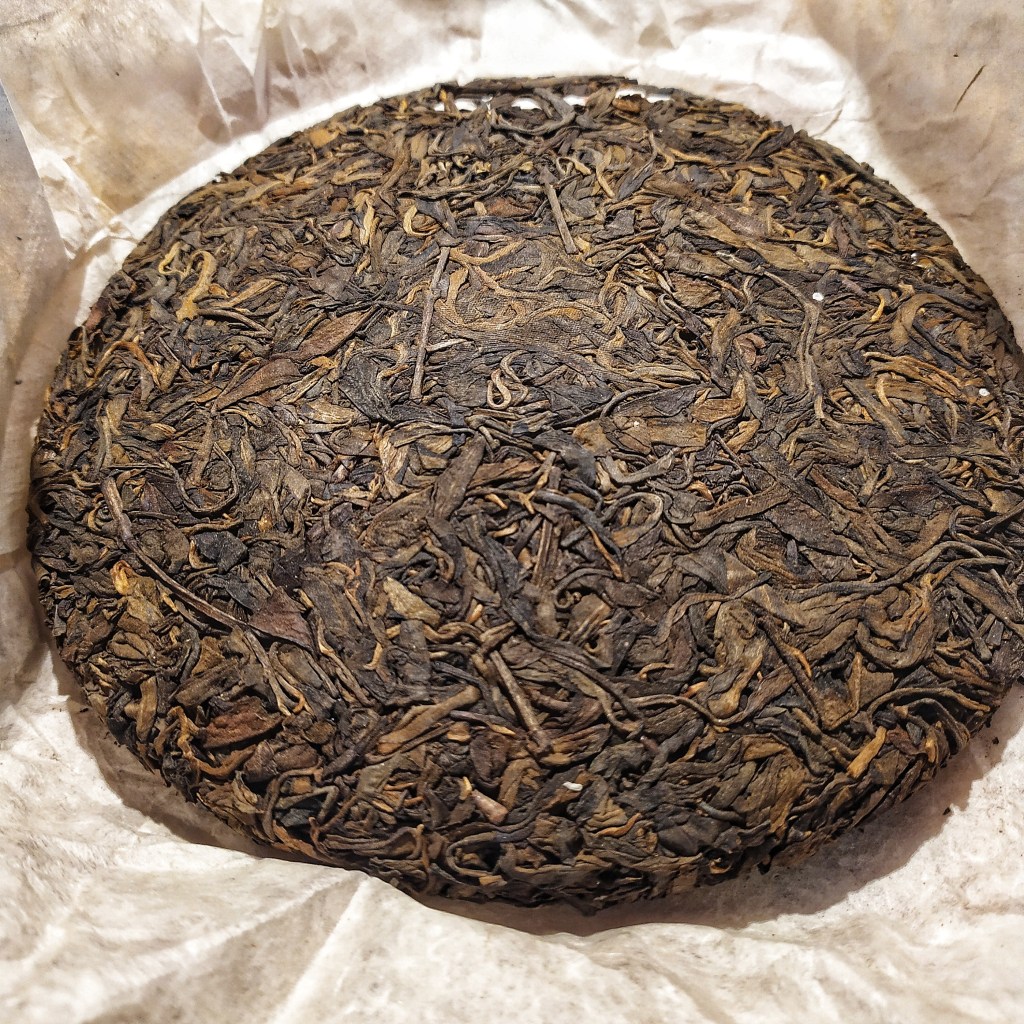
Mr. Quen’s Manzhuan sheng pu’er expresses the charm of the lived, it is the example of those teas that seem to simplify what is most hidden and arcane and complicate what is simpler, making a set of organoleptic notes a complex symphony and a vivid image.
The liqueur has a reddish color with orange reflections, reminiscent of the nuances of a tawny port. The scents of the wet leaves enriched with jinhua bring back memories of raw and primitive landscapes as Bruegel the Elder would have imagined them, with notes of damp earth, dried mushrooms, undergrowth, leading to a wood cabin under the rain, with the smell of aged mahogany, old books and a bouquet of faded flowers. Light balsamic tones take over in the background, together with those of burnt wood, laurel, dried plums, piloto tobacco, black pepper and dried longan.
The gloomy evening atmosphere becomes more vivid with the appearance of notes of leather, cognac and typical hints of aging in oak barrels.
The body is medium thick, the sip has notes of walnut, dried plums and aromatic herbs which are the prelude to the nuances of leather, old wood, cinchona, dried citrus peel and filter coffee.
It is a sheng of great balance and sensory complexity, the bitterness is now perfectly integrated and not very perceptible as is the astringency, excellent huigan and remarkable persistence.
Material from Ba Zhong Zhai village, Manzhuan area, family garden of Quen Cun An.
 Wild Harvested