Tag: 2006

  • When Pu’er gone in a single day. Dialogue on the present, the past and rites with a 2006 CNNP “Yellow Mark”

    When Pu’er gone in a single day. Dialogue on the present, the past and rites with a 2006 CNNP “Yellow Mark”

    When the fragile walls of the pu’er business were crumbling in the early 2000s, many people stood in front of the screens in the Kunming tea market, crystallizing an evocative image, a shared moment of sadness, like those who see their home demolished, those who see their expectations burned, like smokers outside the doors of a hospital, staring at their affliction in the smoke while waiting for some unexpected good news.

    And so the pu’er gone in a single morning, as if all the wealth accumulated up to that point was worth as much as a bright day that tries to make us forget that dark, but much more natural, light from which we defend ourselves at every moment.

    Dark like the soul of this shou, with a frowning and crepuscular essence, with aromas that come from the shadows, from the underground warehouses of humid cities, from the decadence of nature in autumn.

    In those years, pu’er was sold as a commodity capable of accumulating value and in which to find authenticity. In a country in total growth, there was a frantic search for an identity, for its rediscovery and subsequent affirmation, through rites, the ostentation of them and gambling. But not so much of the true rites but rather a plasticization of them to compensate for the sense of loss that nostalgia brings with it.

    In the ritual, in the tea, those who waited, resisted and dared found refuge, they survived because it is the ritual that acts as a contrasting agent thanks to which our present takes on clearer contours even in the darkest night, they fulfill the function of a revealing bath capable of showing the latent image of identity through the reduction of the superfluous.

    In the recovery of the ritual one struggles with oneself and the struggle takes shape when one compares the old action with the new action, with the dynamics that are emerging, when one places the travelled path alongside the new scenario.

    In ritual opera, things are not consumed or used but rather lived, so that they can age and bear witness. Tea was thus able to recover its place in rituality and with it the integrity of its experience that the period of compulsive enrichment had tried to hide.

    This 2006 CNNP yellow mark embodies the residue of that incendiary period, you find that something in it that is not destined to survive but which nevertheless resists and remains. It wears the color of an old vintage Port and in its fragrances of tobacco, old leather, humid wood, lacquered mahogany and jujube you find that pain of uncertainty that constitutes the matrix, the deep layer of something true, intentional, positive.

    The light fermentation has allowed it to survive the banality of many of its peers, to escape the hermetic isolation of immediacy that the over-dense, black as tar and hyper-fermented shou demand. In the mouth it’s silky, of proportionate sweetness with aromas of malted brown bread, raisins, butter cream, chinese herbs, brown sugar and ancient wood.

    Tea by Le meilleur the de chine
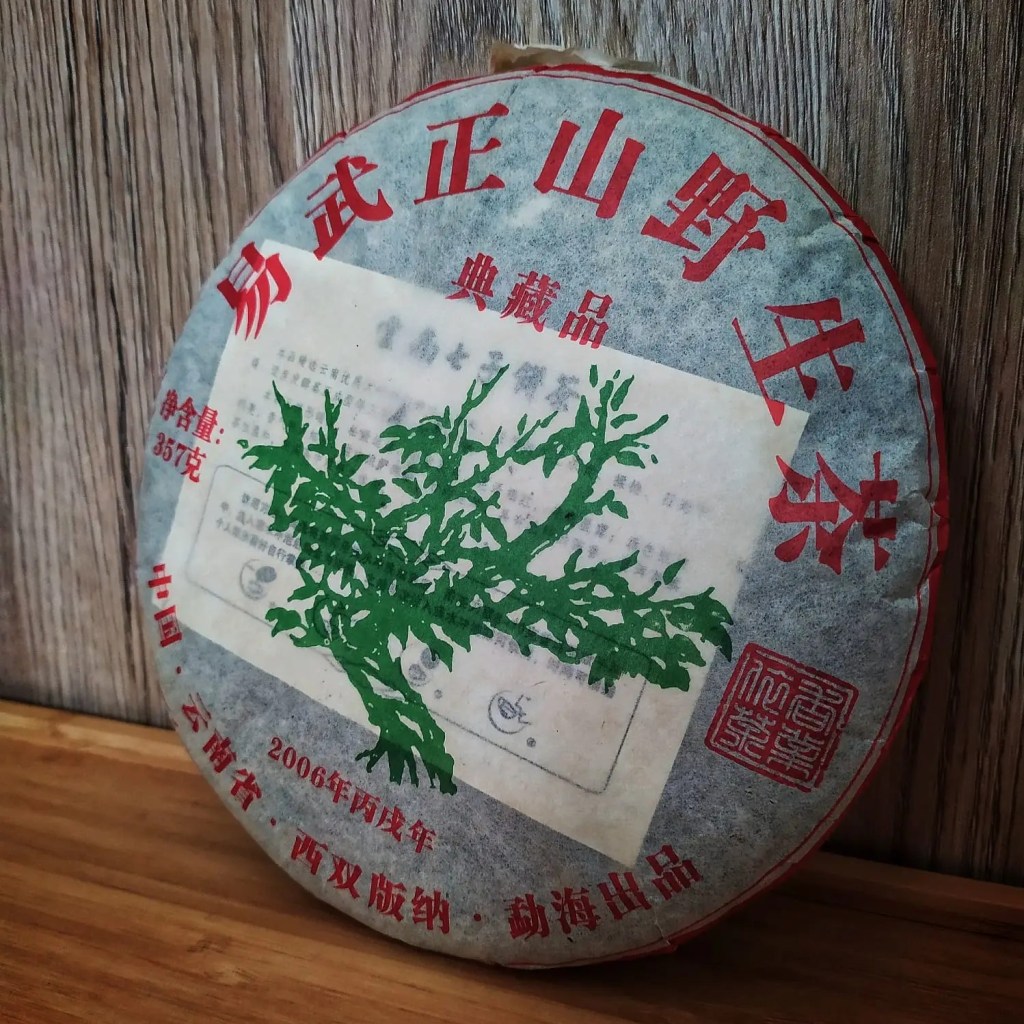
  • Trip to Yiwu mountain through a 2006 classic blend

    Trip to Yiwu mountain through a 2006 classic blend

    In the recent past of Pu’er we have often witnessed a forced association of tea with its most narcissistic and aesthetic-economic dimension, to then observe the deflagration of this concept by those who sought more the practicality of taste and pleasantness in its more utilitarian sense. Without recalling how much before and after the events of 2008 contributed to forging these factions, in front of certain teas we can remember how much Pu’er can escape mere sensoriality, from being a simple pleasure of the palate to rejoin its real aesthetic dimension, that sensitive incarnation that translates an idea, a territory, a community.

    Teas like those of Yiwu manage to reconnect us with that part of ourself which, while searching for information, tends at the same time to suspend from practical sense, making us experience the sensible, the experience in its essence. This cake immediately brings to mind the selections of Mr. Ye Binghuai, the “Big green Tree”, whose story will probably be the subject of future posts, but it suffices to know that it made a good part of history among enthusiasts at the end of the 20th century, as well as having led many Hong Kong auctions with his ’99 selection.

    The harvest dates back to 2006 from wild trees throughout the Yiwushan area, a sensory complexity achieved thanks to the assemblage of several mountain villages. Because from Mahei to Guafengzhai to Yiwu village we are witnessing a radical change in the composition of the soils, a pH that goes from 4.5 for the most acidic to 6.5, an altitude range that goes from the summit, above 2000 meters above sea level, to the 730 m of Nametian with its taidicha and xiangjiaocha, which in antithesis almost seem to offer a gateway to the compulsive modernism that previously struggled to take root among those camellias that looked like imposing bodies, lignified in their dynamism.

    This wild tree puer comes from some of the shengtai areas that flank the mountain villages, leaves that when wet release scents typical of these places and quite similar to those of other vintages chosen by Ye Binghuai, notes of cedar wood, camphor and dehydrated longan, with an almost smoky, balsamic personality while advancing a memory of peat very similar to that of a good Mezcal rather than a Scotch.
    Drinking proceeds in a calm and relaxed tone, one can perceive the scents of a pine forest after the rain, vegetal, musk, peach and floral as a background. Suggestions of banana leaves, Lemet in particular, the yucca cooked in water wrapped in banana leaves, together with spicy, woody and slightly smoky tones similar to those that Mizunara gives to Japanese whiskeys.
    The liqueur is coherent, initially introverted, of a golden-amber colour, slightly lighter than expected but able to develop over time animal, musky and fruity aromas, almost of raisin muscatel, with a qi that gradually becomes evident and pleasant. The sip is juicy, thick, balanced in its medium bitterness and medium sweetness, of good persistance and ending on notes of charcoal-cooked tropical fruit.