Well, you see, when I first started drinking tea I never thought it would become such an important part of my life. I suppose no one ever expects it at the beginning, but I certainly didn’t imagine that something with such a high percentage of water could bring relief to my cirrhotic, worn-out soul, born of a guttural Tom Waits scream and stitched onto me by a drunk tailor.
It’s not something I dwell on very often. My life, like most lives I know, leaves little room for sustained introspection or ascetic reveries, the sort where you retrace your existence with your bare collarbones pressed into cold marble. The last few times I found myself flat on my back, it certainly wasn’t in pursuit of insight. If anything, with me sprawled out like that, the room seemed to shed what little claim it had to respectability.
Every so often, though, something breaks through the ambient noise, something that jump-starts circulation in my tingling brain and brings me back to the keyboard while I’m drinking something unexpectedly pleasurable, wearing that faint, unmistakable smile of post-coital satisfaction, the kind you hope no one is paying close attention to.
Tea, for me, isn’t meditation. It’s maintenance. A necessary distinction, especially once you’ve stopped believing in revelations and settled instead for remaining operational. And this isn’t simply tea. It’s the return of the impulse to move my hands across a keyboard, a reminder of where everything began, when writing hadn’t yet adopted the tone of therapy and was merely a byproduct of staying awake longer than everyone else.
It’s a reminder of my therapist’s office, Bauhaus in style, where amid excesses of glassy functionalism and metallic geometries, the photographs of Jung, her bony hands protruding from the cuffs of her usual wool sweater, beyond the teak surface of that Danish desk, I can feel entitled to sink into my moment, which, in that case, meant the cognac-leather backrest of her Wassily Chair B3. Marcel Breuer did just as fine a job with that chair for my mental well-being. I liked that room; it was furnished as if someone had decided that psychologically misaligned, too, deserved a proper frame, not just polypropylene crap, particleboard, and poly-laminate assembled in some windowless warehouse while singing the praises of aesthetic surrender.
In its own way, Serenade does the same thing.
It’s a frosted batch, from the autumn of 2024 if memory serves, a sweet, sugared liquid that never quite tips into cloying. Aromas of saffron, powder, antique rose. As I inhale the damp leaves, I’m taken back to my mother’s bottle of Baccarat Rouge, two-thirds empty, sitting on her nightstand, the kind of object that disappears alongside the unspoken understanding that something is slowly, quietly ending.
On the palate, those Kurkdjian-adjacent notes return, flanked by hints of jam and honey, followed by an aromatic excess of sandalwood and musk, a depth that arrives late and lingers with the elastic persistence of its own sweet afterimage. It’s a tea that allows anyone access to ecstasy without going into debt: a quietly subversive form of wealth, a luxury that doesn’t improve your standing in the world, but makes it temporarily more inhabitable.
We all know it: social networks always leave too much room for sensationalism. There’s endless space for anyone obsessed with sanctifying new brands and glorifying mind-blowing teas that promise an experience somewhere between spiritual awakening and a methamphetamine binge. A permanent pop-up of disposable enthusiasm. It’s the amusement park where anyone can feel like a prophet for a day, canonizing the newest square meter of the most remote village, where snakes, tigers, and giant beetles supposedly lurk ready to attack the tea pickers, only them, of course, not people practicing any other profession, before moving on without even bothering to stub out their cigarette in the ashtray of final verdicts.
Everything seems to shine, everything seems harmless, everything promises miracles, at least until you realize it was only a reflection, not the source. That’s life.
It has happened to me too: speaking too highly, too soon. But there is one terrain, one terroir, on which I’m not willing to make the slightest concession: Tủa Chùa.
From a mountainous rear area near the Điện Biên Phủ valley, where in 1954 the decisive battle that ended French colonial rule was fought, this region has become an enclave capable of producing surprisingly accomplished Pu’er teas. Many areas once considered marginal and reactionary, such as Tủa Thàng, turned into revolutionary bases, as they combined geographic isolation with strong social cohesion. The karst plateau, with its steep mountains and paths invisible to outsiders, offered natural refuge to high-ranking officials of the Việt Minh. They took shelter in the homes of Hmong villages, protected by the population’s collective silence.
The inhabitants knew the land intimately, guiding men, weapons, and messages along unmarked routes, avoiding French patrols and keeping the mountain areas connected to the Điện Biên valley. All of this unfolded in conditions of extreme poverty, yet they provided food, places to rest, and intelligence on enemy movements, accepting extraordinarily high risks. In those mountains, silence was a form of resistance, and the geography itself seemed to have taken sides.
Now, back to the tea.
If I had to explain to someone what true mineral, botanical, ancestral excellence means, if I had to make them understand what these trees are capable of, and why Vietnam today not only looks Yunnan straight in the eye but openly challenges its borders, I wouldn’t hesitate for a second. I’d pour them this tea. No preamble, no rhetorical acrobatics, no captions.
The way this tea is evolving is sublime, truly the kind of harvest you get once every five years.
I’m sorry to say it won’t deliver the tragic depth of Marina Abramović’s gaze, the high priestess of emotional intensity descending upon us mortals to elevate us by staring into our eyes like a corneal topographer.
What it will give you is a perfect sip.
This is a sheng with an almost exasperated intensity, like an overexposed photograph that somehow works. It lingers on orchid notes, though not like Jingmai, those notes seem wrapped in a dense, almost brooding forest aroma, the kind currently fashionable to flaunt when talking about Guafengzhai, but here they feel more arrogant, they slide under your skin with a needle’s quiet, deliberate precision, an elegance that’s both unsettling and strangely pleasant.
On the palate it’s viscous, medium-bitter, with barely perceptible astringency. The huigan is quick, floral, so persistent it feels more like a reforming than a return.
This isn’t a tea for fragrance addicts or niche perfume obsessives.
The qi is the real point here.
It’s a tea for those who recognize the exact moment when something slips in and changes you.
You don’t keep drinking it just for the aroma, you do it because a part of you has already been pulled in, and now it wants to know what will happen if you keep filling the cup.
If you ask many people what their favorite production area is, they’ll probably start listing off famous terroirs, Bingdao for its body, Laobanzhang for its qi, Naka for its fragrance, and some remote shack in a forgotten Yiwu village, which never hurts to name-drop. In short, a litany of names, as if it were a medical prescription for some trivial pathology to be handled with grave care. Or perhaps just another way to show how worn out the magnetic stripe on their credit card has become.
Jinggu likely won’t even cross their lips, not even by accident. This area is surrounded by mountains on three sides, an enclave where the best gardens are often inaccessible, and where the obsession with naming every single rooftop (as in Yiwu) is quickly anesthetized by a lack of roads and the even greater lack of desire to build them. Here, not even the clunky two-ton electric behemoths at the service of Western merchants can climb their way up.
I agree that vast expanses of flat land, dull stretches of agricultural functionality, are today brutally carpeted with Da Bai Cha, as in the flatlands of Wen Shan Ding. A cultivar that acts like a funerary carpet, its tea merely a collateral damage, a distillate of hardship and credit requests, with a hint of bank loan in the aftertaste. But if you start climbing and forget all that, you’ll reach over 2,000 meters at Kuzhu Shan. There, ancient trees stretch in swathes; in some spots, they’re even Teng Tiao, like in Banuo, but with a slightly different aromatic profile, less delicate, more fragrant, impactful, and mineral. Less mannered, and more Felliniesque, to put it simply.
Some time ago, I met a Pu’er expert, a merchant from Lincang whose main business revolved around the Fangcun market. I asked him why he thought people considered teas from Jinggu less worthy, almost like children of a lesser god, tolerated but avoided, like the uncle with a drinking problem at Christmas dinner. He was a big man, with hands the size of shovels. He stared at me for a moment, with his huge, isochoric pupils, maybe the largest I’ve seen on someone from Yunnan, wide like those of an Australian owl photographed by Joel Sartore, performing tiny mechanical micro-adjustments every time you locked eyes with him, as if missing an autofocus. He answered in monosyllables, he looked like someone who read Anna Karenina just to root for Vronsky. He smiled too, but it seemed like his facial muscles were slightly jammed from decades of monsoon rains. And yet, he was one of the most knowledgeable people on Pu’er I’ve met.
It took him a while, then he said something, I don’t quite remember what. I was too busy noticing the irrelevant details I’d later include in this article. But the meaning behind his cocktail of anthropology and Moutai was clear: Jinggu was guilty of not being immediate enough. Too real, too unavailable. Add to that the fact that the era when people chased uniqueness has been over for a couple of decades. They discovered the villages of Yiwu, Laobanzhang, Bingdao, a few others in between, and the punch bowl quickly ran dry. Because, you see, he said, the markets want exclusivity. The consumers who arrive in polished shoes at the edge of the forest, who slip on plastic sandals before posing in front of an ancient tree, are looking for tea like they’re looking for sushi in Berlin.
And he was right. Some want only the illusion of a mysterious narrative, not the truth of the land. They prefer a tea that behaves like a cool, aloof actor, properly trained to play the silent type, the tormented one, the aged-in-a-hut-with-a-hidden-past role, rather than someone, or something, that simply tastes like what it is.
Jinggu teas aren’t for complexity maniacs. They’re rather blunt, direct, break through your guard with a few solid punches, enveloping you in sweetness and asserting themselves through their huigan and bodily sensation.
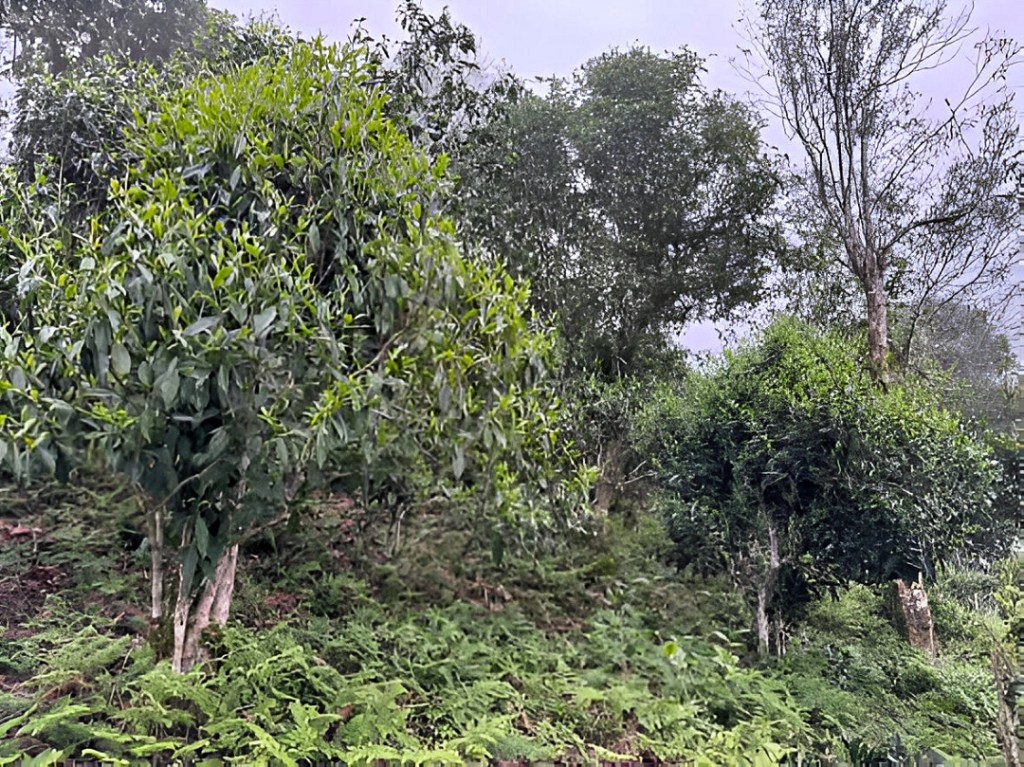
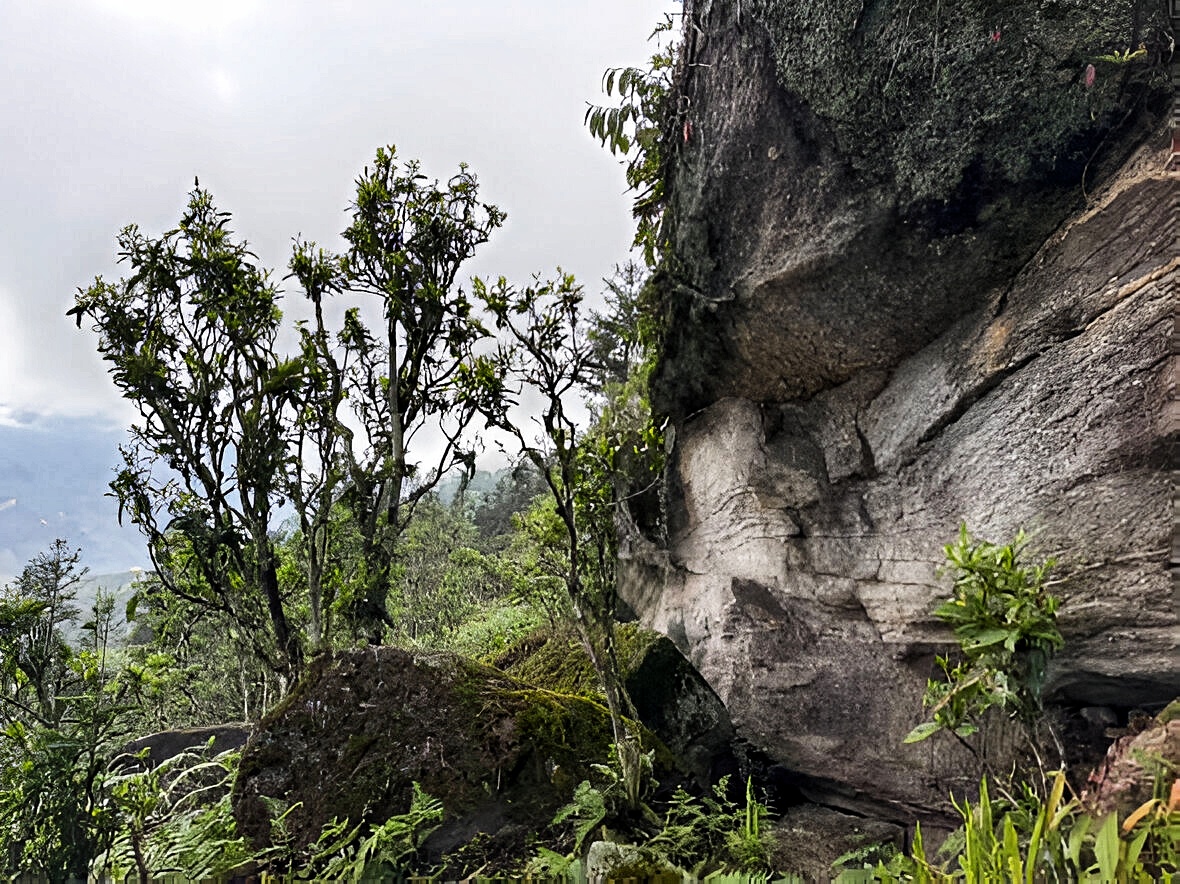
In the Kuzhu and Tang Fang Liang Zi areas, you’ll find real forest coverage where tea is harvested, like some portion of Yiwu, the northwestern edges of Laos and Vietnam, or the forested zones of Guogan in Myanmar. Here, the trees grow close to and inside the forest. The soil is clay-based with a good amount of rock, confirming the tea’s mineral and sweet character. The plants are spaced well apart, and younger trees are left to grow naturally. You won’t see any drastic pruning, only containment cuts.
It’s a complex terroir. In one cup, you’ll think you’ve stumbled into Jingmai. Drive twenty kilometers and drink again, you might swear you’re tasting Yiwu. Walk another ten, parched and hopeful, and you’ll find bitter cultivars whose huigan is so forceful, so magnetic, it makes some Bulang teas feel like passive-aggressive outbursts by comparison.
Here, like in Laoman’e, bitter and sweet varietals sometimes coexist in the same natural amphitheater. The former, known as kucha, often dominates the more remote slopes, but it’s never overwhelmingly bitter, never out of place or chaotic. It soon turns its cheek to a wild sweetness, like a fist on the table that prepares the caress. If the sweet variety is a well-composed, harmonic melody, the bitter one is drama and catharsis, leaving every door open for further development. These are teas that, even years later, remain an enigma. Tasting them again over time is like revisiting a neighborhood in daylight where you partied in the night before. You barely recognize it, and the sunlight seems to restore a grace you previously failed to notice.
In both cases, what stands out is an oily, umami-like sip and a genuine, full-bodied chaqi, it feels like it thins your tissues, filling your chest and pushing every muscle fiber up against your skin. A tea with a soul that doesn’t scream, but also doesn’t compromise. A tea you don’t expect, and which, especially in the case of ancient trees, hasn’t been tamed to soften its impact.
Southwest of Jinggu Town lies Jiu Tai Po, one of the most expensive and coveted areas, graced with the elegance of something that knows how to stay hidden. Few signs, no selfie points, no desire to be disturbed more than necessary. The village itself, small and vaguely adrift in agricultural amniotism, has little tea directly surrounding it; most of it is in the forest zone, along the ridges or on the opposite slopes. Road access is practically nonexistent, and like Guafengzhai, it takes hours of hiking to reach the tea trees. These aren’t roads for people in Italian leather shoes, and a camo cap won’t get you to the top. The landscape feels like a James Cameron set, shot with Kubrick’s cinematography and directed by a mood-swinging park ranger. There, the leaves aren’t picked by good boys, but by madmen, neurotics howling at the moon, yelling into the western wind, and probably monks armed with faith and an unearthly amount of patience. Climbing up there feels like trying to earn a glance from Maria Callas, flailing pathetically to grasp the corner of her eye, she ignores you, and you thank her anyway.
In recent years, Jinggu has had its big moments, times when even the cynics had to admit that yes, even from those mountains often relegated to Act Two of the Pu’er narrative, something remarkable could emerge. Like the Pu’er from Tang Fang Liang Zi by Farmer Leaf, especially the single tree series that reads like an elegant lithograph set by De Chirico; the 2017 Chawangdi or the 2016 You Shang from Chawang Shop, perhaps among the Western forerunners of Jinggu’s nouvelle vague, to the 2007 Shang Pin by Xi Zi Hao or the old relics from Changtai, old-school, decadent, like an old house with silk on the walls, with the scent of leather and creaking parquet.
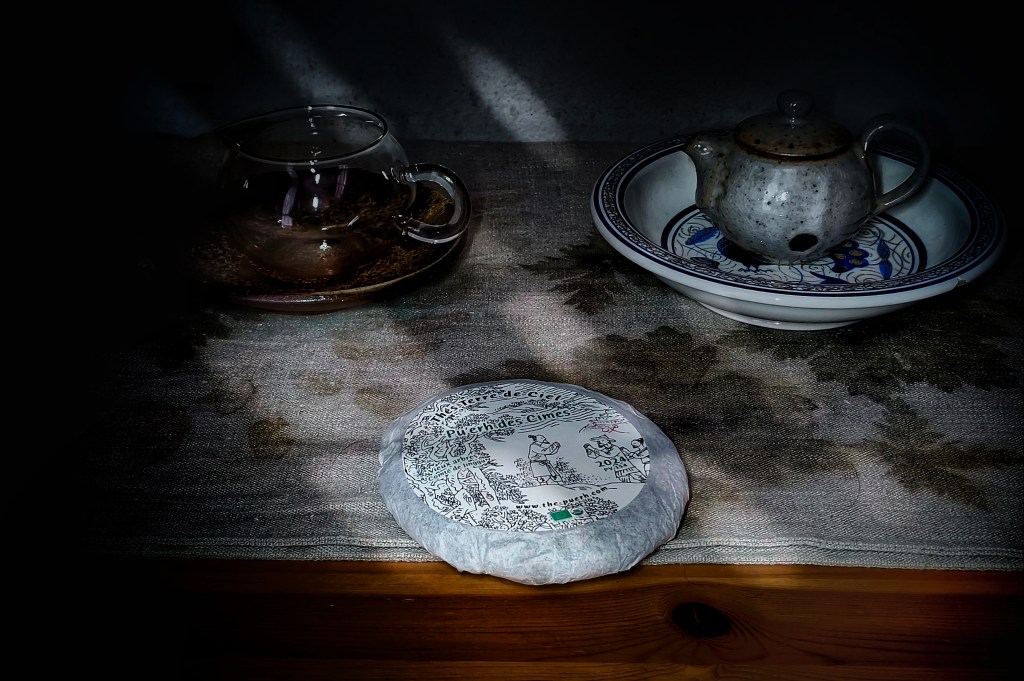
But today, I’ll focus on two other excellent sheng Pu’er by Thés Terre de Ciel, both from old-ancient trees.
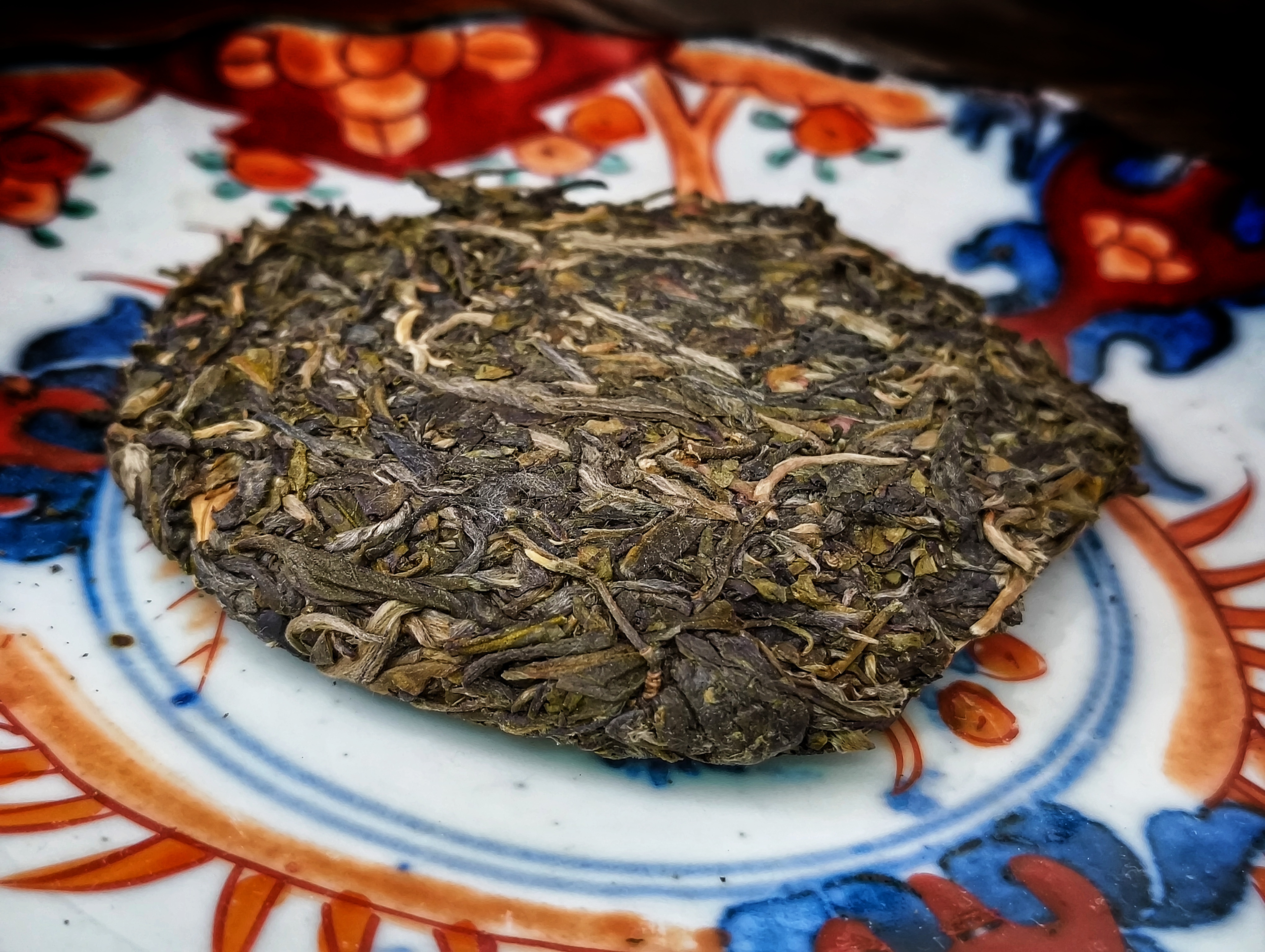
TdC Spring 2024 Xiao Jinggu Puerh des Cimes
I’ve always had a soft spot for the Pu’er of Jinggu, for their remoteness, their distance from the inflated rhetoric about the primordial nature of its landscapes, for from the market wars over taste profiles and terroir cred. Jinggu teas owe nothing to expectation; they answer only to themselves.
This is one of those teas. The kind with no prefabricated image, no guiding archetype. Nothing to anchor your imagination, no Muse whispering interpretation in your ear, as Hesiod might have hoped. Just you and the leaf. No crib sheet. No narrative. Only the moment.
The leaves are twisted, dark green. The sip is viscous, with a round, sticky umami reminiscent of chicken broth from a market stall in Chongqing. There’s a sweetness too, unopposed and undistracted, a sensory monologue rich in subtext. The huigan lays itself across the tongue like a seamless silk blanket. Bitterness exits the discussion early.
The Qi is delicate, but it moves under your skin, subtly shifting your posture, your pace, your pulse. The salivation it provokes becomes a kind of gustatory capital. The sensation is almost organic-minimalist, like an alabaster vase with no sharp edges, revealing more intentions than it cares to admit. The intensity of the peach note approaches something like an orchestral delirium, building in a near-psychedelic crescendo, and that out-of-the-ordinary umami makes it feel less like a beverage, and more like a pre-dessert at L’Arpège.
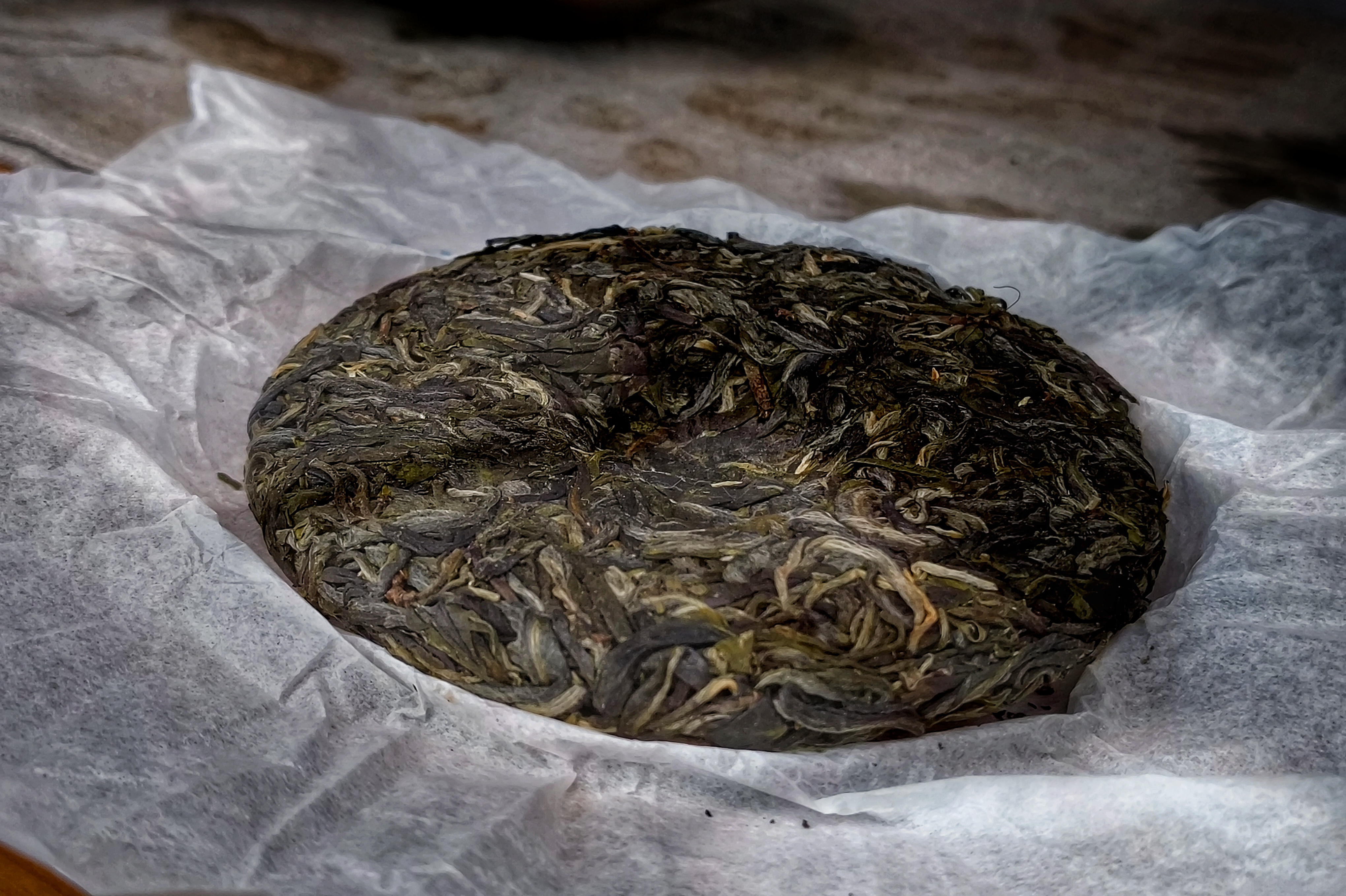
TdC Spring 2023 Kuzhu Shan
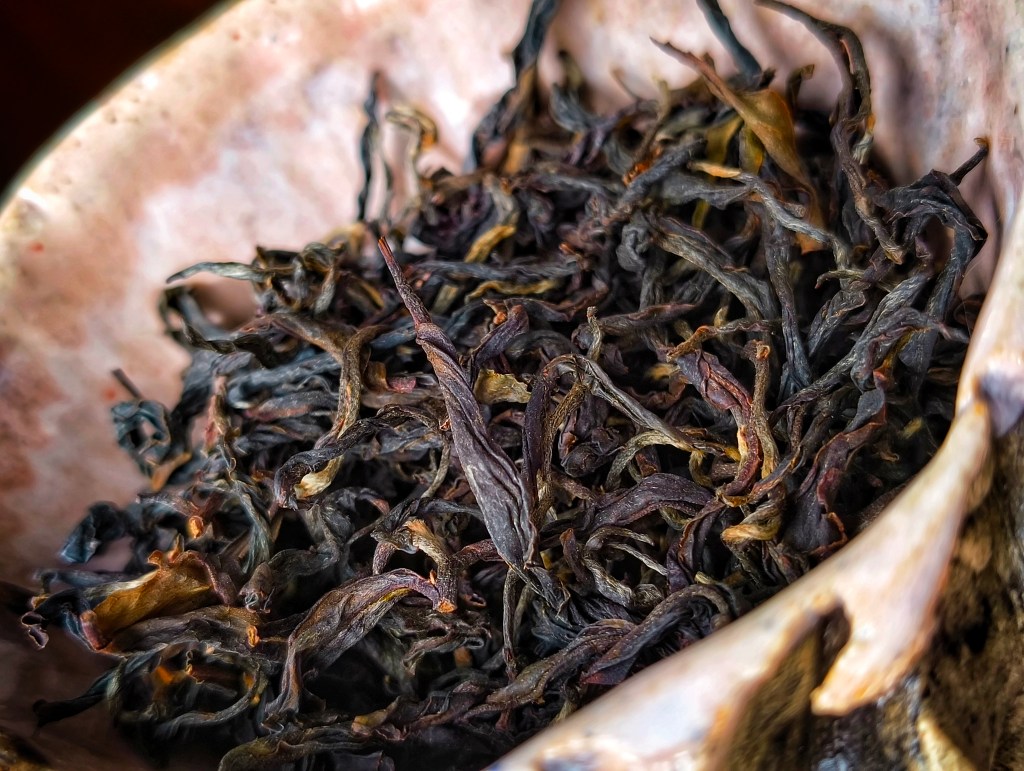
This Pu’er from Kuzhu Shan seems like it emerged straight out of a William Morris wallpaper, drawn after two glasses of fine Vin Jaune. Alienated, eclectic, remote, saturated with organic vitality. The dry leaves exude hints of light tropical fruit, citrus, and wildflowers. As expected, this is not a tea that lingers in a labyrinthine dimension of complexity, but that’s not the terrain where Kuzhu teas show their hand.
The true opera magna takes place in the mouth, which becomes the theater for a clash and debate between a pronounced yet agreeable bitterness and a sweetness that follows quickly, almost antithetical to it. It’s a generative tension that drives this medium-bodied sip to evolve, to layer itself, each new sensory stratum tearing apart, cannibalizing the one laid down before it.
The tasting unfolds as a kind of sensorial acceleration, like a Baz Luhrmann film, abrupt cuts, frenetic pacing, a hyperactive montage, leading to a terribly refreshing, surreal sensation with an unmistakable note of tonic water.
It’s a Gin & Tonic stripped of its damnation, as Nick Carraway might say while struggling with his addiction. This is a vividly alive liquid, whose finish is so enduring it seems pointless to measure. It unwinds slowly on notes of ginger beer, candied lemon peel, and rhubarb, while your tongue’s receptors are still stunned by the mineral lash it dealt twenty minutes earlier.
Usually, when I drink a Pu’er, I think about its aging potential, its price-to-quality ratio, I imagine derivatives and equations, risk and return curves, asking myself whether it’s better to keep it for the medium or long term. I make a lot of projections, hypotheses, even metaphysical guesses.
But the truth is, this is one of the few teas where none of that matters. I drink it because it’s simply really good. Whether it lasts twenty years or disappears in two days, for once, I really don’t care.
In Sanmai, the harvest embodies collective power, it remains there, sedimented, like the slow burn of an inexhaustible cultural fire. It reemerges in the ritual act, with the tension that grows as the air’s humidity rises, escalating like a migraine that starts at the base of the skull and radiates to the eyes. Hope mingles with the fear that the rain might arrive at the wrong moment, transforming the river into a clay demon and the crumbling mountain into an army of rock.
Here, Mengsong seems to speak through the very stones of the houses. And what it says is not just a verb numbed by modernity, but an echo that comes from far away, from a larger world, perhaps lost, but still alive in the people. It kindles itself on the walls, becomes flesh, becomes identity. The fragile power of its tea is like the fire in Ella Fitzgerald’s voice resonating in the aorta. You cannot ignore it.
These are not odes nor exercises in writing. This is ground zero of the attempt to understand. To truly come into contact with a tea that hides in sensory detail, that, like its land, wears you down and demands understanding at the edges of perception.
This danzhu from Thés Terre de Ciel is a truly unexpected tea, unsettling in some respects. We are often accustomed to teas from Naka, Benglong, Bameng, with their floral, sometimes fruity, gentle characters. But Sanmai doesn’t play with gloves on. It is a clean, precise, yet powerful tea. The Qi is profoundly forest-like, dense, almost physical; it seems to influence every mechanoreceptor. You feel it in your hands, your legs, your stomach. It seeps into the nerve plexuses, as if the body were enhancing the perception of every distal extremity, of each of its boundaries.
The huigan is long, incessant. It lingers. The bitterness is there, but it doesn’t last. It retreats quickly, making way for a mineral, almost effervescent, electric sensation that settles on the sides of the tongue, along with a sweetness that makes no compromises. Salivation is continuous, rhythmic, like waves that come without pause. Like the crowd at Glastonbury, a constant flow. Every infusion up to the twelfth is a tactile theater, alive, dense, full. No drop, no faltering.
With A Comparative Journey Through Two Traditional Viet Sun Sheng Pu’er
When I first saw Steve’s photos, his Vietnam, made of fiery red sunsets, emerald pastures, and motorcycles whose tire treads were mere memories, I was left hanging in a sense of emptiness, of existential incompleteness tied to never having visited those places. Looking at those shots felt like peering into a parallel world, embraced by a sort of ontological nostalgia.
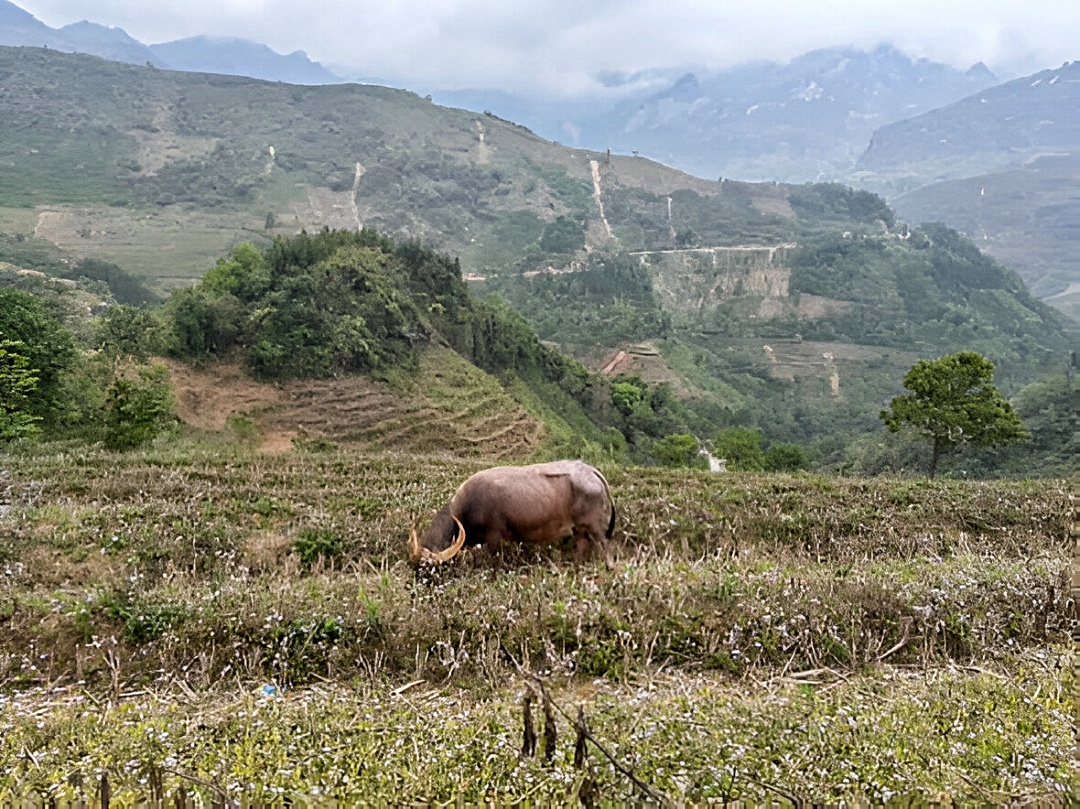
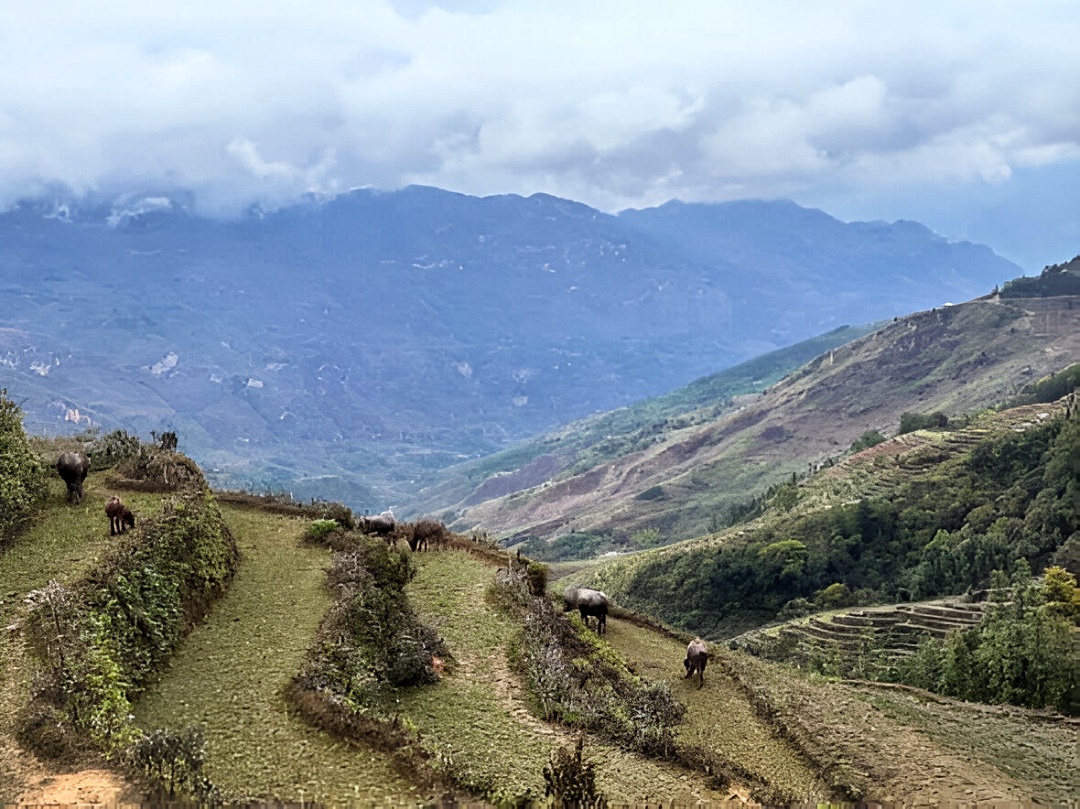
The snapshots of Tả Củ Tỷ, the “Big Rice Field,” reveal the truth of a borderland world, of earth and blood, behind the major cities, whose distant lights appear like a sarcastic smile with pearl-white teeth. Then the horizon arches, growing increasingly vertical, rising further along the crumbling clay arteries, beyond the rice paddies, moments ago drained, now swollen with rain and reflecting the vastness of the sky.
Here, every tree, every tea leaf, every sensory experience is an imperfect shadow of an eternal idea. This is where one of the best Pu’er teas in Vietnam is made, loaded with a near-theological sincerity, vibrant in every vintage, soft, flowery, and endlessly mineral. The shengs of Tả Củ Tỷ are like the Rieslings of the Mosel, a form of resistance against the trials the gods impose through the elements. They express the same minerality and layered memory. But while Riesling whispers sweet notes and sings praises like a Romantic poet on a summer evening surrounded by Viennese Jugendstil, the Pu’er of Tả Củ Tỷ elegantly drags you down a muddy mule path under relentless monsoon rain. In both, there is the same sharp and ruthless beauty, but whereas the Mosel wines evoke the rarefied skies of Chagall, suspended in uncorrupted blue, in Tả Củ Tỷ the image offers no redemption, it demands confrontation. Time here doesn’t pass, it presses. The landscapes are those painted by Turner, but not the sublime, ethereal artist of the Dover sea, rather the feverish, visionary Turner of his final years, where light shatters into curls of shadow and smoke, and the scene dissolves into an intensified, nebulous inner reality.
The province of Lào Cai hosts a pedological diversity of rare complexity, the result of interactions between lithology, comprising metamorphic and sedimentary bedrocks, and a harsh topography shaped by steep slopes and variable altitudes ranging from the Red River’s lowlands to peaks shrouded in mist. In this living landscape, far from documentary clichés, ten major soil groups intertwine, distributed into around thirty subcategories, reflecting an extreme variety of geomorphological, climatic, and land-use conditions. In this mosaic, most fall into the categories of alluvial soils, minimally developed, fertile, fine-textured, laid across the Red River’s floodplains. As elevation rises, submontane zones host deep ferralitic soils, with aggressive pedoenvironments and reddish-brown hues. Then come humic soils on red-yellow parent rock, which inhabit the gentler slopes of the Sa Pa and Bắc Hà districts, ideal for mountain orchards and medicinal plants, the same ones that Dao grandmothers will grant you for a spider bite, heartbreak, or to recover quicker from the drunken night before. Higher still, where the air thins, the sun burns your skin, and geology shifts from academic subject to a lesson in humility, you find the brown, acidic forest soils typical of high-altitude tea forests, marked by thick organic horizons and excellent water retention, where the labor is real, marketing fades, and matter begins. The higher you go, the more essential the soil becomes, and the mountain strips you of every excess you thought you needed.
Since ancient times, the region now known as Lào Cai has been a living tapestry of peoples from the H’Mông–Dao (including Mông, Dao, and Phù Lá) and the Kra-Dai groups (including Tày and Nùng). The Phù Lá migrated from Yunnan during the waves of the 15th and 17th centuries and opened the Lào Cai–Hekou pass, a crossroads for southern Chinese merchants and Tibetan fugitives, military settlers, and Tonkinese textile makers. Salt, tea, silk, and livestock crossed gorges and cliffs towards the Red River Delta, in exchange for rice, gourds, rare spices, and La Chi cotton fabrics. The trade route stayed open for five centuries, until the war with China in 1979. Tả Củ Tỷ and the entire Bắc Hà highland area have always been a “slippery edge” of the Vietnamese empire: formally part of Đại Việt, but in practice governed by local clan leaders and traversed by cross-border trade routes. Only with the expansion of the Nguyễn dynasty and, later, the arrival of the French, did state control become more pervasive. But that’s another story.
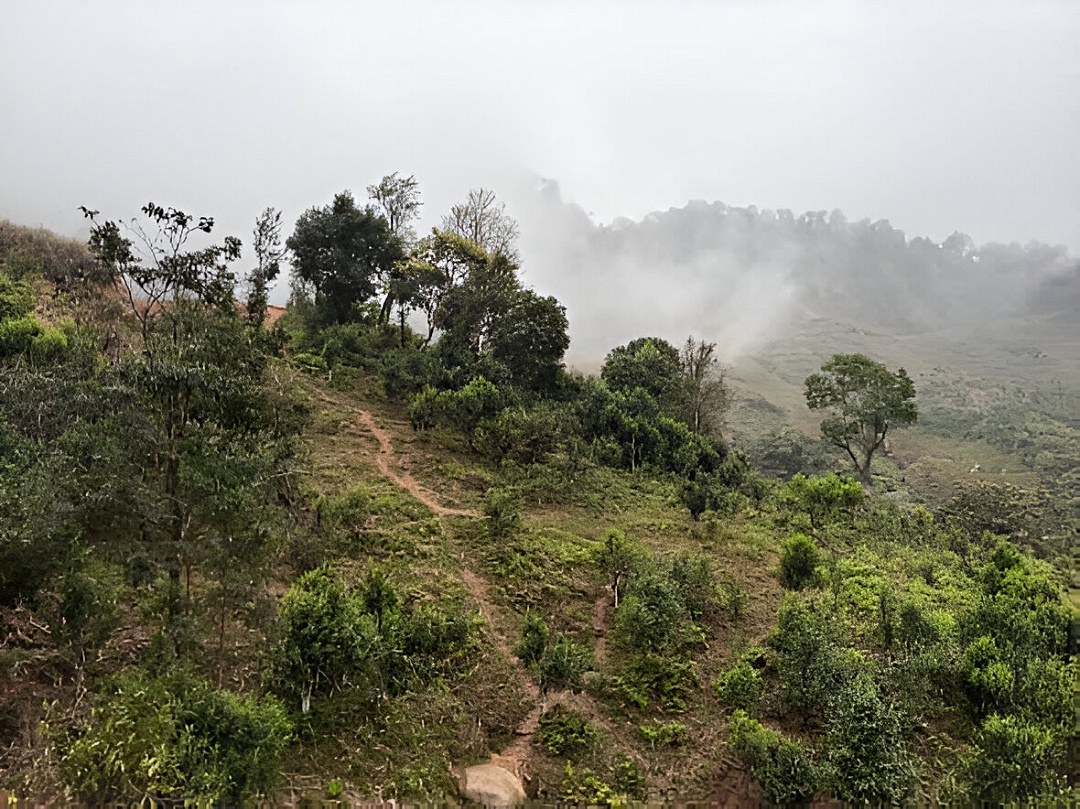
The forests of Tả Củ Tỷ possess a mad, honest allure. The color palette feels like something conjured by a cosmic hangover, while the mist moves slowly, like cigarette smoke drifting in a closed room. Its radiance isn’t the kind choreographed by a cheerful smile or Caribbean hues, but rather the disarming kind of beauty of a woman who’s cried all night and then looks at you at dawn, bare-faced. A fleeting moment of rare grace, allowed to linger briefly in the interlude of suffering, the kind of incorruptible, visceral visual rapture that doesn’t let you lie.
These dusty clay paths have been trodden by pack leaders, smugglers, and warriors. They’ve witnessed rites of passage and the initiations of Dao and Mông shamans, the veneration and sacred songs of the Tày, and offered shelter for markets and negotiations, for secrets traded with Xôi ngũ sắc, and for boisterous jokes between bowls of Thang Cọ and glasses of rice wine.
From this thread of bare earth echoes the sound of an absolute beauty that refracts through the contingent, like a bridge between the transitory and the infinite. I could be among them now, being filmed as I say that it is in the resilient rurality of these villages that Heidegger’s concept of Gelassenheit unfolds, that is, a spiritual disposition of letting-be, an openness to the essence of things, and, as he interprets in his Parmenides, how it reveals itself through history and daily life. But at some point, a scooter would honk to urge me out of the way, and it would be right to do so. So, thousands of kilometers away, I conclude by saying that there, people have never betrayed their own history, even while embracing change, reminding us that the truth of a place is not measured by the order of its exotic scenery, nor through a mere anthropological lens. Especially not in that land, Vietnam, daughter of the sky, immersed in the dreamlike dimension of its eternity.
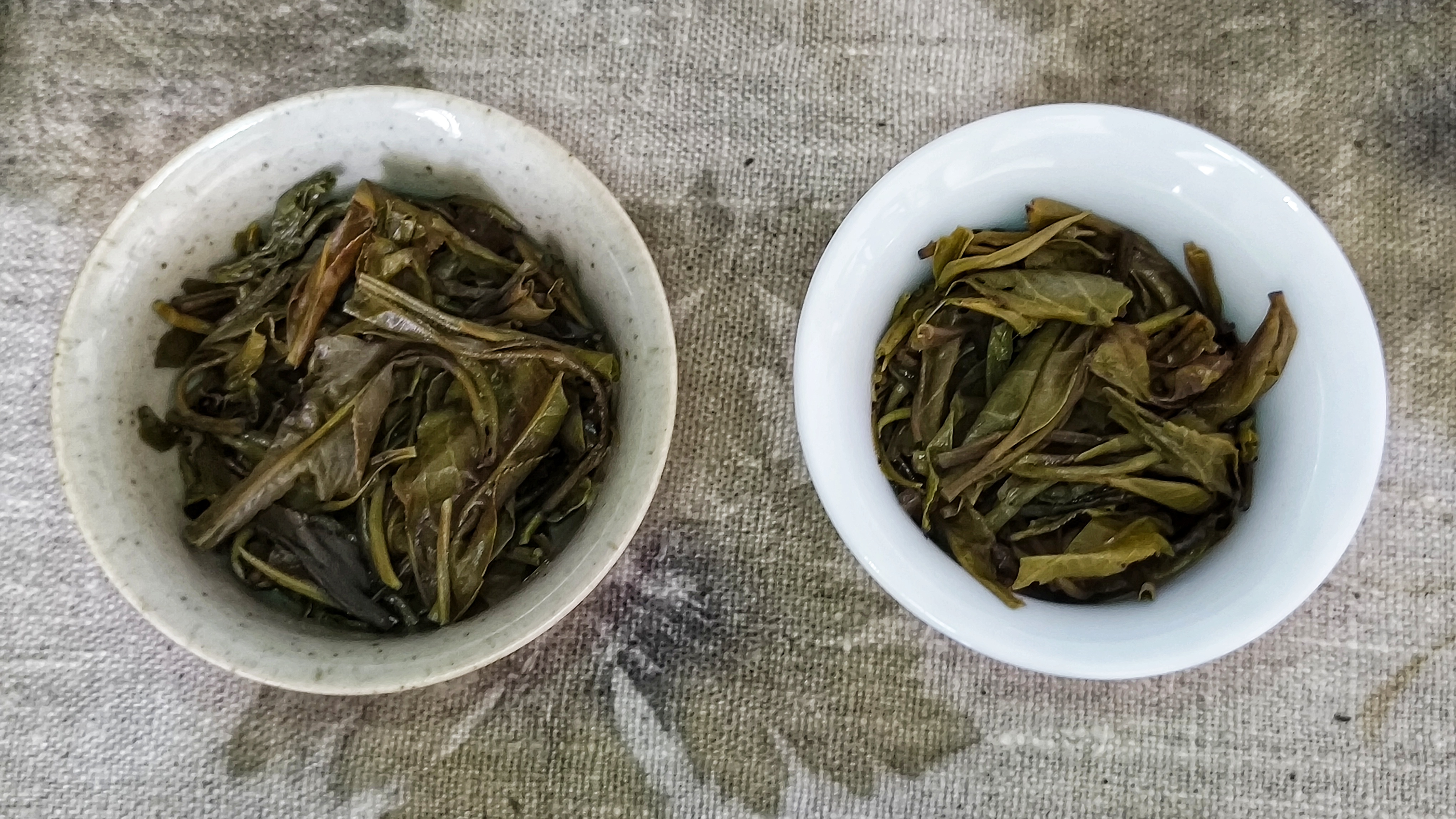
On the left: Tả Củ Tỷ Sheng Pu’er Autumn 2023, medium aged, old and ancient trees On the right: Tả Củ Tỷ Sheng Pu’er Spring 2024, old and ancient trees
Viet Sun Tả Củ Tỷ Sheng Pu’er Autumn 2023
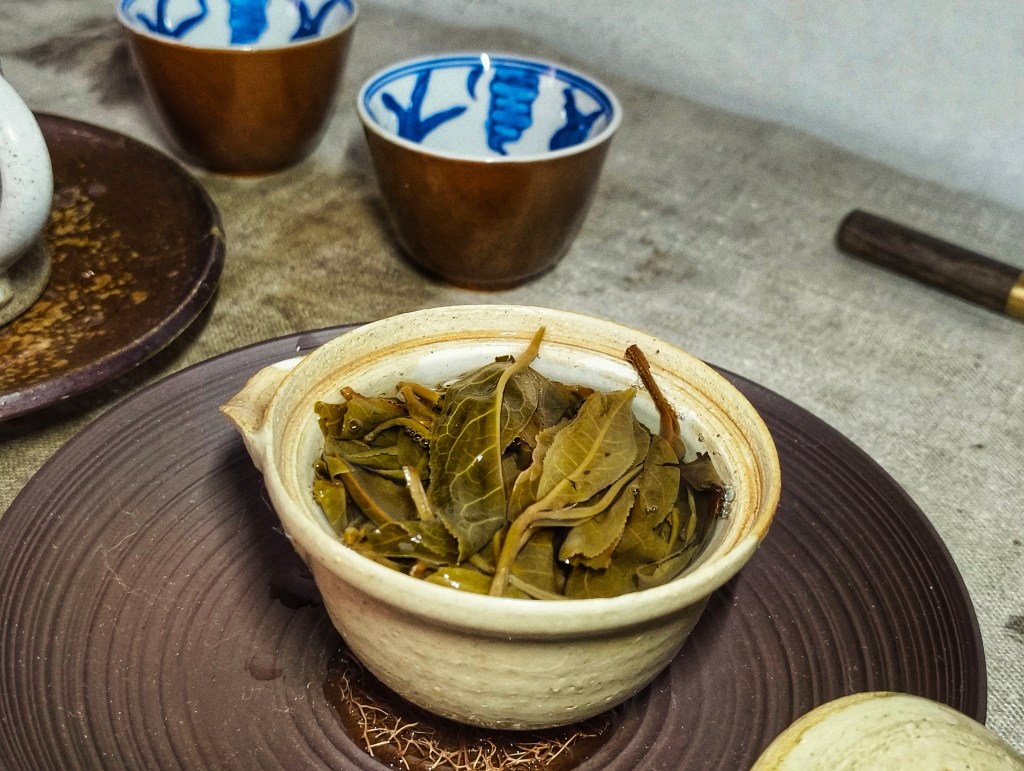
The autumn version comes from a mixture of medium-aged, old, and ancient trees growing at different altitudes and on diverse soils. It presents itself with a mature register, more oxidized, and the difference from the spring version is indeed perceptible. The autumn leaves are darker, as confirmed by the liquor, a decidedly golden hue, with shades that recall Turner’s Goethe’s Theory, to stay on theme. While the wet leaves retain a line of continuity with the orchid and apricot notes typical of the spring harvest, here honeyed tones and hazelnut hints emerge more clearly, intertwined with musky nuances, dried fruit and pan-fried greens memories, with lightly buttery accents.
Although vibrant, the sip is clearly more fragile, with a more hesitant body compared to the spring tea. Its huigan is more restrained and immediate, with sharper astringency, although the impression remains of a sweet brew with well-calibrated bitterness. Rather than floral aspects, the palate leans more toward raisin, apricot, and unmistakably honeyed flavors. The mouthfeel is less viscous, with more modest intensity and persistence, yet it remains decidedly interesting for this theater of contrasts between warm, comforting fragrances and still grassy notes, between roundness and sharpness. It is a tea that certainly holds aging potential, but is already quite enjoyable in its youth.
Viet Sun Tả Củ Tỷ Sheng Pu’er Spring 2024
I believe there are four essential elements that make a Pu’er good, if I were pressed to summarize: aroma, the taste of the mountain, excellent viscosity and huigan. And all of them are here. There are no substantial altitude differences compared to the autumn counterpart, but here we have leaves only from old and ancient trees. They appear lighter, less reddened, the liquor takes on a straw-yellow hue, and the aroma recalls that of orchid, not the florist’s kind, but the wild one you stumble upon between the cracks of limestone, with scents of an intensely floral field and apricots.
Framing it is a very light smoky note that fades quickly over the course of the session, while a constant forest-like tone remains, along with wet stone elements that greatly define the olfactory texture. The character is decidedly more intense, more subtly grassy and floral, geared toward evolution over time. The liquor is beautifully smooth, sustained by light bitterness and astringency, which pave the way for a huigan that is reactive, quick, enveloping, and progressively expands from throat to palate.
As the session continues, it constantly reminds me of some Pu’er from Gedeng, but even more boldly floral and with a distinctly mineral signature. The huigan and the persistence of the aftertaste are undoubtedly the pillars of the tasting experience, two traits that make you forget many gushu from beyond the border.
Note: All the stunning photos of the passages were taken by Steve(Viet Sun)
Augury is a Seven Essence Darjeeling oolong conceived under a notion of tea-making that is almost Liberty-like, moved by a secular liturgy made of gestures, of manners, of repetitions never entirely identical to themselves. It is the progeny of a movement that knows no envelope, neither of the body nor of the imagination; it is a struggle against the terror of uniformity and constraint. It compels one to separate from judgment dictated by the flesh.
Drinking it brings back memories of late nights, with the head resting against the wall in front of Casa Florio Nizza, a massive liberty building by Bellini, adorned with cast stone phytomorphic decorations, where the opacified windows let the light filter in like a profane cathedral. The wrought iron of the railings, twisted with almost conscious intent, seemed aware of being among the few survivors of an extinct architectural race.
This tea brings back to my throat the mineral warmth of those walls, thoughts on the excesses of a life long past, on surrendering beauties, on the last cigarettes smoked standing among those fervent buildings, custodians of descents into hell and fleeting redemptions. A youth lived on worn-out sidewalks, eroded by the disheveled snobbery of its regulars. These were neighborhoods inhabited by angry adolescents, womanizing masons, criminal dandies, penniless but enlightened artists and inept silver spoon kids; people who, in any other context, would never have met.
The cup appears like that neighborhood, a unifier of opposites, a place incapable of saving anyone, but at least able to ennoble our desire for consolation. With its scents of magnolia, orchard grass, fermented fruit and tuberose, it seems conceived by the olfactory extremism of Cavagna, but what strikes is not only its flamboyant sweetness, the total absence of bitterness, or its glyceric texture, but the verticality of the composition: a Dantean ladder climbing through wildflower honey and the early setting of gooseberries. There are notes of peach candy, guava nectar, coconut water, and pomelo, followed by an archetype of tropical fruit that closes on a fragrance of passion fruit, with an almost surreal intensity.
I believe there are few people on this earth for whom I have ever felt even a modicum of envy, and I do not say this out of vanity nor from some absurd, ultraterrene awareness. I’m simply indifferent to the allure that possession exerts on people, the resonance of an echo of absence, the trace of a denied desire. Yet Bubble and Abhijeet have a rare, transcendent empathy when it comes to tea, a quality that is either innate or remains scarcely graspable, one that probably I don’t even have. Their autumn collection attests, indisputably, to their status as the Vaughan brothers of the Darjeeling terroir and to the perception that selecting leaves is a virtuous act, a testament to aesthetic discernment.
The election of the proper material is not a mere sorting process; rather, within it dwells that lyricism, that aphonic language in which what resides is lifted from its ordinary form, unfolding into a dizzying array of aromas and scents where time contracts and expands with a diaphragmatic cadence. To select leaves is an invocation of the sublime, a re-creation of the universal tension between order and chaos, wherein the structural opposition of what is utilitarian and what lies beyond utility is drawn and maintained open, rendering tea not merely a beverage but a vehicle of meanings.
Masquerade is a Darjeeling oolong produced from the AV2 cultivar, a tea with a dense liquor, a chromatic snapshot vibrating between ancient gold and dusty amber. The leaves exude the fragrance of rose and jasmine, of olive oil and fruit tart. The infusion is sweet, soft and persistent, with hints of pear, pistachio and dried apricot. It is a sip of freshness, capable of rejuvenating even those weary nights, illuminated by the flashing lights of police cruisers deployed in one of those torrid, sleepless nights.
Notes of chlorophyll, subtly vegetal, along with hints of olive leaf and mango, evoke an introspective road movie, laden with trembling shooting of hands brushing against corn stalks and bodies staggering in the sultriness, a spiral of rural unrest and youthful rage, of adolescent fights in the badlands, where typically nothing was too dear but everything cost too much.
Years ago, I met a professor, one of those old, gruff Labour men, fond of humanity provided it was kept at a safe distance. He lived in permanent exile from pragmatic reality, an outcast who had sought refuge in erudition, guardian of a nation that had ceased to exist before he was even born. He listened to Mahler after his Darjeeling, but would only play it if the tea had truly satisfied him, perched on that Danish Art Nouveau oak stool with its black leather seat, with his fingers gripping the keys like ash roots burrowing into earth.
Epilogue by Seven Essence brings him back to me, sitting in his study poised within the hypothetical temporal sliver between Hope’s Regency style and Ruhlmann’s Art Deco. He never chained tea to a fixed hour, nor did he treat it as a prelude to elitist drunkenness. To him, it was the liquid echo of ancient civilizations and their highest reasoning.
The mahogany, varnish, sweet potato, petrichor, rye bread and cask notes, all wrapped in a cloak of earthy minerality, bring back that room drowning in bound pages and an excess of ebony. Watching it in the cup, I recall our conversations about Vermeer — the tea shines, releasing a warm light, as the one that illuminated the flesh-like surface of the Girl with a Pearl Earring, a radiance both earthly and sacred.
The sip is rounded, neoclassical, sober yet embracing, with a warm, exuberant body, full of pepper, cocoa, violets and autumn fruit. The sip ends with a sugar cane sweetness almost severe, like the curtain closing on a Powell or Pressburger finale, those directors who knew how to grasp the soul of things without succumbing to sentimental drift.
Epilogue reminded me of those cultured, discursive forays and how drinking tea itself is politics: a good, human politics that forces us to admit our dependence on the earth, on history, on the cultures of those far from us, in another time or place. Every cup is a choice. Drinking good tea is an act of resistance.
Seven Essence Caprice is the whim that comes from that land pushed to the edge of the sky, it’s the tea you wished you could offer to the stranger you met every morning on the subway, with that porcelain skin not exactly free from subtle traces of time, those perfectly arranged marks that made her attractively real and weave memories of encounters that never happened in your mind. But you never came up with the right words, only the absurd idea of the right tea to offer her, and that tea is this.
The leaves, once wet, declare themselves on tones of magnolia, mango pulp and tomato. Then come marine notes with a Mediterranean accent-hints of salicornia, caper, green olives, and herbs butter. The extraordinary complexity reverberates in the mouth with aromas of millefeuille, white peach and cactus leaf to close a theatrical sip, sweet and at the same time salivating and refreshing.
These notes are the orchestral delirium that connects Akita Tonburi with horseradish cream to the hysteria of strawberries with rose jam and frozen cherry blossoms at Eleven Madison, they are the trigger for a ecstatic dance in the middle of those buildings on the upper west side that stand like giant soldiers at the service of the stock market and you are leaning against the wall, rolling your tongue on the palate, trying to retrieve those aromas of mango, green plum and wild strawberries. Caprice is the highlight of the day before you disappear into the usual pre-war urban coffee shop between 6th Avenue and 8th Street, with late Art Deco interiors mixed with a sober mid-20th-century functionalism, with the reek of scrambled eggs and burnt fat in the air, the typical late-night aroma that smells of debt, perdition and broken promises useful for detoxing from the unbridled luxury of Caprice.
It’s difficult to write about a tea like this without it seeming like an act of submissive flattery, I assure you that it’s not a simple narrative, but with some teas you don’t witness a simple act of tasting but rather a controlled hallucination, designed for those who seek disorientation and sudden revelation in taste, they are a sensorial vertigo, a chase in a context of constant perceptive tension.
I’ve often tried Seven Essence teas in recent months, and I’ve observed how they are able to construct a language that oscillates between lyricism and the most material pleasure, weaving a plot of formal innovation and human depth. I believe that Patois is no exception.
Patois comes from the frozen AV2 buds of the autumn harvest. In that gaiwan, where the trembling light of yet another winter morning filters through, you can find a liquor that seems like liquid gold with shades of amber, giving off a disarming note of salty pistachio once the ceramic is heated. It’s one of those teas where, while you drink it, you find yourself absurdly in another place, torridly hot, watching the noisy and oscillating fan on the ceiling of a hotel room overlooking the bay, with curtains too heavy and the atmosphere influenced by the neurotic light of a neon sign now three-quarters off. And you, accustomed to the notes of green mango, basil, and wild thyme, wonder if the person still lying next to you thinks you’re crazy or is also feeling the liquid move in their mouth, soft as avocado melting on the tongue, with an aroma of magnolia and gooseberry jelly that enters the retronasal cavity like a promise.
Teas like this are not for those who seek comfort in the warm steam of the broth your mother made when you couldn’t stand, nor the embrace of hot coffee the morning after a night out clubbing. Patois is the tea for those who stubbornly try to remember what they’ve never experienced, for those torn by nostalgia for a film that was only staged inside their mind.
Patois is the tea Jay Gatsby would drink after a night staring at the green lighthouse, if only he were a tea person. It’s the sip that accompanies the suspended interlude before making the wrong choice. Patois is not for the faint of heart or hypochondriacs of disaster; it doesn’t comfort or warm. It leaves you there, feeding on that aphasia pregnant with suspension, which accompanies the gaze toward the trace of a Venetian coquetry-style perfume that you wish had been put on for you, but is now on the coat of someone who is too far away, fit to seduce someone else.






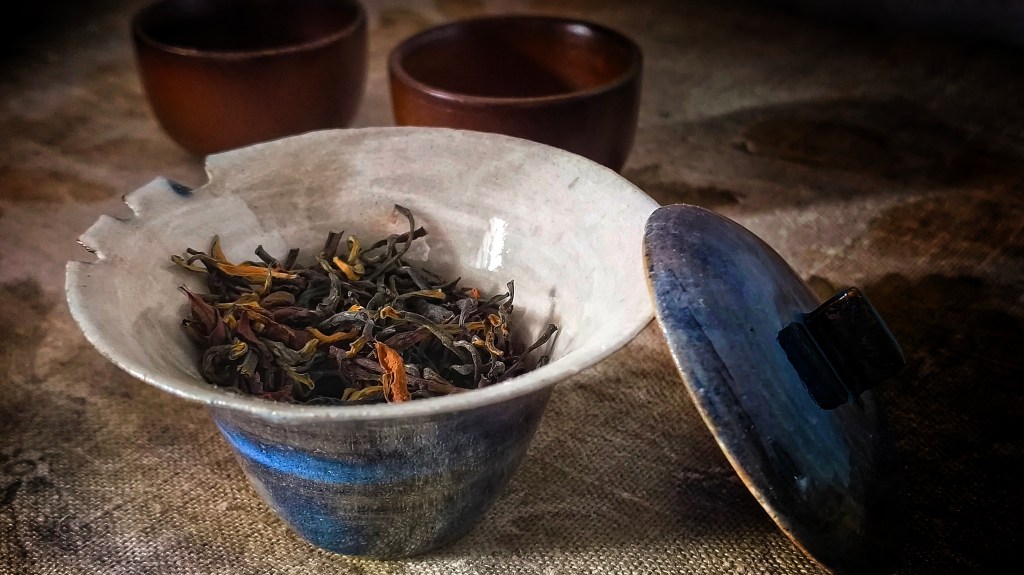
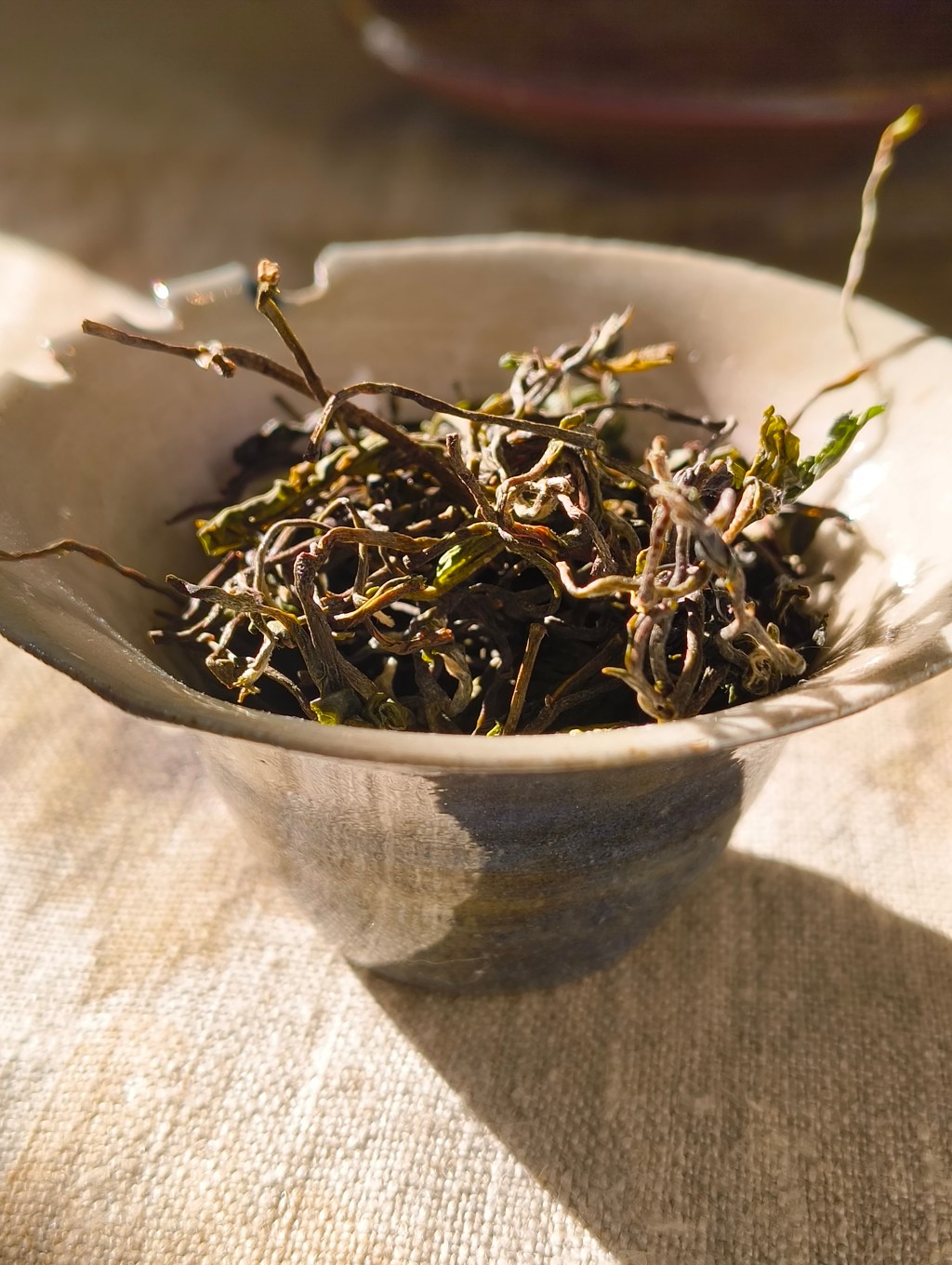
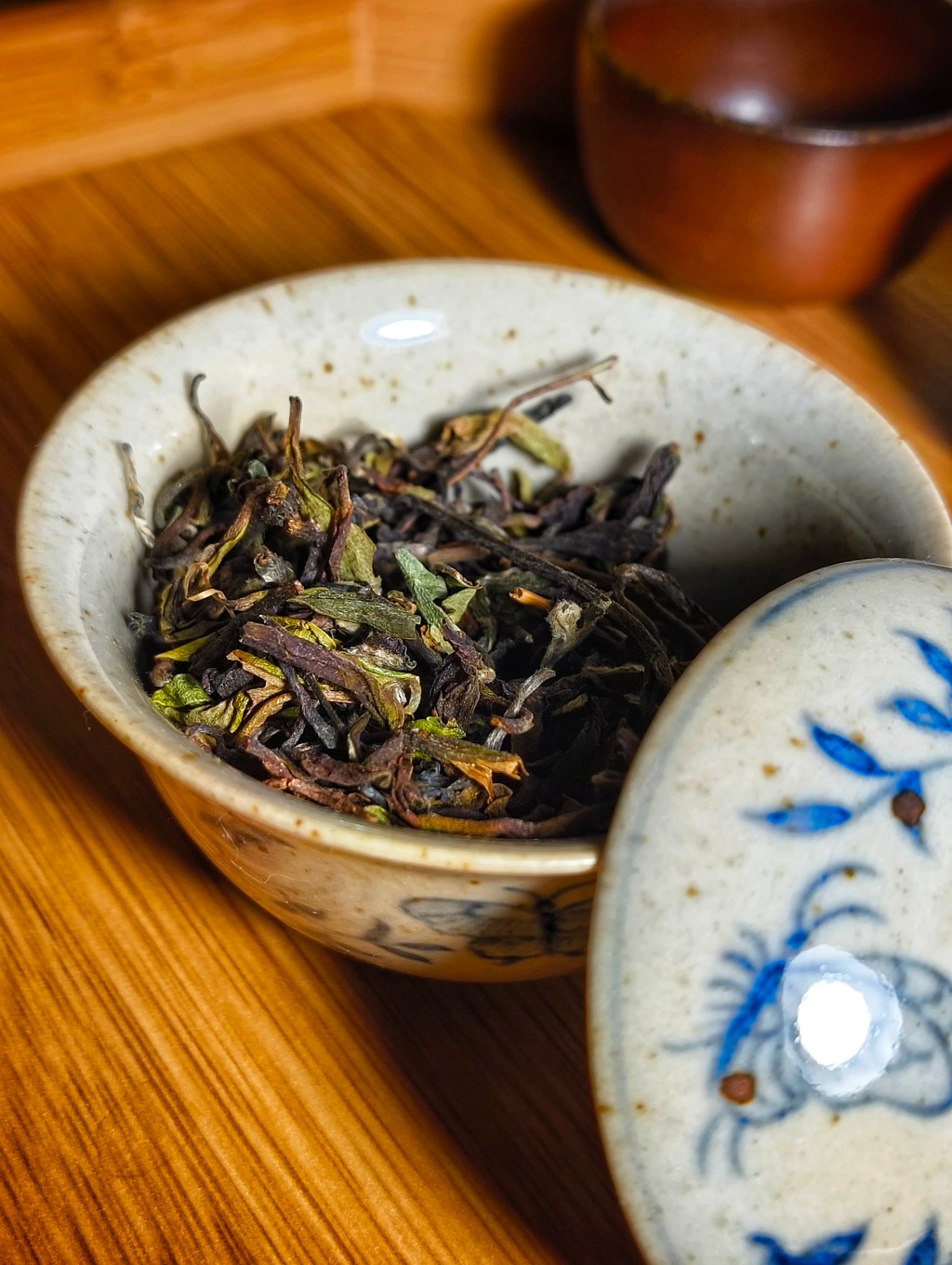
 Wild Harvested