Tag: blend

  • Geography of Mengku, a bit of history of the Shuangjiang factory and an excellent pu’er

    Geography of Mengku, a bit of history of the Shuangjiang factory and an excellent pu’er

    Yunnan’s soil is complex, as is the climate in its multidimensionality. In a single region we find a tropical climate or a mountain one, in the chromatism that envelops the observer, the eyes find both rest and the neurasthenia of the course of nature in a landscape that seems to be the meeting place between Cuyp’s Flemish vedutism painting and the almost brittle and super-ideal accuracy of Xiang Shengmo.

    But it is where this takes place in its verticality that we find the remnants of the history of the camellia, in the 18 villages between the peaks of Ma’an and Bangma, respectively east and west of the Nanmeng River.
    In the Middle Eastern areas we find the villages of Mangbeng, Banuo, Najiao, Bangdu, Nasai (including Zhengqitang and Xiaocun), Donglai, Manna and Chengzi; while in the mid-western area are included the villages of Bingdao, Baka, Tanguo, Dahusai, Gongnong, Banggai, Bingshan, Hudong, Daxueshan and Xiaohusai.

    It is mainly in the latter area that much of the material of the Shuangjiang factory of Mengku is concentrated, a company of the Rong family founded in 1993 but whose first generation dates back to 1935. Much of the material comes from the mountainous area of Mengku, especially from Daxueshan and Bingdao of which this factory was one of the forerunners. In 2005 the Rong family used the leaves of Bingdao, especially Laozhai and Nanpo, for the base of their “Mushu cha” which was followed by series dedicated to this area, as well as a lot called “Bingdao Cha” by professor Gao Zhao in 2006.

    Since the 1930s, the Shuangjiang factory has always focused on the art of blending, creating a standard of Mengku tea, a character that contrasted with the Yiwu and Bulang teas in the Jianghu of Puer in the early 2000s. The feature of the Mengku blends is that of a suspended cup, a tactile and gustatory return after the liqueur has left the oral cavity, a chewable sweetness that coexists with bitterness, almost creating a receptive antithesis in the same areas of the tongue. They are pleasant teas even in their youth despite their initial roughness, managing to relax elegantly without excessive dissonances in the evolutionary path.

    This 2011 pu’er from Shuangjiang factory is made from old trees leaves from different mountains in Mengku. The scents of dry leaves are reminiscent of an old mountain house, made of ancient, damp and slightly moldy wood, it almost recalls the smell of an old leather sofa. The wet leaves bring to mind earthy and woody notes, of wild mushrooms and undergrowth, wet wood and antique furniture. As the infusions pass the water dilutes the strongest odors, bringing back aromas of jujube, camphor, leather and virginia tobacco; it then evolves into a more fruity texture of apricots, stewed apples and madernassa pear poached in wine. The initially primordial and nostalgic character continues in the liqueur, with primarily animal smell on the nose, on the other hand notes of dates, wild oregano and dulsita sugar emerge in the mouth, a sugary sensation increases salivation together with the bitterness that takes possession of the sides and bottom of the tongue. The fruity notes close a complex, intense, soft, persistent and identifying sip.
  • Trip to Yiwu mountain through a 2006 classic blend

    Trip to Yiwu mountain through a 2006 classic blend

    In the recent past of Pu’er we have often witnessed a forced association of tea with its most narcissistic and aesthetic-economic dimension, to then observe the deflagration of this concept by those who sought more the practicality of taste and pleasantness in its more utilitarian sense. Without recalling how much before and after the events of 2008 contributed to forging these factions, in front of certain teas we can remember how much Pu’er can escape mere sensoriality, from being a simple pleasure of the palate to rejoin its real aesthetic dimension, that sensitive incarnation that translates an idea, a territory, a community.

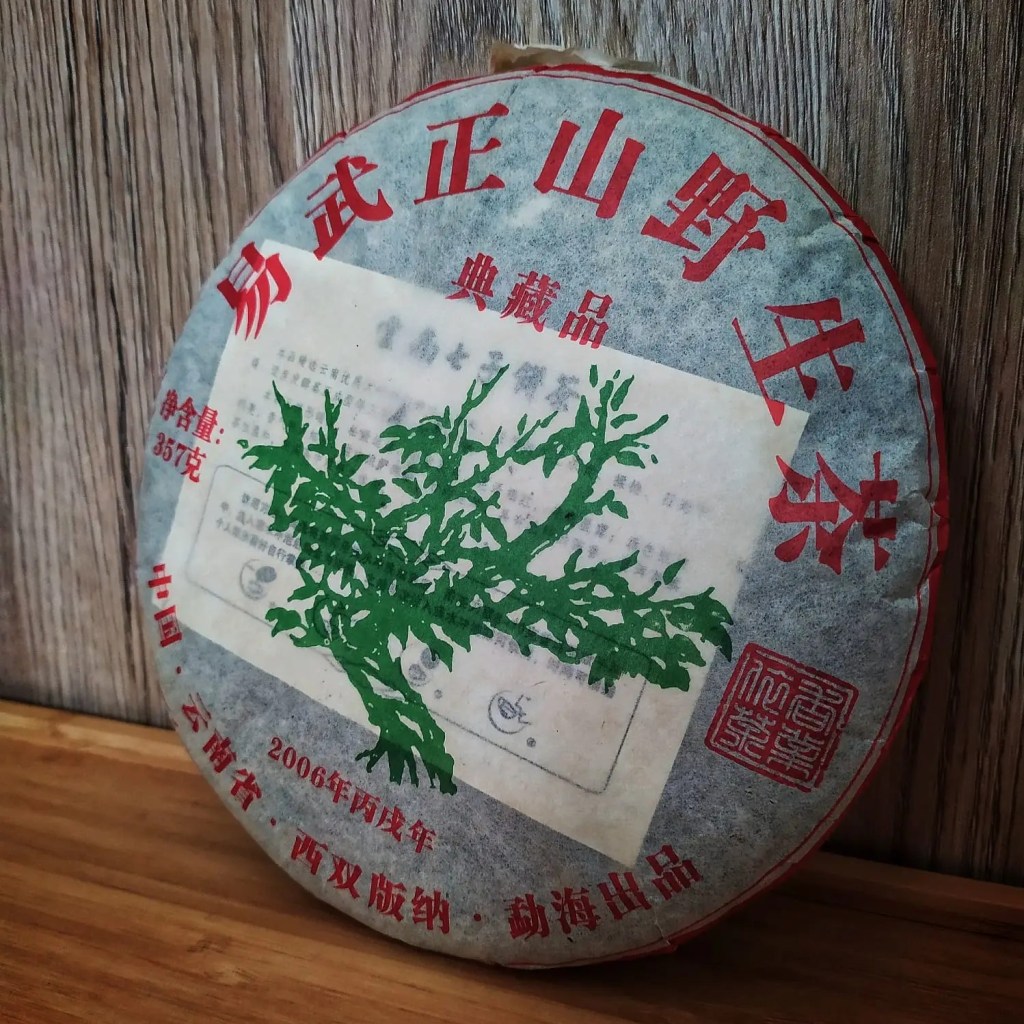
    Teas like those of Yiwu manage to reconnect us with that part of ourself which, while searching for information, tends at the same time to suspend from practical sense, making us experience the sensible, the experience in its essence. This cake immediately brings to mind the selections of Mr. Ye Binghuai, the “Big green Tree”, whose story will probably be the subject of future posts, but it suffices to know that it made a good part of history among enthusiasts at the end of the 20th century, as well as having led many Hong Kong auctions with his ’99 selection.

    The harvest dates back to 2006 from wild trees throughout the Yiwushan area, a sensory complexity achieved thanks to the assemblage of several mountain villages. Because from Mahei to Guafengzhai to Yiwu village we are witnessing a radical change in the composition of the soils, a pH that goes from 4.5 for the most acidic to 6.5, an altitude range that goes from the summit, above 2000 meters above sea level, to the 730 m of Nametian with its taidicha and xiangjiaocha, which in antithesis almost seem to offer a gateway to the compulsive modernism that previously struggled to take root among those camellias that looked like imposing bodies, lignified in their dynamism.

    This wild tree puer comes from some of the shengtai areas that flank the mountain villages, leaves that when wet release scents typical of these places and quite similar to those of other vintages chosen by Ye Binghuai, notes of cedar wood, camphor and dehydrated longan, with an almost smoky, balsamic personality while advancing a memory of peat very similar to that of a good Mezcal rather than a Scotch.
    Drinking proceeds in a calm and relaxed tone, one can perceive the scents of a pine forest after the rain, vegetal, musk, peach and floral as a background. Suggestions of banana leaves, Lemet in particular, the yucca cooked in water wrapped in banana leaves, together with spicy, woody and slightly smoky tones similar to those that Mizunara gives to Japanese whiskeys.
    The liqueur is coherent, initially introverted, of a golden-amber colour, slightly lighter than expected but able to develop over time animal, musky and fruity aromas, almost of raisin muscatel, with a qi that gradually becomes evident and pleasant. The sip is juicy, thick, balanced in its medium bitterness and medium sweetness, of good persistance and ending on notes of charcoal-cooked tropical fruit.