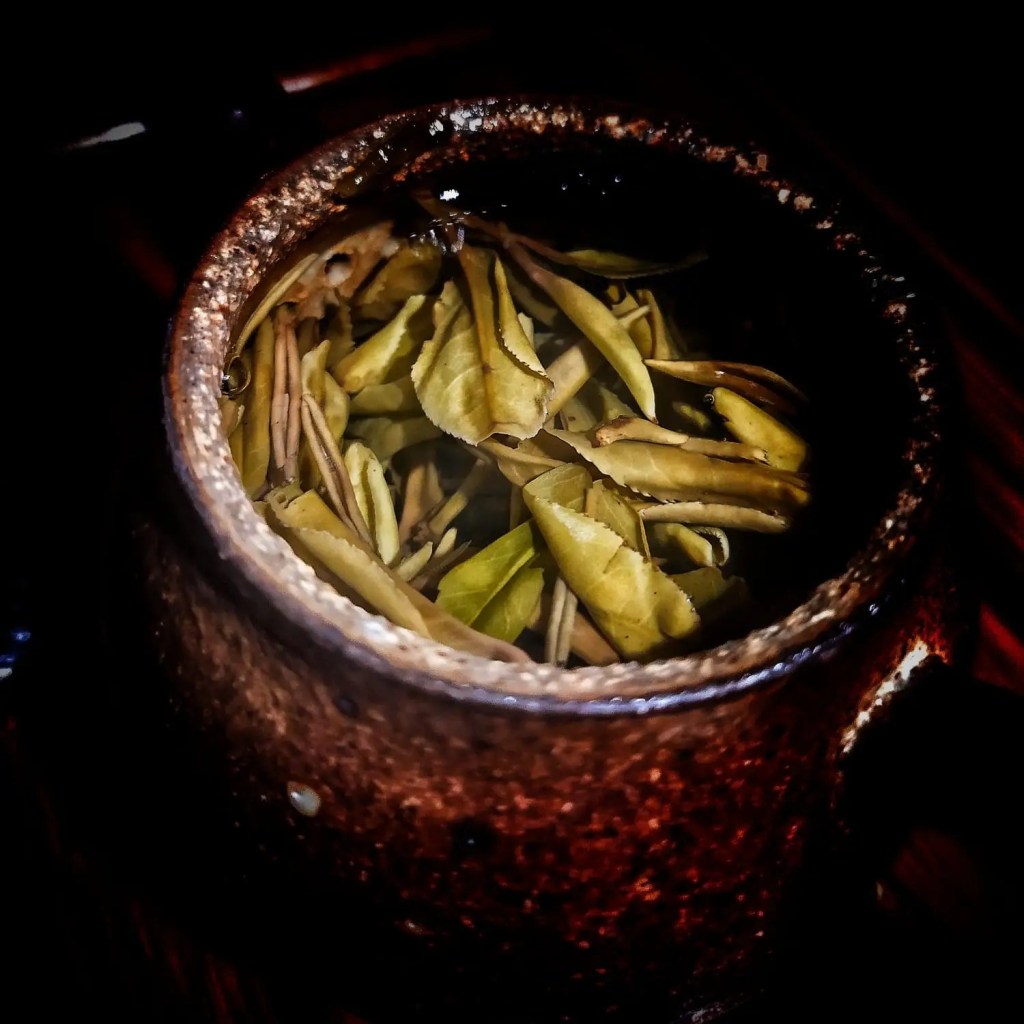
Tag: eastern leaves

  • When a great pu’er become an elegy. Eastern Leaves Lunan Mountain ancient trees 2020

    When a great pu’er become an elegy. Eastern Leaves Lunan Mountain ancient trees 2020

    For generations, caravans laden with pu’er have traversed the steep paths of Lunan, eluding the harsh karst landscape, leaving it behind them, slowly advancing towards Tibet.

    The muleteers, with their faces hollowed by frost and fatigue, relied on themselves, on their companions, on the tenacity of their horses, following the paths traced by their ancestors, where every bend concealed stories of exchange, trade and survival.

    Pasha seems to have been able to overcome everything, from the destruction that occurred with the Panthay rebellion to the wreck of traditionalism and the collectivization of the Cultural Revolution, to the persecution of the Red Guards.

    Hölderlin wrote “where there is danger, what saves also grows,” and so it is here that natural beauty and spiritual aspirations intertwine into a rich and vibrant cultural cloth, and teas like this, with their dense depth of flavors of vanilla, candied fruit, nuts and persimmons, take us into a dimension of time that we cannot easily grasp, a place where tradition is not only preserved, but continually recreated.

    With its silky sip, honeyed sweetness, musky and citrus tones, the cup becomes a sort of refuge, a bridge rather than an end.

    When we sip a cup of pu’er like this we are entering into a dialogue with the past, it reminds us that not all is lost, that in its slow and patient aging lies both a concession and a resistance to time.

    A great pu’er becomes an elegy, not only a lyric of sadness for what is lost but a celebration of the intrinsic value of what has been. In its leaves pervaded by scents of red dates, walnuts and toasted pumpkin seeds, of withered broom flowers, its elegiac essence revived through a call to the earth, to history, to the culture, every sip becomes an existential plan, a way of inhabiting time with consciousness.

    It offers us a key to a further, more saturated dimension of time, in which loss is not an obstacle to overcome but nourishment for our being. Both, the elegy and the pu’er make memory a cure, an antidote to oblivion, reminding us that the past is not a wound to be closed, but a legacy to draw from.

  • Brief historical excursus on the efforts and resilience of the Anhua people

    Brief historical excursus on the efforts and resilience of the Anhua people

    Politics clouded every public and private space in China at the end of the 70s, revolutionary inspiration raged incessantly from the large squares to the alleys of the rural dimension. The Hunan we know today, a land of extraordinary teas, has seen some of the most important Chinese political figures sit at its hickory wood tables.

    The dark liqueur, imbued with smoky aromas, was a participant in the CCP meetings, a witness to history and speeches that were never revealed. The heicha was present during the strategies of a young chairman Mao, of Liu Shaoqi, Wang Zhen, and then-Liberation Army militant Hua Guofeng, who would become the main supporter of the monumental growth of tea cultivation and agricultural modernization during the Cultural Revolution.

    Before leaving for Beijing, having defeated the gang led by Mao’s mad widow and being recognized as one of the most powerful men in China until the takeover of the Deng Xiaoping movement, he saw the acreage of Hunan tea increase from 42 to 172 thousand hectares in ten years, even if half were removed around the 90s.

    It was the heicha that warmed the souls of the soldiers during the Sino-Japanese battle of Ichigo Operation, that sustained the squadrons on days when not even the land could give relief to the dead.

    The huigan of a heicha dates back as the disenchanted voice of those who have now passed away and those who continue their work. Homeland of farmers, idealists, politicians, the look at Hunan is left to a feeling of fatigue and historical awareness that never seems to find rest.

    Initially tea was a necessity for the inhabitants of the province, planting it meant having preferential access to coal, kerosene, iron for work tools and fertilizers, furthermore the cooperatives purchased all the tea produced with advances in cash, so that farmers could purchase inputs before harvest, although often at unfair prices.

    Even today the roads that lead to Yiyang are part of an arduous pilgrimage where few still venture out, at times it seems like everything has remained still, you seem to have entered another era where in many rural villages no one will offer you a flat image for families or a little speech from a leaflet, rather a cup of tea together and lives to listen to. The people, the territory, are like their teas, a hermitage in the highlands, stranger to that sad modernist compulsion and the sadistic urbanism that seems to bypass history.

    In many homes you can still see jars containing remedies and potions on wooden shelves, alongside old ceramic and copper teapots; you are greeted by the warm whine of the kettle on the stove, the wood is now white ash, the smell of smoke still sometimes saturates the atmosphere and the drops of condensation look like tears on the windows, those little things that drag you into your corner of familiar comfort even in the most remote place in the world.

    Here, in the early Hongwu years of the Ming Dynasty, Shaanxi tea merchants opened a factory to purchase and process tea, then transport it to Jingyang. After fermentation and flowering was pressed into bricks and then sealed with hemp paper. The central government established inspection and transportation departments in Xining, Hezhou and other places in Shaanxi. Fucha was so important that to prevent tax evasion, sanctions were approved such as beheading for those who illegally left the province with tea and imprisonment or death sentence for officials who allowed their escape.

    Anhua tea traders were later empowered to transport tea on grueling and brutal journeys across the Anhua Ancient Tea Horse Road, starting from the ancient market of Huangshaping and Yuzhou, along the Zishui River, then to Dongting Lake by sail boat, and then transferred it to Shaanxi.

    However, the birth of the farmer movement and the Shaanxi-Gansu Muslim Uprising blocked tea trade routes in the northwest, resulting in a slowdown in trade and the people of Anhua found themselves without anyone to accept the import, creating a circuit of tax non-compliance that was at that point incurable. Furthermore, foreign capital took advantage of contractual asymmetries and inadequacies between sellers and the Qing government to directly purchase large quantities of cheap tea.

    The first signs of recovery came with Zuo Zongtang’s “Tea Law”, opening the doors to a new tributary system and a new and prolific tea export route, but new problems were created, however, during the political disintegration of China under the blows of the warlords of Beiyang and in the early years of the Republic of China.

    The central government’s control over local forces weakened considerably, the tea trade in the northwestern region was left to the local government which was solely concerned with the collection of tea taxes without any attention to direct control over tea market policies.

    After a slight relief from the markets due to a fiscal relief of the provisional regulation of April 1942, throughout all the 40s to the following 40 years there would no longer be much news; the social unrest, the Sino-Japanese war, the consequent destruction of the roads to block supplies and the lack of intervention in the management of the markets in Hunan caused the disappearance of this type of tea, whose presence persisted almost exclusively at a local level.

    The history of Anhua has always concerned people, going beyond politics, beyond market logic, carrying on its shoulders the weight of history and the torment that accompanies the sunset of eras, but it is certain that a new future awaits this territory, worthy of these people and their tea.

    While I’m doing this soliloquy I’m drinking a wonderful Eastern Leaves 2007 Fucha from Anhua, and I am more and more convinced of how this is a tea that more than others is a veteran of incendiary contexts, a reactionary symbol endowed with the cadence of the human voice in narrating with spiritual sincerity our past, when farmers produced tea surrounded by the metallic noise of trucks and the smell of kerosene, fixing the historical truth in the persistence of consciousness.

  • A forest out of this world, shaped by a Caravaggesque hand. This is Paliang

    A forest out of this world, shaped by a Caravaggesque hand. This is Paliang

    Passing the muddy paths close to Bulang, with those mountains behind you that seem to have been born from the virtuosity of a Caravaggesque hand, shaped by tectonic inclemency, by geological tension, the sun shines burning over the tropical karst sinkholes, a place where nature and men weave millenary relationships, meeting in the most inaccessible forest and in the architectural remains of the imperial era.

    The light filters through the dense forest, radiating the tea trees that look like illuminated actors in a naturalistic work twisted in lignified gestures, while the boys in the village load the trucks with cassava and laughter intones a background melody. Here stands the ancient village of Paliang, an out of this world place at about 1850 meters above sea level, surrounded by primitive works, where popular customs are preserved in their amnioticism.

    All this is defined by leaves that show in an objective elegance what is an empathetic initiation to Bulang teas. The infusions reveal a more restrained astringency, a character devoid of that fatherly austerity represented by the strong bitterness of some teas that are encountered a few tens of miles away.

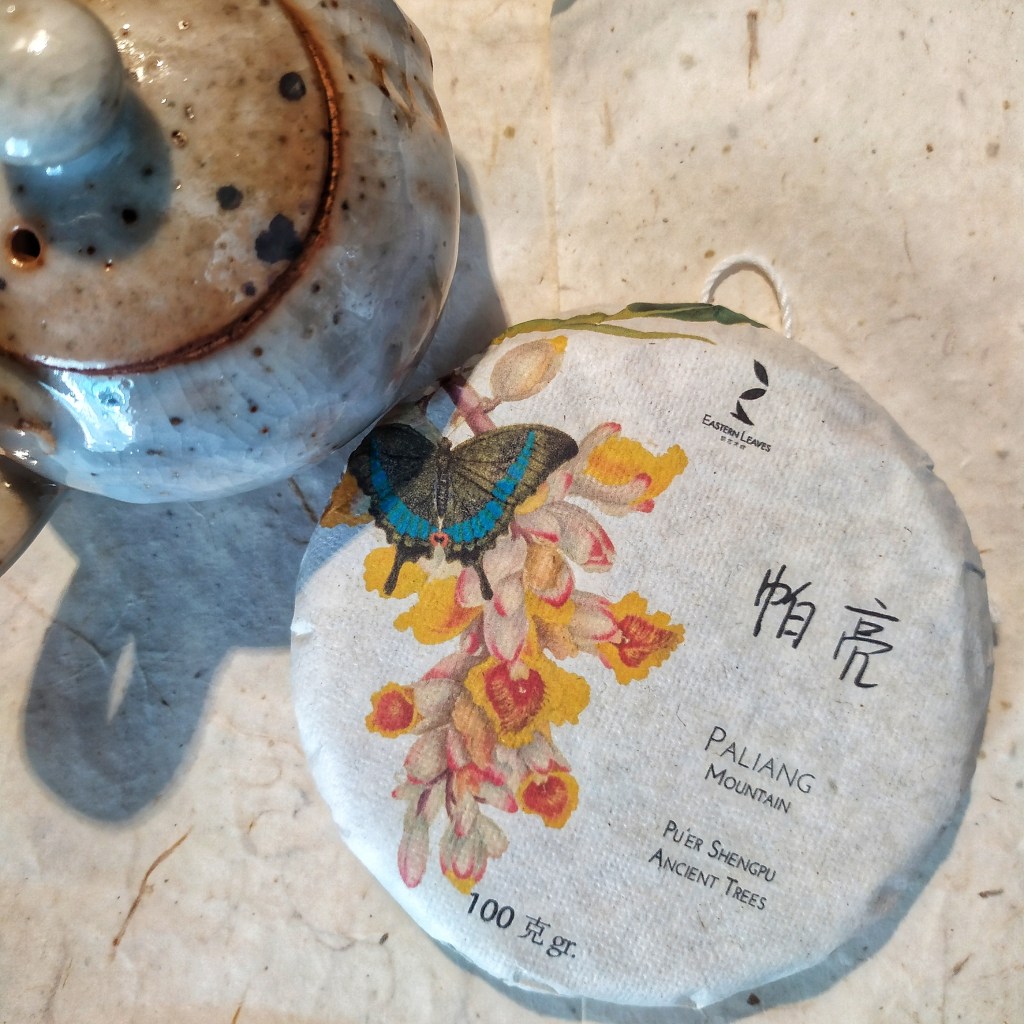
    This sheng pu comes from material harvested in 2021 in Paliang. The scents of the leaves are like taking a look at an ancestral view, when wet they recall charcoal-cooked tropical fruit, the wild flowers bring back memories of an excursion on the bank of a wooded river, surrounded by deep forest moss, pervaded by the smell of wet rock. Almost primitive and mineral scents are accompanied by those of the juiciness of a basket of ripe fruit, there are notes of toasted dried fruit and slight hints of ancient leather.

    In the mouth it flaunts a smooth texture, it seems wrapped in silk drapes, the bitterness is contained although present, tempered by the soft and deep echoes of a sweetness resulting from the juiciness of a ripe peach. The sip recalls the sensations of a good Montrachet, the palate is soon refreshed by a peculiar minerality and eagerly seeking the next contact with the cup.

  • Reaching the highest peak, where the air is more rarefied, where the silence of the place becomes a virtue. Tribute to Huazhuliangzi.

    Reaching the highest peak, where the air is more rarefied, where the silence of the place becomes a virtue. Tribute to Huazhuliangzi.

    To the northeast of Menghaizhen we follow the dirt roads that lead to the highest point, the peak of Banna, between the fog that seems palpable and the city behind us at every point the eyes find rest wherever you look. The old trees covered in moss and xylophagous saprophytes draw attention, among the rocky outcrops they look like lignified souls, guardians of a place that does not seem to have been disfigured by urban compulsion. Leaving Baotang and Luotang we continue in the direction of Bameng, towards the peaks of Huazhuliangzi, where the air is more rarefied, the silence of the place becomes a virtue as we cling to those slopes above 2000 meters.

    On the top the climate is cool, drama dissipates in front of a gaiwan, the smell is that of the surrounding vegetation while you exhale the steam of the kettle which pervades the room; tea welcomes as an implicit idea of manifestation of a greatness able to overcome the transience of events, it is the pride that relieved from the burden of living in a premeditated order when the civil conflict had just ended and the desire for reconstruction took refuge in time, the one necessary to the rain to bury a war that at its resolution allowed only that smell of oils and fuel of the first trucks.

    These mountains are the home of the Hani, Lahu and Han people, mainly settled in the areas of Baotang (Xinzhai and Laozhai), Benglong and Bamen. The tea trees here are mixed with wild bamboo and other native arboreal species, the tea varieties of Huazhuliangzi are the broadleaf typical of Menghai County.
    The Huazhuliangzi teas seem far from a prescriptible attitude, the unique character of these leaves welcomes in itself that sometimes antinomic but inescapably linked relationship between the contingent and the sacred, between sky and earth, between human science and nature.

    Easter Leaves Huazhuliangzi 2021 sheng pu masterfully exemplifies the character of this area, there is a mountainous and wild charm in it, a composed sweetness postpones an evident and brief astringent sensation that leaves the mouth in seconds, without stagnation, and the aftertaste it is incredibly persistent.

    he infused leaves recall notes of mango, ripe peach, aromas of melon and peach gums. The musky notes blend with the fruity sweetness recalling the Moscato passito, combining childhood recalls such as ramassin and rosehip.
    The sip flows easily along the throat refreshing the palate, the aromas are reminiscent of white melon, lemongrass and sorrel. The vegetal acidity seems almost chewable, animates the tea exalting an already complex experience, adorned with aromas of peach and white cherry, continuing incessantly in its silky and endless texture.

  • All the fragrance of Naka

    All the fragrance of Naka

    Naka is one of those places whose tea manages to make the contemplative intent coexist with the liberation that accompanies a state of inebriation, of marked well-being. The teas from this mountain are often not famous for their complexity but rather enliven the experience with their persistent sweetness, an immediate sugary sensation that is almost palpable beyond the blanket of initial bitterness, a sip that returns a sensation that shines through as an existential parable where suffering and gratification alternate.

    Teas like those of Naka, Bingdao or Laobanzhang transport us to another dimension of thinking, more ancient and simple, the one that makes us grasp Holderlin’s vision of a “measure common to all”, the one removed from our evaluations, the one of a taste purity capable of embodying the reason and essence of a place.
    They are unique scenes, to which even if we don’t belong, we adopt as a spiritual homeland.

    Naka’s is perhaps the most representative of Mengsong’s teas; here the woods surround the village in which there are approximately 40-50 hectares of ancient tea trees, most between 300 and 500 years old. The 1660-meter high peak is located on the eastern slope of Huazhuliangzi, the ground is sandy and rocky, the climate is humid and rainfall is abundant and more frequent than in other areas.

    The small-leaf variety predominates along with the medium-sized variety, which is a unique condition in the Menghai area. From Da’an to Nongbeng, from Baotang to Damengsong each village here has its own microclimate and its own shrewdness in the processing of the leaves; Lahu and Han with their respective dialects and cultural traditions have lived together for centuries in these mountains where time seems to have stopped.

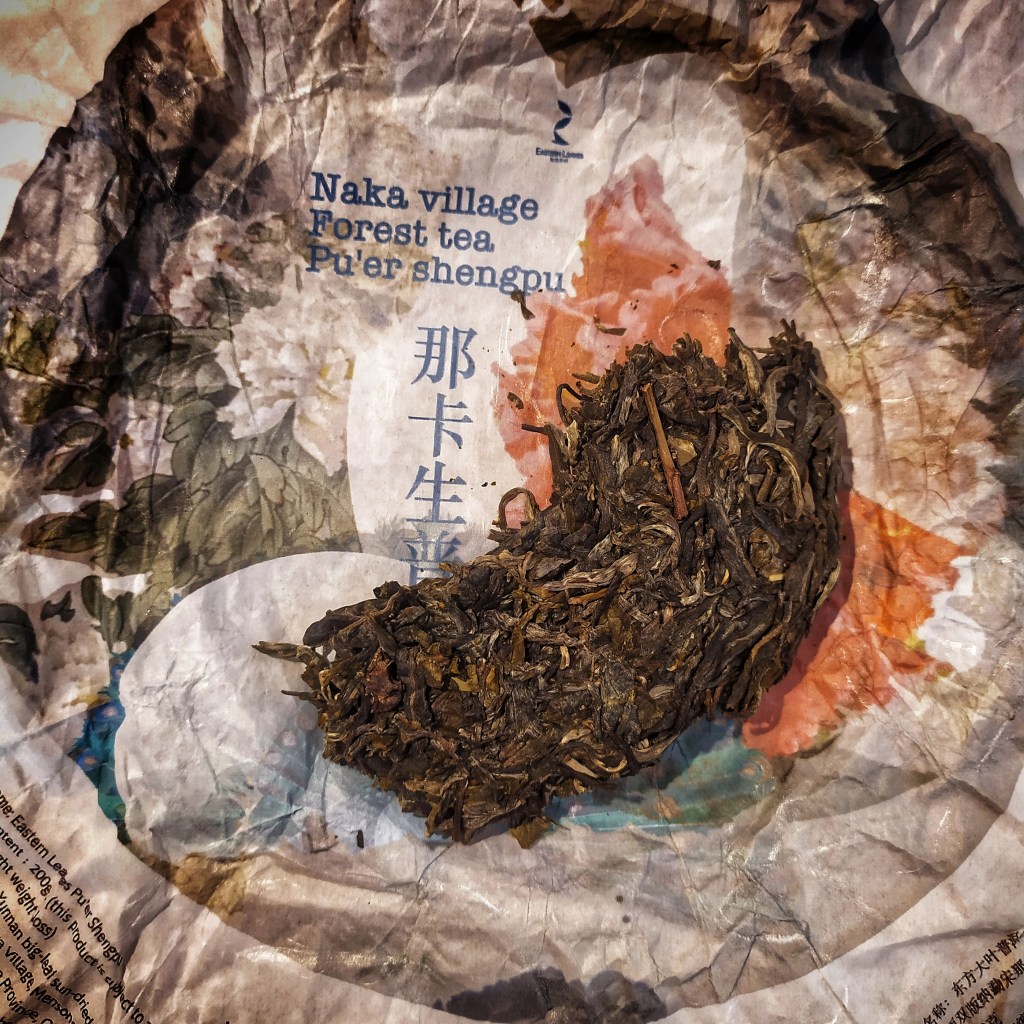
    This 2022 Eastern Leaves sheng pu is a tea that is not afraid of meditation or of the most convivial moonlight. The wet leaves are a unique journey just outside the village, the memory is that of a pastry shop in the middle of the forest where the scents of the woods and wet leaves envelop you, among the rocky tones you can perceive scents of apricot curd, peach , mountain flowers and citrus fruits.
    The liqueur has an antique gold dress; on the palate it is soft, enveloping, beautifully balanced and progressive in the bitter tones that quickly unfold in a sugary dimension, an endless sweetness that seems almost chewable. It is a tea with an excellent structure already in its youth but whose time can only act as its guardian.

  • Along the road to Lhasa: a break with Eastern Leaves’ Huangxiaocha 2022

    Along the road to Lhasa: a break with Eastern Leaves’ Huangxiaocha 2022

    Mengdingshan is one of the areas of Sichuan best known to tea enthusiasts, a universe of its own, an almost oracular function of a system apparently disconnected from the world with gardens immersed in the clouds that cover them creating an intense environmental and philosophical contrast, a metaphor for the history of this region which was the cradle of the civilization of the camellia sinensis, of its taming and of being the guardian of time.

    But as true of civilization throughout history as it is of the tea plant, while sky covers the earth sustains, with the great fertility of the eastern plains that open beyond Chengdu as a source of sustenance during times of famine and wars, but it is beyond the mountains of Ya’an, on the road that leads to Kangding, on the slopes at an altitude of 3000 m whose paths lead to Garze and finally to Lhasa that the cultural heritage and identity of an entire people must be sought. It is among the peaks Jingquanfeng, Qingfeng, Lingjiaofeng Ganlufeng, Yanufeng that the Mengdingshan imperial tea was harvested before Qingmingjie and sent to the imperial court, it is here that the present is reconciled with history, where the order of things meets natural disorder, where earth and sky become organs of that Heraclitean measure that escapes being cadenced by human planning.

    Eastern Leaves Huangxiaocha was harvested at the end of March 2022 on Mengding Mountain. The dried leaves express buttery, biscuity and hazelnut chocolate hints. When infused, they take on nuances of white truffles, chestnuts, then biscuit and cooked vegetables hints until they become floral with wild flowers scents before the occurrence of toasted pumpkin seeds and orchard hay memories. The sip is coherent, balanced, soft with a sugary thickness and a sweeter sensations the more you continue with the infusions. Aromas of shortbread and cane sugar, toasted seeds and hazelnut emerge in a lingering finish that leaves the palate sweet with an extremely satisfying sensory sensation

  • Eastern Leaves Nannuo wild forest sheng pu’er 2020

    Eastern Leaves Nannuo wild forest sheng pu’er 2020

    Nannuoshan is located halfway between two large cities of Xishuangbanna, Menghai and Jinghong, and has long been a destination for tourists and enthusiasts who crave the cakes of this mountain, who hike the summit in the day and return home with tea bought for be given to family and friends. Now it’s always good to remember that in areas where teas are sold by themselves, those intended almost for Eucharistic acts, there’s an obligation to search for the truth in those leaves, which are translated into a corresponding liquid that doesn’t tell of simple poeticisms, but which as a disembodied voice tells of who is there and who has been there, of millenary soils, extreme climates and plants that seem to keep time.

    This Eastern Leaves Pu’er sheng comes from wild trees at 1800 meters above sea level, in a tremendously difficult year characterized by a long drought. Here we find not only the floral notes that distinguish Nannuo pu’er, but an olfactory complexity that develops right from the wet leaves an evanescent smoky suggestion as a background for hints of wet rock, citrus of green oranges and vegetal like cut grass, to evolve towards hints of exotic fruit and apple compote. The sip is full, round and at the same time agile, with medium bitterness and minerality, as an excellent Nannuo tea should be.
    Aromas of persimmon and chinchona, bitter orange and medicinal herbs appear and continue in the aftertaste, counteracting sweeter memories of strawberry custard, creating a tasting stratification, in which infusion after infusion a typical and satisfying huigan emerges.