
To the northeast of Menghaizhen we follow the dirt roads that lead to the highest point, the peak of Banna, between the fog that seems palpable and the city behind us at every point the eyes find rest wherever you look. The old trees covered in moss and xylophagous saprophytes draw attention, among the rocky outcrops they look like lignified souls, guardians of a place that does not seem to have been disfigured by urban compulsion. Leaving Baotang and Luotang we continue in the direction of Bameng, towards the peaks of Huazhuliangzi, where the air is more rarefied, the silence of the place becomes a virtue as we cling to those slopes above 2000 meters.
On the top the climate is cool, drama dissipates in front of a gaiwan, the smell is that of the surrounding vegetation while you exhale the steam of the kettle which pervades the room; tea welcomes as an implicit idea of manifestation of a greatness able to overcome the transience of events, it is the pride that relieved from the burden of living in a premeditated order when the civil conflict had just ended and the desire for reconstruction took refuge in time, the one necessary to the rain to bury a war that at its resolution allowed only that smell of oils and fuel of the first trucks.
These mountains are the home of the Hani, Lahu and Han people, mainly settled in the areas of Baotang (Xinzhai and Laozhai), Benglong and Bamen. The tea trees here are mixed with wild bamboo and other native arboreal species, the tea varieties of Huazhuliangzi are the broadleaf typical of Menghai County.
The Huazhuliangzi teas seem far from a prescriptible attitude, the unique character of these leaves welcomes in itself that sometimes antinomic but inescapably linked relationship between the contingent and the sacred, between sky and earth, between human science and nature.
Easter Leaves Huazhuliangzi 2021 sheng pu masterfully exemplifies the character of this area, there is a mountainous and wild charm in it, a composed sweetness postpones an evident and brief astringent sensation that leaves the mouth in seconds, without stagnation, and the aftertaste it is incredibly persistent.
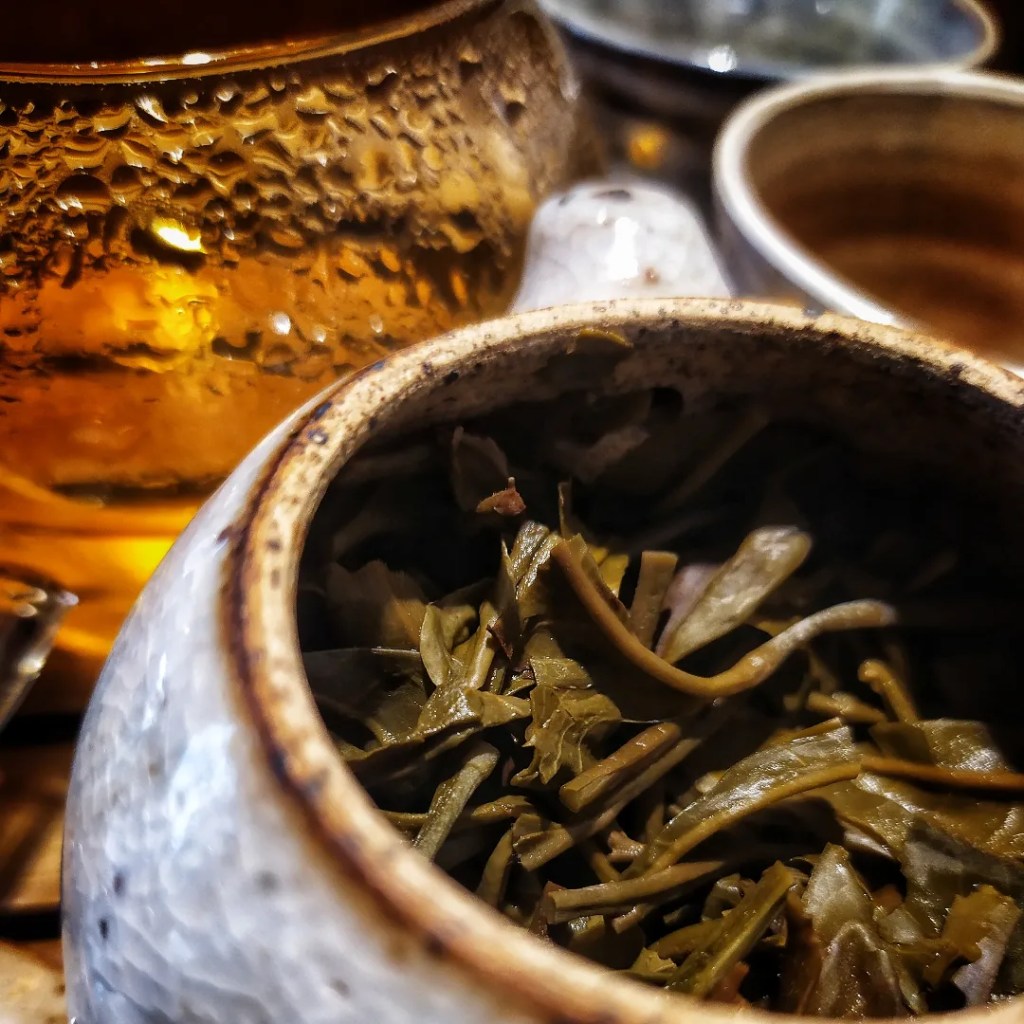
he infused leaves recall notes of mango, ripe peach, aromas of melon and peach gums. The musky notes blend with the fruity sweetness recalling the Moscato passito, combining childhood recalls such as ramassin and rosehip.
The sip flows easily along the throat refreshing the palate, the aromas are reminiscent of white melon, lemongrass and sorrel. The vegetal acidity seems almost chewable, animates the tea exalting an already complex experience, adorned with aromas of peach and white cherry, continuing incessantly in its silky and endless texture.
 Wild Harvested