
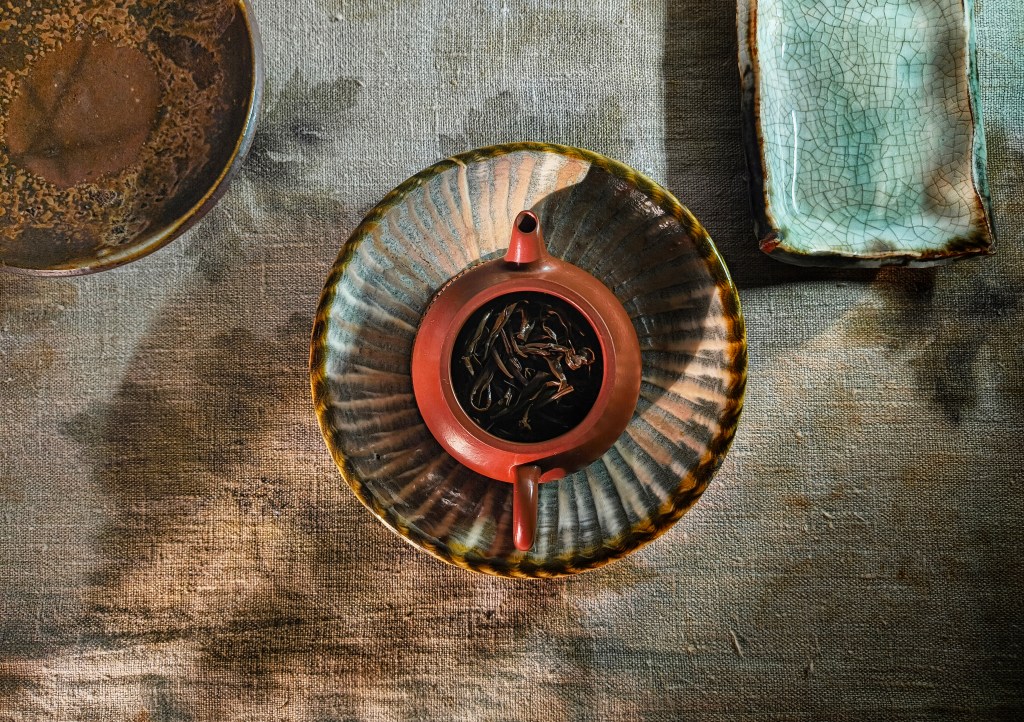
I sometimes think we take far too much for granted just how complicated it is to make a truly good tea, especially a good black tea.
It’s treated as a Pavlovian reflex, a gesture made without thought, like pouring yourself another glass of prosecco when the guests’ conversation has already descended into collective complaint.
We grow used to the idea of that same black tea we’ve known since childhood, the one we dip into hot water, pressing it against the bottom of the cup with a spoon as though drowning an enemy soldier, then lifting it out in an act of sheer mercy, waiting for answers that will never come.
But how difficult is it, really, to make a tea that isn’t just another instrument of urban survival, like the burnt acid coffee of a NOLA diner where Truman Capote used to sleep off his drunk?
Crafting an excellent black tea can be a perilous act, a poorly calculated risk, a climatic roulette.
The best terroirs, in Yunnan, Vietnam, and Thailand, where the best Dianhong and wild black teas are born, are surreal, high-mountain subtropical zones with humidity often above 80% and violent diurnal temperature shifts.
Many varieties from these regions, particularly the wild non-sinensis sinensis types, bear large, waxy leaves with thicker cell walls requiring greater mechanical force to rupture.
And in cold, damp environments such as Lào Cai, leaf plasticity itself changes with temperature, creating irregular breaks that result in uneven oxidation.
During withering and oxidation, intracellular water regulates enzymatic kinetics and oxygen diffusion; therefore, the microstructure of the leaf, guided by the degree of mechanical rolling and the residual moisture content, controls the access of O₂ to phenolic substrates. In large, thick-cuticle leaves, diffusion is limited, and mechanical rolling, by potentially breaking cells unevenly, can create micro-anoxic zones that produce grassy notes alongside over-oxidized regions responsible for bitter flavors.
To make matters worse, these varieties exhibit a polyphenol oxidase activity significantly higher than that of sinensis sinensis cultivars, sometimes two to three times greater.
This causes a much faster initial rate of oxidation and a greater release of heat, since these reactions are strongly exothermic.
The result is a local rise in temperature within the leaf pile and extreme sensitivity to even the slightest thermal or oxygen fluctuations.
A gradient of merely ±5 °C between surface and core can produce differences of 20–30% in the local oxidation rate, turning the process into a blind sprint toward excess.
The pronounced diurnal temperature range triggers metabolic oscillations, leading to unstable enzymatic activity. Add to that the high humidity and the coincidence of the rainy season during harvest and processing, and the withering can drag on for hours and hours. Moreover, even the final natural drying can prove impossible and storage can turn into a logistical nightmare.
All this leads to the constant risk of unwanted chromatic heterogeneity, partial over-oxidation, and distorted aromatic profiles, dominated by earthy and metallic tones, mouthfeel stripped of viscosity, and a finish that is absent, unpleasantly vegetal-oxidized, laced with the taste of missed opportunity and lost money.
And yet, this Lào Cai Deep Forest 2025 by Viet Sun tells another story.
Its wet leaves smell of a kind of wildness that would even coax a smile from Eduardo Kohn, of forest berries, amber, and guava.
The olfactory profile deepens through the corroded cortex of a nostalgic old Tory: leather and forgotten colonial furniture, oak aged Pedro Ximénez, and the memory of a wilted rose.
On the palate, it is soft, seductive, with a sugarcane sweetness and flavors of wild berries, dried flowers, and dehydrated cherry.
It’s a difficult tea, one whose making requires traversing a desert of problems, an act of resistance against mechanization itself.
But perhaps that is the price to pay for something potentially extraordinary.
Kerouac once wrote that “problems are the general definition of the things in which God exists.”
And here, God is probably caked with mud, smokes Saigon Red, and occasionally takes refuge in the hands of those who still believe in difficulty.
 Wild Harvested