Tag: manzhuang

  • An emotional tea along Xiangling Highway. Mr Quen Cun An and his early 2000’s Manzhuan pu’er

    An emotional tea along Xiangling Highway. Mr Quen Cun An and his early 2000’s Manzhuan pu’er

    Along the Xianglun Highway, the entrances to the forest alternate with those of the taidicha, a single main road connects the village of Manzhuang to that of Manlin. The primeval essence of the tropical forest can be seen from the few patches of bare earth left; the age, mineralogy and extensive leaching of acrisol, which have led to low levels of plant nutrients, counteract the silt-clay undertones of the iron- and aluminum-rich ferrarsol in which the camellia has found its home.

    In the teahouses you drink the liquid consequence of a territory and its time, of a history of sacrifices and the search for the truest self-assertion. They become a place to find a family, a group or a simple shelter where one can abstract oneself from taxes or from any contradiction of contingencies, where every soul, even if tacit, does not wander alone, but together with other worn out and thirsty souls.

    Mr. Quen’s Manzhuan sheng pu’er expresses the charm of the lived, it is the example of those teas that seem to simplify what is most hidden and arcane and complicate what is simpler, making a set of organoleptic notes a complex symphony and a vivid image.

    The liqueur has a reddish color with orange reflections, reminiscent of the nuances of a tawny port. The scents of the wet leaves enriched with jinhua bring back memories of raw and primitive landscapes as Bruegel the Elder would have imagined them, with notes of damp earth, dried mushrooms, undergrowth, leading to a wood cabin under the rain, with the smell of aged mahogany, old books and a bouquet of faded flowers. Light balsamic tones take over in the background, together with those of burnt wood, laurel, dried plums, piloto tobacco, black pepper and dried longan.

    The gloomy evening atmosphere becomes more vivid with the appearance of notes of leather, cognac and typical hints of aging in oak barrels.
    The body is medium thick, the sip has notes of walnut, dried plums and aromatic herbs which are the prelude to the nuances of leather, old wood, cinchona, dried citrus peel and filter coffee.

    It is a sheng of great balance and sensory complexity, the bitterness is now perfectly integrated and not very perceptible as is the astringency, excellent huigan and remarkable persistence.
    Material from Ba Zhong Zhai village, Manzhuan area, family garden of Quen Cun An.

  • As long as the root is still there, everything is still there. A few words about Manzhuan

    As long as the root is still there, everything is still there. A few words about Manzhuan

    “只要根还在,一切都还在”
    Before the advent of a group of Taiwanese tea explorers in 1994, Manzhuan was a heavily rural area, dominated by vegetation surrounding classical Han architecture. Residents of Manzhuang, Manlin and Manqian were still recovering from the war that decimated many families, the losses due to the famine and class sacrifices of the Maoist era, especially between the 50s and 70s, brought the area of Manzhuang to count less than a hundred people, the sale of tea was almost impossible and agriculture was not even enough for self-sustaining.

    Social regimentation had devastated the existence of a place, disfigured the quiet by imposing an artificial order irreconcilable to it. But history soon revealed a whole other future, and from the mid 70s onwards the production and sale of tea was resumed, many centuries-old trees were pruned to increase production and answer an ever-increasing demand. This happened until the early 2000s, when the effects of the Taiwanese expedition and the explosion of the pu’er market made sure to return to a policy of conservation and preservation of their land, reliving their past.
    As long as the root is still there, everything is still there “只要根还在,一切都还在”.

    Manzhuang is one of those few remaining places that detract from humanity the superficial, in which between man and earth there is not a mere utilitarian link as between an animal and a drinking trough, but rather existential as the one between the world and God. It is here that trees distill the air full of herbs and wild fruits and man becomes able to transform it into the liquid painting of a land that still resists modernization, taking root in its primordial essence.

    Drinking Manzhuan pu’er like Mr. Quen’s is like letting a sip of reconstruction run down your throat, giving you the keys to a hard-earned identity. They are teas that allow to go beyond the material nature of the object, a liquid synthesis of the historical complexity of a region that has been the cradle of tea lyricism and incubator of a natural heritage for more than a thousand years.

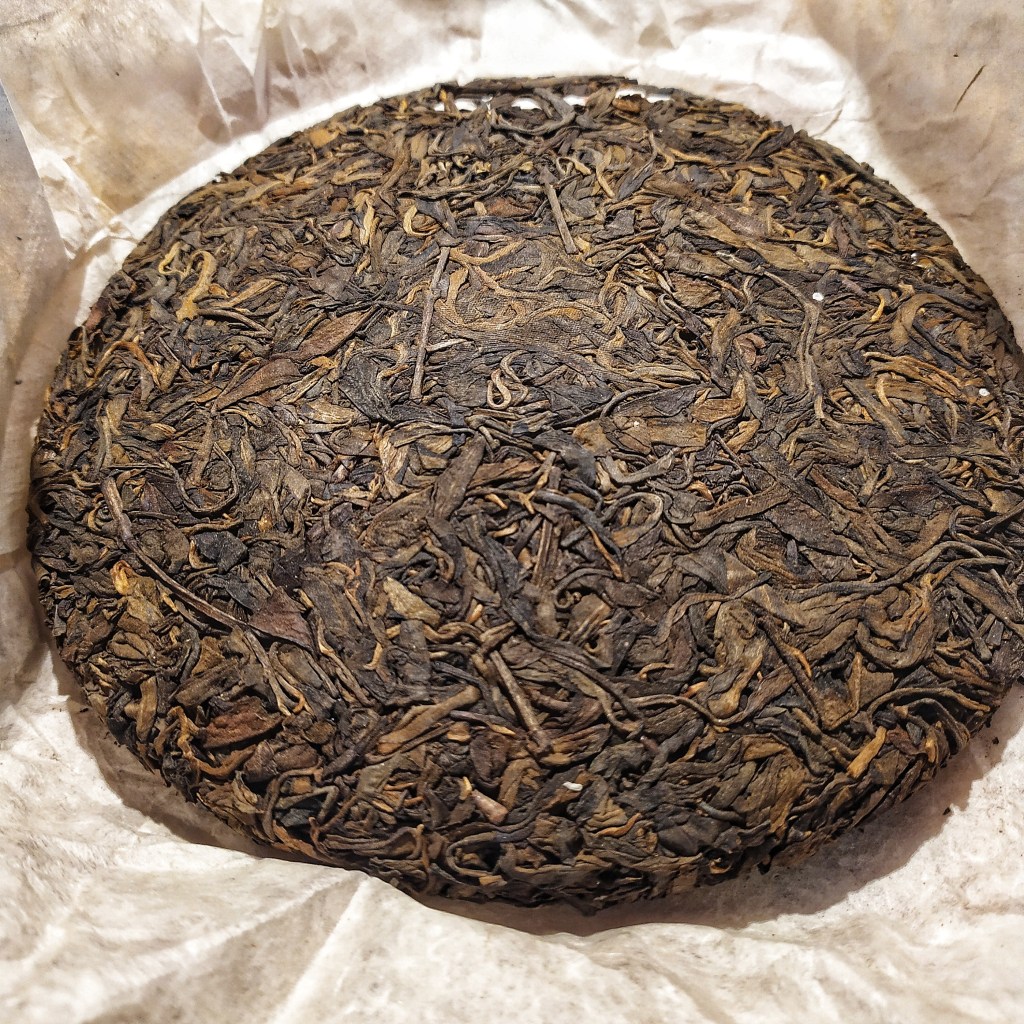
    P.S. the cake in the photo, although produced in Yibang, bears the symbol and style of the productions of Mr. Quen Cun An’s family (Quanjihao tea factory), who manage gardens throughout the Six Mountains, including Manzhuan.