Tag: mengla

  • Gaoshan, the village between uncertainty and change. Bitterleaf “Vision” Gaoshan sheng 2023

    Gaoshan, the village between uncertainty and change. Bitterleaf “Vision” Gaoshan sheng 2023

    Gaoshan is a village in the Yiwu area, a place where about 100 families live, mostly Yi, more specifically Xiangtang. The first time I saw a photo of Gaoshan it portrayed a child under a table and a woman in her sixties with a basket of fruit in her hand, behind her house, she had a stern face sculpted by hardship and dark loose hair, without any hint of layers, as if it were cut with a razor. One of those people who seemed to have never changed their hairstyle in their life or residence.

    Every morning she fetched water from the well, collected wild herbs, walking tens of kilometers in that rippled gorge, where the road appears like a clay snake running through the forest.

    The photo collection also included the dense forest of tea trees and fruit trees, on a periwinkle-gray afternoon, the kind that precedes a storm. The boy, about five or six years old, was sitting on the floor under the large kitchen table, partially covered by the cloth drapes that were not long enough to hide him, but long enough to make him feel hidden.

    I believe that at the time neither the woman nor the child knew how profoundly their village would change in the next twenty-five years.

    Uncertainty and change are to Gaoshan as a bell tower is to its church, its teas are often among the truest in Mengla because they tell of their time without resorting to sweeteners or nefarious adornments, they are the fruit of the virtuous life of the settled person, who beautifies and sanctifies a place that is his, the natural result of having roots in the place that gave you the first dawn.

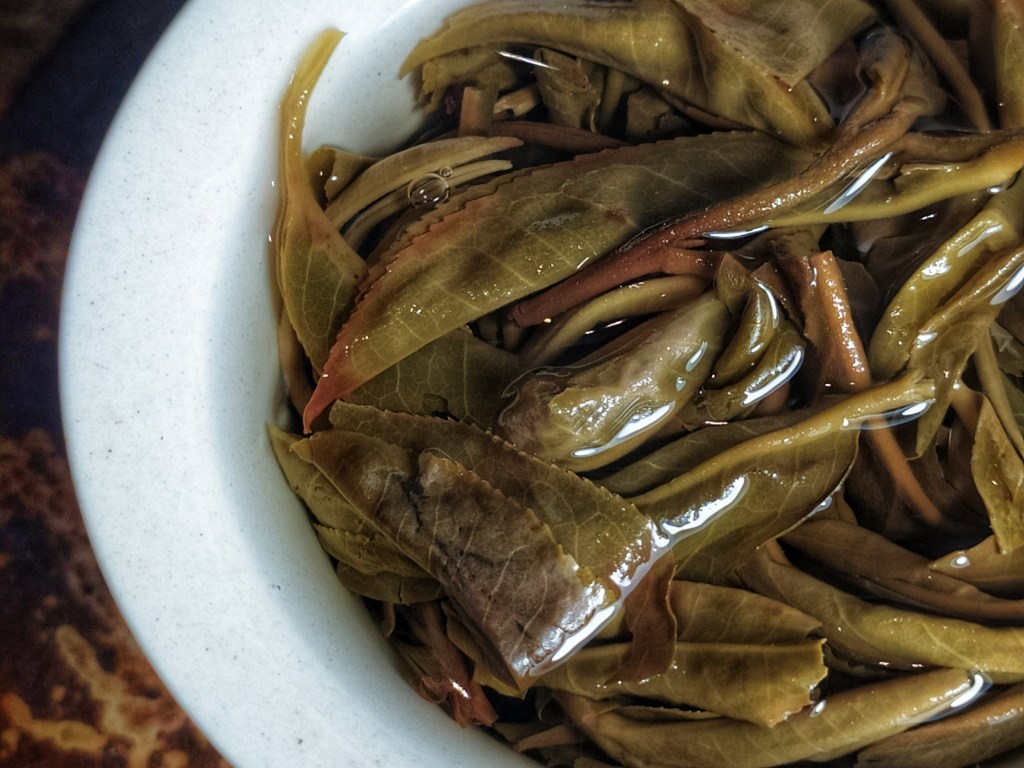
    The changing nature of this village can be found in this Bitterleaf Gaoshan sheng pu’er, where the aromatic fan seems to mark a new narrative trajectory every time we meet it in the gaiwan, the leaves are pervaded by a profusion of flowers in a wicker basket, but withered and in the process of changing clothes surrounded by a series of chiaroscuro, as only Rachel Ruysch would have imagined them, that battle of lights and shadows that package and give depth to the human experience.

    It is silky, complex, rich in notes of ripe fruit, such as white peach, mango, hibiscus, orchid, mineral sensations of wet lava stone, dried apples. From the first infusion you are enveloped by the honeyed and orchid sweetness typical of Gaoshan with a very nice huigan.
    The sip seems perfectly orchestrated in its essential elements but equally chaotic in its accessory elements, the way in which the aromas vary throughout the session creates a swing in which it seems to pass from one existential plane to another, from matter to concept, as in a mixture of science and spectacularization in which the result of the experiment is uncertain.
  • Discussing again about Yiwu and authenticity with a 2003 CNNP “Sheng Tai Gu Shu cha” via Camellia Sinensis

    Discussing again about Yiwu and authenticity with a 2003 CNNP “Sheng Tai Gu Shu cha” via Camellia Sinensis

    Almost 20 years have passed since the declaration of Yiwu as a “Special tourist village of Yunnan”, the program which aimed to attract more and more people to a city which was growing economically at a spasmodic pace and which was obsessively trying to make its authenticity perceived.

    Often this intention came into conflict with the reality of a territory profoundly transformed, by wealth, by the introduction of QS, by the architectural disharmony caused by evident asymmetries in the urban development and modernization plan. Shortly thereafter, the rapid and unsustainable rise of the pu’er business would have collided with the bursting of the bubble, raising not only doubts about the economic future of families but also questions about the true authenticity of Yiwu tea which until then had faltered.

    Those were years in which the vision was different, although not too distant from the current one, in which the importance of the object was provided by its price and not by its value, the meaning of tea was given by its correspondence to the useful; the forests, despite the already present distinction between them and the taidicha, were already utilitarianistically defined even before their understanding. While many farmers fought for their authenticity, just as many others built the stereotypes of heroic naturalism and “nostalgic” as a symbol of an identity that can be regained through tea, and clearly through its profits. “The truth” was not explored but a proud surrogate was created to be put on sale.

    For this reason, my opinion of many teas from the early 2000s is less enthusiastic than what is out there, many although not all were soulless teas, on which was placed a fake effigy of cults and traditions. Without the soul and its intention there could be no authenticity, because in this way the past becomes irremediably past, the mythologies that have passed through it become dull and irremediably dead languages, or in any case incapable of supporting that subtle kinship that exists between thinking and memory, between memory and identity and between identity and the authentic.

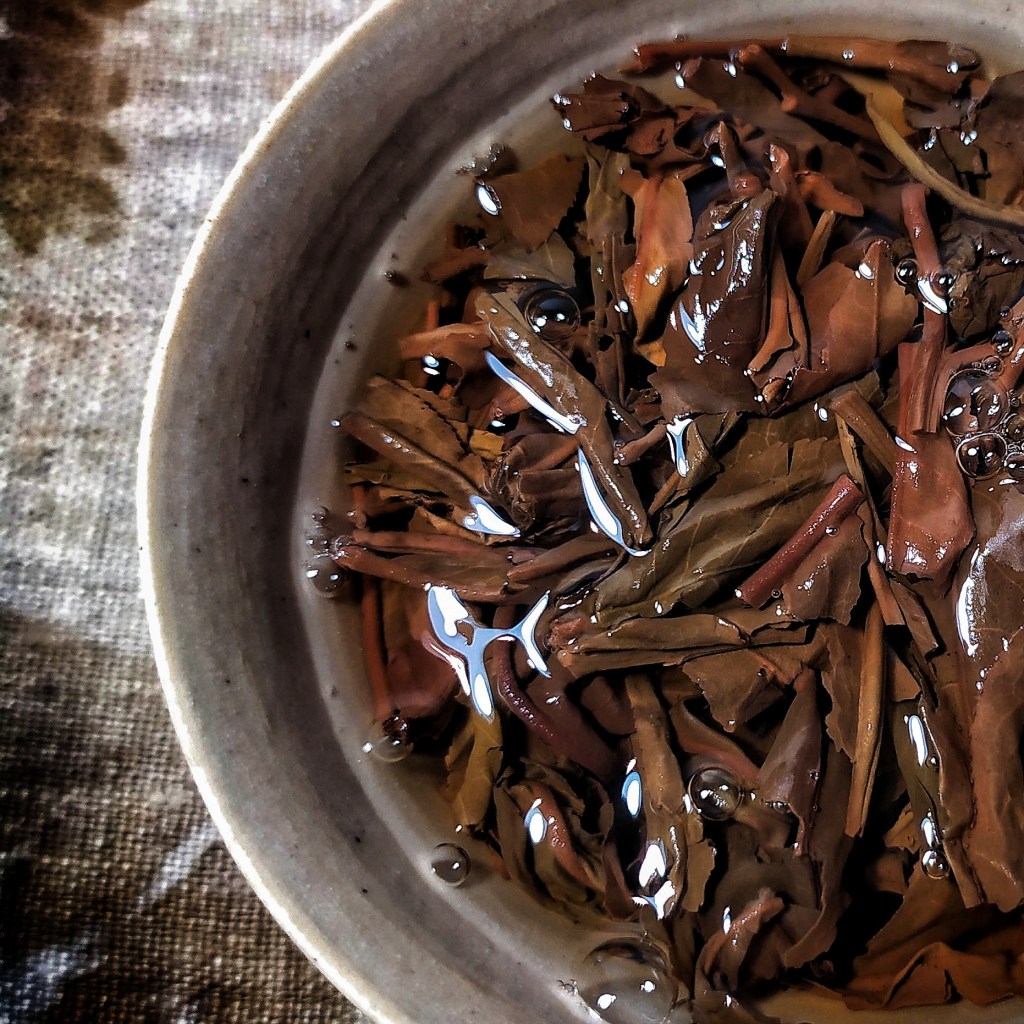
    This is a 2003 Yiwu pu’er “Sheng Tai Gu Shu cha” via Camellia Sinensis, in a CNNP label different from the typical “white and red zhong cha”, probably the result of an anonymous packaging from a small producer.

    One of the testimonies in a “unknown soldier” version of an attempted reconquest of “the authentic”, of the traditional taste that does not come to terms with the conventional. The leaves bring with them smoky notes, of vetiver and seasoned cedar wood perfumes. From the gaiwan come the smells of an ancient lutherie and those of an old wooden church.

    The aromas are reminiscent of dried flowers inside a book, evolving olfactorily towards notes of leather, virginia tobacco, incense, dried rose hip and pepper. The medium-thick sip ends on hints of tamarind, dried longan, dandelion root and medical herbs, fading into an ancient sweetness and granting a strong and focusing qi.