Friday never fails to ambush me with military precision, a shard of LED light that needles the cornea just as the blog-renewal alert detonates my hard-won, tax-season calm. I can’t remember the last time I lingered over a single tea. Perhaps the moment I proclaimed independence from performative tastings, a small act of mutiny against what Instagram has become: a midway of recycled meanings, its algorithms drifting steadily toward isolation and middling advertorial fodder, or maybe it was the darker undertow of existential unease.
Everything seems already said, about tea, about Pu’er, about teapots, each new sentence feels like drilling a dry well, an intellectual oil rush I quit long ago. Yet tea keeps seducing me. At dawn it steals into the room with the breath of damp undergrowth, commandeers my hands before I’m fully awake. That’s hyperbole, of course; most mornings begin with cold water in the face, then the office, the stench of burnt coffee and courtesy smiles fit for a character in Severance.
Still, tea moves me viscerally. In the sprawling, anarchic stack of cakes looming from the shelves, each sip is a small act of resistance against the world’s static. Writing has become a private necessity, a way to pry loose stories before premature cerebral rust deletes them.
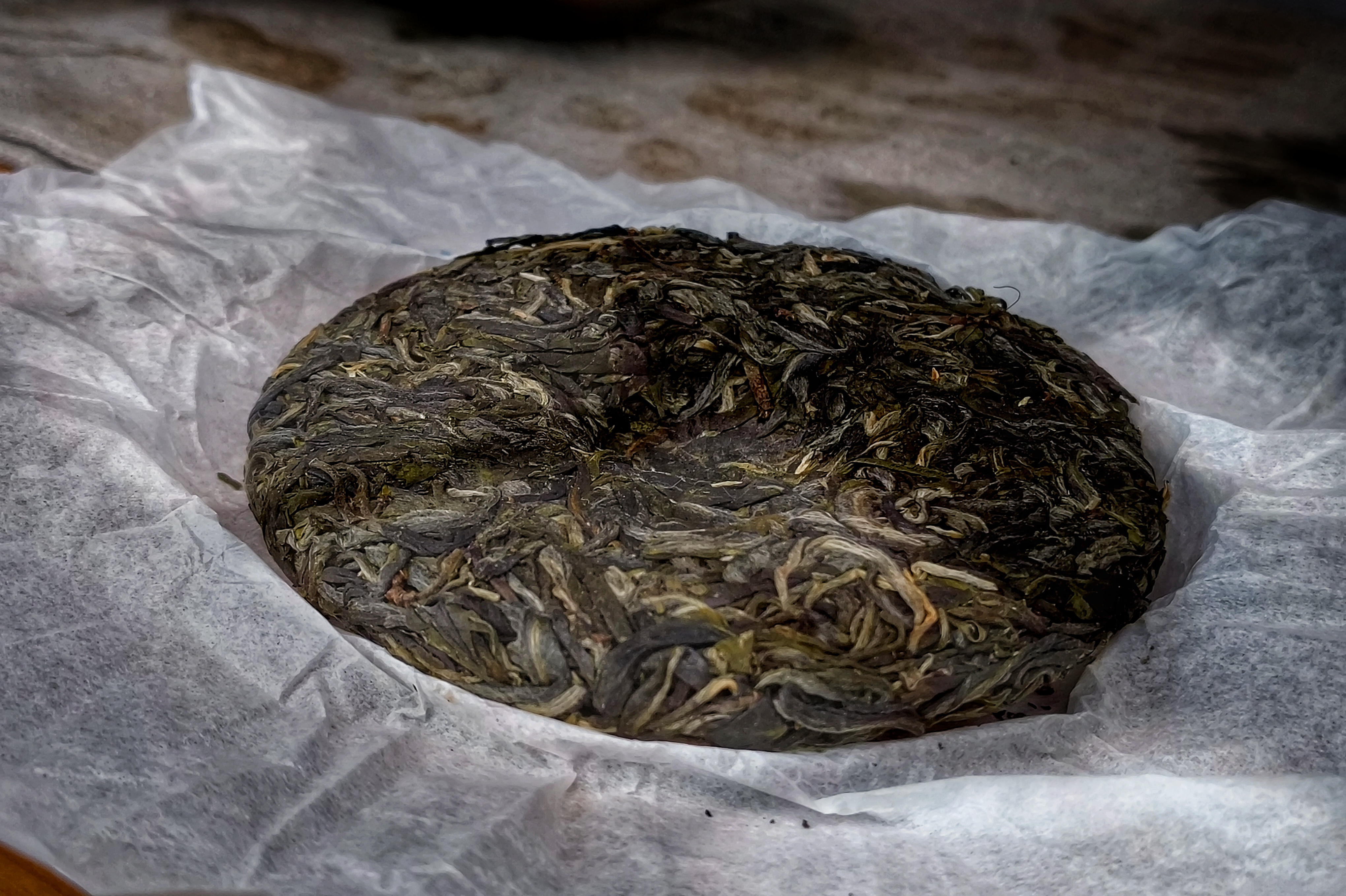
I think of this while I pry open a modest 100g Gua Feng Zhai cake, one I’d assumed desiccated by the parched air of northern Italy, where the weather is as unstable as Liz Truss’s cabinet. The first scent summons an obstinate old man I met long ago: hunched, wrinkled, spirited, flashing the few teeth he had like contraband. He reminded me of my grandfather, another riverbank curmudgeon, though oceans apart. He’d abandoned Sheng Pu’er after seventy, blaming sorghum liquor for his rebellious stomach.
We spoke of tea, yes, but mostly of the fragments he’d salvaged from youth, like how his father, Yu Senior, served in the logistics rear in ’39 while Japanese forces chewed through Hunan and Jiangxi toward the lower Yangtze. The old man conjured red-rice paddies where the smell of bruised grass mingled with kerosene and swamp rot; his father boasted that once shook hands with Long Yun and claimed familiarity with generals of the Kuomintang. To Yu the terraces looked like mercury pools, with the rice stalks standing at attention like soldiers waist-deep in blood; he recalled drunken sprints in the forest, collapsing against girlfriends’ bellies, a bottle of rice wine sweating in the palm as they trudged home from the factory.
Decades later, after the collapse of the Great Leap Forward, granaries emptied and markets dwindled to skeletal queues. Yu and his brother waded waist-deep in the canal’s narrowest throat, hauling up níqiū, “those idiotic serpent-loaches,” he growled, for supper. Evenings they gutted fish on elm stools, washing them down with tea and sorghum spirit. His wife, seated a short distance away, bent fish-hooks into makeshift needles and embroidered fields of millet on the threadbare fabric, sewing with fishing line instead of thread.
His village, he swore, produced the bravest and the crookedest, the finest lovers and the wildest drunks. He spent his last working years at the Fangcun market; he was there when the Pu’er bubble burst, watching price charts bleed the same crimson as his father’s paddies. I listened, sipped, and took mental notes, half-inebriated on rice wine, as he tested my liver’s resilience, clutching the bottle’s neck with his hands swollen by bulging veins, mottled and capped by knuckles the color of mother-of-pearl.
“Just wait, this quiet leaf always finds its voice again, the way my wife does after a quarrel; she can’t sulk for long,” he would say, letting the words tumble into a laugh that instantly dissolved into a tobacco-cured cough, as if his lungs were plotting an orderly escape from the cage of his chest and the habit that ruled them. One hand stayed clamped to his breastbone, as though bracing it against the strain.
“Blame the sorghum liquor, and those stupid serpent-loaches,” he added. Certainly not the thirty Chungwas a day drilling through his alveoli. Smoke had become the grain of every anecdote, a reminder of his father, who smoked opium but never let it own him. That haze was now a curtain behind which to duck from his wife’s scoldings, the latest triggered after he’d wandered into the fields alone and lost his bearings. It wasn’t the first time, but previously he had always found his way back by following the river’s murmur.
Amid that swarm of cigarettes, tea, and wry marital sparring, I learned to trust time, to let what matters breathe, settle, and finally declare its meaning.
Honestly, I’ve been looking for a topic worth an article for quite some time now. For the past few weeks my Instagram feed has once again been clogged with photos of old factory cakes and boutique brands whose teas easily cost more than a gastroscopy.
As I write this it is Sunday, and even though I don’t particularly care, somewhere in the nave of the church inside my head a patriarchal voice keeps echoing, suggesting that, just this once, I should not be as caustic, or, how shall we say, corrosive toward other people’s ideas.
I still haven’t decided whether to listen to it.
In any case, I often hear people refer to pre-2005 teas, or generally anything produced before the Pu’er speculative bubble burst, as a sort of baseline, a ground zero from which to build one’s knowledge. They are often accessible; sometimes you can find 15- to 20-year-old material at relatively reasonable prices, even if occasionally it feels like drinking a decoction of your own sweaty shirt, baptized by the humidity of Taiwan’s western coast. And this is the first principle of my disagreement. A logistical criterion (access) is often mistaken for an epistemic one (understanding quality). The fact that something is accessible does not make it instructive; it only makes it easy to build a theory around it.
Act I: the baseline. A “baseline” serves to calibrate sensitivity, language, and critical measure; it should therefore be built on samples that clearly represent key variables (raw material, processing, storage style), not on what the market makes convenient to buy in terms of quantity and price. One still hears the fairy tale that sheng from the 90s and up to 2005 were intrinsically sublime, but this is not always true, often it is simply mediocre tea swallowed at great expense, only to discover that it is worth little more than a drunken lost bet, and its chaqi will not save you from the terrible judgment of the Sabbath.
For clarity: chaqi exists, even if it lacks a clear and unified scientific explanation, but it cannot be what motivates a purchase. Tea discourse often turns mystical, full of “energy” and “vibrations”, frequently because a shared vocabulary for describing quality is missing. Chaqi may be a real, even if subjective, experience, but used as an argument it is often an easy escape hatch. As proof, it amounts at best to a personal impression elevated to a criterion.
00s factory teas mainly teach an industrial profile: standardization, blending, productive compromise. It is one of the worlds of Pu’er, but not the qualitative world of Pu’er in any absolute sense. That alone is enough to produce a distorted baseline. You grow accustomed to the “factory taste” as a norm and judge everything else as deviation.
Act II: storage. We know quite a lot about storage in general principles, very little about real reproducibility, and almost nothing about comparability between storage environments when data are lacking. There are physical principles, but also an absurd number of uncontrollable variables and complexities, and the whole discussion often dissolves into a broth of anecdotes and mysticism. Whenever I hear conversations about storage invoking names like Kunming, Taiwan, Malaysia, and Hong Kong, I feel as though I am witnessing an Allan Kaprow performance: no one understands what is happening, but everyone has been sufficiently involved that no one can criticize it.
Storage undeniably influences a Pu’er’s development and quality over time, one need not summon a climate physicist to admit this. Yet its impact is decisive even after only three years. At 17–20 years or more, especially with wetter storage, many differences in raw material and processing compress into a potentially generic profile. This always happens, it is biochemistry, though this does not mean all aged Pu’er tastes the same. Storage is excellent for understanding style and for objectifying a general aromatic dimension, but weak as a baseline for intrinsic quality.
Act III: aging. I come from the world of wine. Twelve years ago, before I began studying what Pu’er actually was, that’s where my free time went, along with a credit card financed by badly paid jobs. Among the initiates of the Bacchus sect one thing is clear: aging is not simply getting old, and aging “without collapse” is not the same as aging “with depth.” The same, frankly, applies to Pu’er.
Seeing vendors raise the price of unsold Pu’er after a single year already gives me gastritis. But when people identify “aging success” as merely avoiding decay, I feel certain dendritic networks in my brain quietly die. Aging, in the sense of maturation, cannot mean only that bitterness softens and edges round off. Aging is not mere attenuation. Quality, in its dynamic and evolving sense, implies aromatic layering, structure, intensity, huigan, persistence, and a clean transformation not excessively dictated by storage.
Act IV: prices. Tea was once conceived to be stored, not immediately consumed. Even my goat Violette understands this. And Violette knows that if the grass was poor when cut, aged grass remains poor grass. Watching her, one easily understands that the essence of mediocre things is marked in a subtle, almost existential way.
For years, until roughly 2010–2012, the Pu’er market priced time itself. Primitive, but effective. Now high prices follow expectations of material and origin, desirability, trust, social value, intentions, and all the things Tony Blair might have said to sweeten a policy for his electorate. In short: narrative.
I have never spent fortunes on old cakes. Not out of moral superiority, but suspicion. Or perhaps because I am not spiritually elevated enough to perceive what the fetishists of granny Pu’er claim to see. I see the risk of fakes, uncertain origin, possible smells of basements sublet for ransom kidnappings, people in windowless humid rooms swapping wrappers while smoking, selling rubbish for four-figure sums, and speculation about batch reputation formed long before the moment of consumption yet already determining the purchase price. A book on the economization of modern art would explain half the Pu’er market.
In some cases 80s–90s cakes have been among the most meaningful Pu’er I have ever tasted. More often, however, they have earned me a night on the couch and a bitterness in the mouth, the kind reserved for layoffs and extortion, lasting until morning.
Act V: historical-economic context. During the bubble, observers noted raw-material shortages and flows of maocha from border regions into Yunnan, with consequences for average quality and perceived authenticity. Combined with heavy herbicides and chemical fertilization spreading, drastic pruning, and new low-altitude, high-density plantations expanding since the 80s, it is reasonable to conclude that the Pu’er boom pushed toward compromises in material quality and left a large quantity of mediocre tea that has now reached us. This was not mysterious; it was the predictable behavior of a market convinced it had found an eternally appreciating good.
Factories are logistical machines. When demand rises and high-grade material is scarce, sourcing widens and more ordinary leaf is used. The result is not necessarily bad tea, but tea designed to be reliable, purposeful, not memorable for a few thousand obsessives like me. This baseline represents a supply-chain compromise, not a qualitative summit.
Look around: a great deal of old Pu’er still circulates, even in Europe, at crazy prices. Ask when you last heard someone speak negatively about those exact teas. Never. Either people lie, or they submit to the mechanisms already described here, or here. In perhaps 20% of cases the tea is genuinely good.
And here lies the curious point: often we are not drinking what survived because it was the best, but what survived because it was abundant or left aside in who knows what conditions. Or widely counterfeited.
Act VI: the disciples. Other people’s opinions are initially valuable and eventually dangerous. Understanding quality requires experience directed toward objective judgment, not passive adherence to an ideology. Accumulating recommended tastings is not enough. Today the idea of quality in Pu’er resembles a permanent biennale: much celebration, occasional sterile condemnation, and little critical sense. Direct experience is replaced by informal hierarchies, mediated tastings, questionable reviews, preferences learned before tasting. It is not deliberate deception but cognitive economy: easier to recognize a judgment than to form one. Thus a community of interpreters emerges rather than drinkers, a voyeuristic party rather than a participatory community.
Act VII: philosophy. Early in my Pu’er journey, drinking old teas often irritated me. As soon as one session ended something better appeared: rarer, more expensive, a batch from the cellar of some semi-mythical Mr. Someone had to be tried. The hyper-specialized vendors were like dealers in a 1970s novel, not selling a product but the possibility of never stopping.
It reminded me how, when I was younger, I had a vague idea that my sentimental education might be the result of a permanent structural dissatisfaction typical of the young middle class, a bohemian depression, vaguely Marxist at its origin, the kind felt by those who know they might not truly have it but choose to appropriate it anyway as a social role. A collective suffering based on the impossibility of reaching the next level, something to be simply accepted. Pu’er was exactly the same: happiness and remorse, desire and correction, like a nun who ardently longs for carnal sin and then runs to confession.
There was certainly repeatability and reliability in each cake, but reliability is not always positive when it becomes leveling. Small productions often vary within the same batch; that variation is the character of craftmanship, not a conscious and unconditional pardon of flaws, but an acceptance of random error and the human element. I had believed that, at least in a product like Pu’er, originally laden with symbols, people were not seeking serial reproducibility and technical anonymity. Factory Pu’er reduces uncertainty, avoids surprises, and allows a judgment consistent with what has already been said. It does not become a baseline because it explains Pu’er, but because it stabilizes the drinker’s experience. Yet there are those who consciously desire exactly this, and even appreciate it. Another shot fired at the memory of Walter Benjamin.
To escape the warm amniotic comfort of sterile criticism, a possibility exists: constructing a baseline “by matrix” and not by category. One learns nothing from merely drinking “good” teas. One learns only by comparing comparable ones.
Pu’er is a system of four macro-variables: material, processing, storage, and time. Evaluate them all at once and draw conclusions, it is like reading tarot, not tasting tea. A baseline built on old factory cakes fuses all variables. Excellent for consumption, poor for understanding.
Taste relatively green-processed samples from different regions of the same year. Try modern “honged” or “oolonged” shengs meant for early drinking: they act as reagents, revealing what happens when processing dominates leaf. Then compare teas from the same vendor or producer, stored similarly for 5–8 years and again for 12–20. Only then you will begin to see what time actually does. At least three of the four parameters should remain fixed.
Okay, it is not romantic, no mountain sages, no mythic wrappers, no secret Malaysian cellars guarded by tigers. But the differences become legible.
And here the strange thing happens: once you see the variables separately, much of Pu’er’s narrative evaporates, not because it was false, but because it was not knowledge. It was the socialization of taste.
We all know it: social networks always leave too much room for sensationalism. There’s endless space for anyone obsessed with sanctifying new brands and glorifying mind-blowing teas that promise an experience somewhere between spiritual awakening and a methamphetamine binge. A permanent pop-up of disposable enthusiasm. It’s the amusement park where anyone can feel like a prophet for a day, canonizing the newest square meter of the most remote village, where snakes, tigers, and giant beetles supposedly lurk ready to attack the tea pickers, only them, of course, not people practicing any other profession, before moving on without even bothering to stub out their cigarette in the ashtray of final verdicts.
Everything seems to shine, everything seems harmless, everything promises miracles, at least until you realize it was only a reflection, not the source. That’s life.
It has happened to me too: speaking too highly, too soon. But there is one terrain, one terroir, on which I’m not willing to make the slightest concession: Tủa Chùa.
From a mountainous rear area near the Điện Biên Phủ valley, where in 1954 the decisive battle that ended French colonial rule was fought, this region has become an enclave capable of producing surprisingly accomplished Pu’er teas. Many areas once considered marginal and reactionary, such as Tủa Thàng, turned into revolutionary bases, as they combined geographic isolation with strong social cohesion. The karst plateau, with its steep mountains and paths invisible to outsiders, offered natural refuge to high-ranking officials of the Việt Minh. They took shelter in the homes of Hmong villages, protected by the population’s collective silence.
The inhabitants knew the land intimately, guiding men, weapons, and messages along unmarked routes, avoiding French patrols and keeping the mountain areas connected to the Điện Biên valley. All of this unfolded in conditions of extreme poverty, yet they provided food, places to rest, and intelligence on enemy movements, accepting extraordinarily high risks. In those mountains, silence was a form of resistance, and the geography itself seemed to have taken sides.
Now, back to the tea.
If I had to explain to someone what true mineral, botanical, ancestral excellence means, if I had to make them understand what these trees are capable of, and why Vietnam today not only looks Yunnan straight in the eye but openly challenges its borders, I wouldn’t hesitate for a second. I’d pour them this tea. No preamble, no rhetorical acrobatics, no captions.
The way this tea is evolving is sublime, truly the kind of harvest you get once every five years.
I’m sorry to say it won’t deliver the tragic depth of Marina Abramović’s gaze, the high priestess of emotional intensity descending upon us mortals to elevate us by staring into our eyes like a corneal topographer.
What it will give you is a perfect sip.
This is a sheng with an almost exasperated intensity, like an overexposed photograph that somehow works. It lingers on orchid notes, though not like Jingmai, those notes seem wrapped in a dense, almost brooding forest aroma, the kind currently fashionable to flaunt when talking about Guafengzhai, but here they feel more arrogant, they slide under your skin with a needle’s quiet, deliberate precision, an elegance that’s both unsettling and strangely pleasant.
On the palate it’s viscous, medium-bitter, with barely perceptible astringency. The huigan is quick, floral, so persistent it feels more like a reforming than a return.
This isn’t a tea for fragrance addicts or niche perfume obsessives.
The qi is the real point here.
It’s a tea for those who recognize the exact moment when something slips in and changes you.
You don’t keep drinking it just for the aroma, you do it because a part of you has already been pulled in, and now it wants to know what will happen if you keep filling the cup.
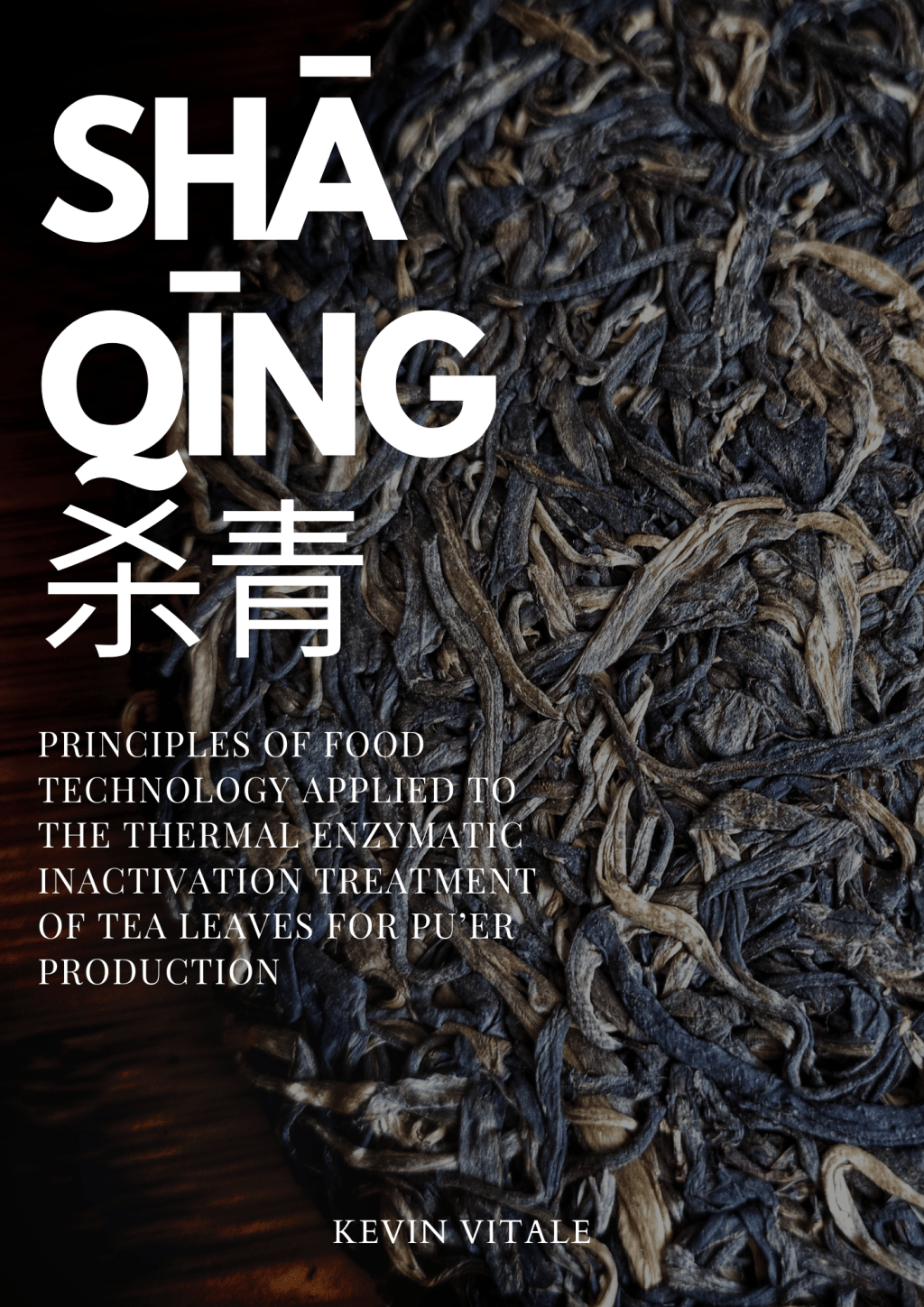
With this post, I would like to share the result of a project that has accompanied me over the past few months: a publication born from the desire to present, in an ordered and comprehensible form, the most significant insights I have gathered about the world of fermented teas.
More than a year ago, I began collecting material for a book that would include a wide range of information concerning the engineering, microbiology, and biochemistry of fermented teas. Given the complexity of the project, and unsure whether it would ever see the light of day, I decided to publish a preview dedicated exclusively to shaqing.
There are not many publications capable of addressing tea processing with clarity and rigor; even fewer do so in a way that is accessible and free from economic barriers. This work attempts, at least in part, to fill that gap by offering a starting point for understanding the complexity of production processes, particularly those of Pu’er and fermented teas.
I have always believed that knowledge, to be genuine, must be offered without ostentation; that it should serve as a space for connection rather than exclusion. For this reason, I wanted this excerpt to be freely available.
It is a gesture of gratitude toward those who have stood by me, toward those who are no longer with us, toward all who have contributed to the creation of this work, and naturally toward tea itself and the people whom, thanks to it, I have been fortunate enough to meet.
If you choose to read it, I hope you will find within these pages not only information, but also a measure of the care and passion I have tried to pour into them, and that you may feel inspired to share it with as many people as possible.
In the end, as often happens with traditions that endure, what truly matters is not merely knowledge itself, but the community that forms around it.
Below you will find the downloadable file, available in both Italian and English.
Usually, I would write about a place, a land, the wind disturbing the fragile balance of the hats of farmers bent by time and sciatica. I would use rhetorical tightrope acts that might seem almost contrived to some, or romantic and evocative to others. But this time I won’t do any of that, no recycled sensations, no stories about the battles in the Tây Côn Lĩnh mountains or about how this tea recalls that Eastern peace we like to import in small doses into our European afternoons, that peace found in watching Maggie Cheung walk under the rain while time slows down, when everyone holds their breath, diaphragm tensed, as absolutely nothing happens. Things that usually grant every tea a kind of added grandeur, a metropolitan dignity sweetened with a touch of neo-rural nostalgia.
I’m not John O’Hara, and I don’t think people care to see every banal gesture described as a moral battlefield. So, this is a sheng. We’ve more or less all arrived there. And if I stopped here, I’d already be more honest than most of contemporary gastronomic documentary.
But I believe this is one of those few Pu’er teas that doesn’t need me, or my words, or anyone else’s, to be understood. Roland Barthes saw in photography two fundamental aesthetic elements: the studium, the set of information one needs to know, and the punctum, the element that wounds, that seizes attention and couldn’t care less about the rest, about its translation into prose; it just arrives, contracted like a beast.
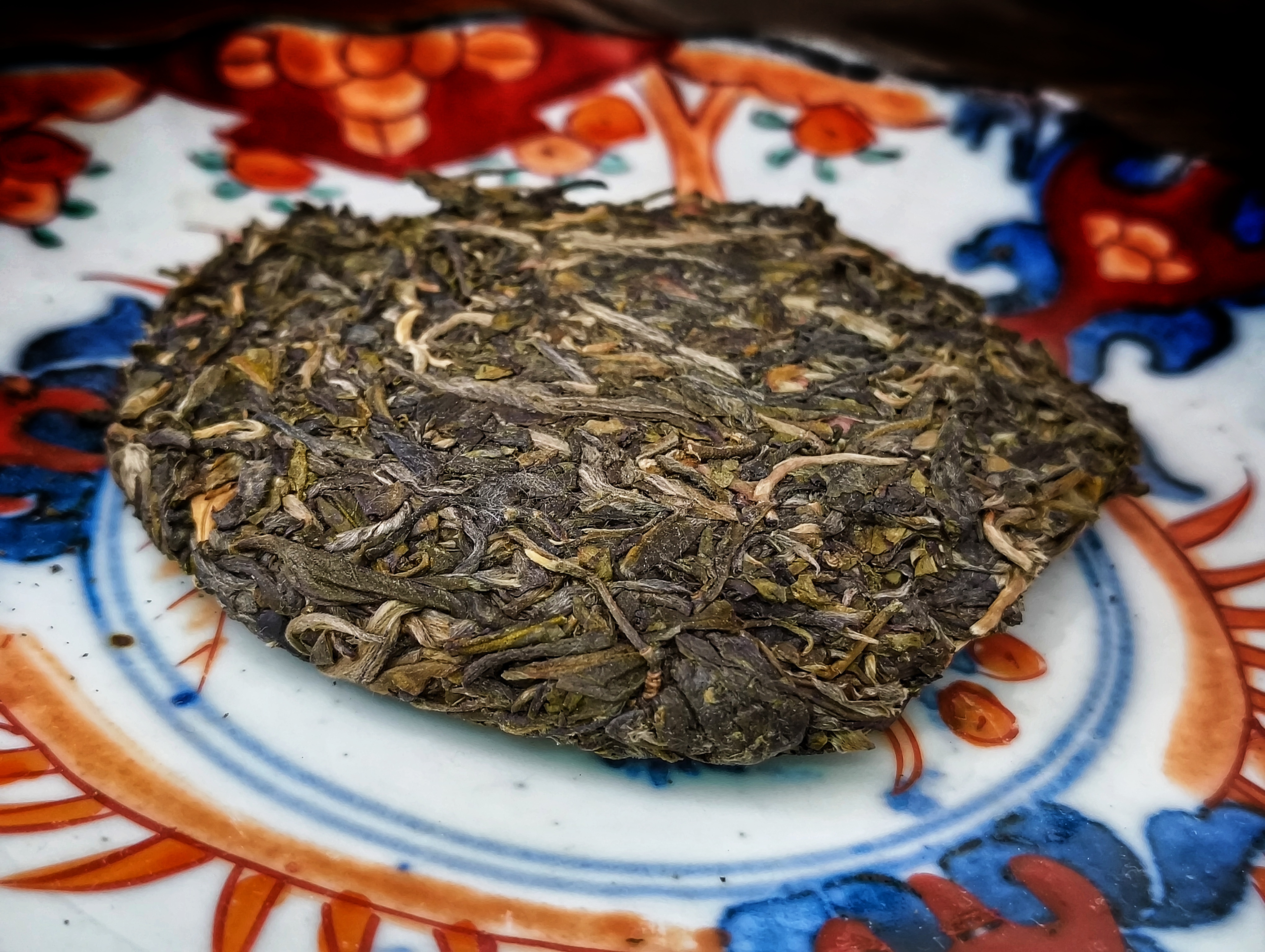
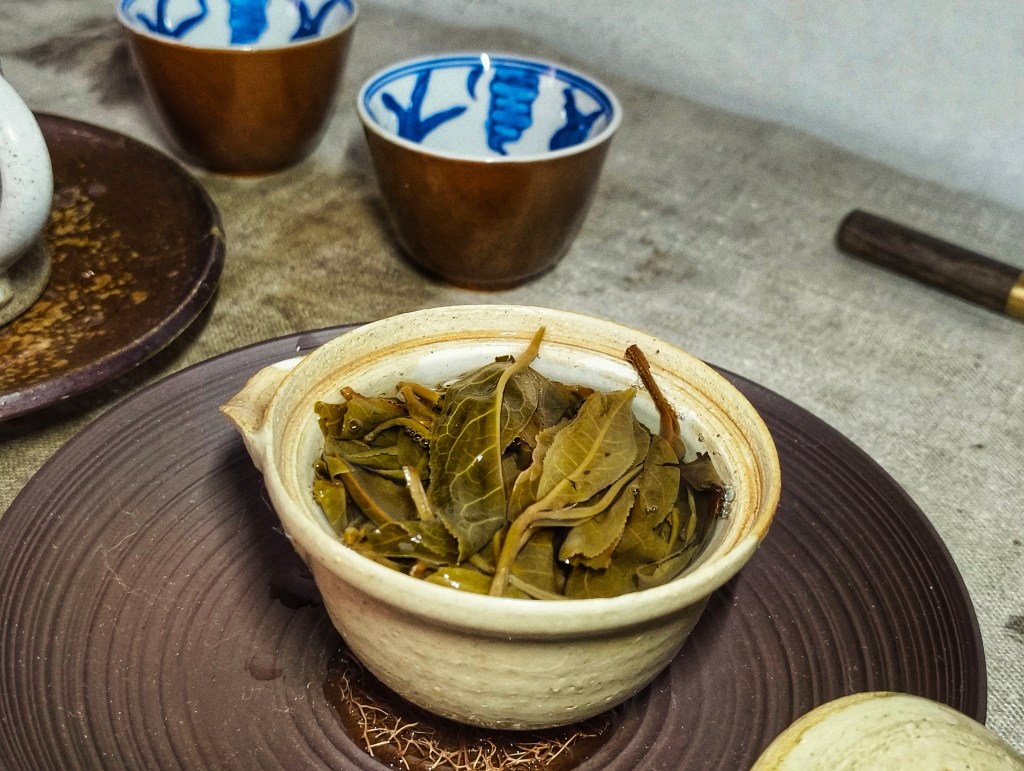
It’s in its wet leaves, tremendously fruity and earthy at once, in that quarrel between magnolia, orchid, dandelion root, and Tellicherry pepper that the punctum arises. Barthes would say it’s in that absurd moment of unconditional pleasure that meaning breaks and truth seeps through, like a development flaw on a film roll.
This ancient tall trees tea it’s a bomb wrapped in silk drapes, almost nervously delicate and at the same time powerful. It’s a sip of terroir served at a hundred degrees; it has everything that remains when you strip away the narrative. The texture is medium-soft; it tastes of pepper and wildflowers, white grapes, juniper, it tastes like that childhood photo with the grain too visible, the one you wish you had but that someone is now romanticizing somewhere on Netflix.
The qi leaves you with a strange calm, almost clinical. The huigan is excellent; the bitterness is low, the astringency absent. The persistence is long, the sip seems to linger there, clinging to the squamous epithelium of your throat like a gentle remorse.
When a person starts consuming a lot of tea, and at the same time begins spending significant amounts of money, creating those situations where every online purchase takes on, in their mind, the aura of a bid at Christie’s for a Rubens painting, sooner or later, the people around them will pose the classic question: “That 20-year-old tea, aged, stale, with a questionable aroma to many, costing $3 per gram, is it really worth that much?”
As I wrote in a previous article, we are all touched by the rough hand of “the psychopolitics of consumption.” Whether we like to admit it or not, price becomes a revealer of a kind of pseudo-truth, colonizing our sensations and emotions to the point that we start believing that the object bearing that price tag is somehow from a higher reality, a vehicle of a superior sensory condition.
In recent years, I’ve noticed a certain invasion of the market by cakes from producers like Xi Zi Hao, Bao Hong Yin Ji, Chen Yuan Hao, and all these boutique brands you’ll see featured in at least two or three posts a day on your Instagram feed. These aren’t brands that appeared yesterday, to be clear, but lately there seems to be a kind of viral obsession around them, adorned with a certain propensity for sensationalism.
During a tea session I attended a few days ago, many people expressed an almost frantic desire to purchase cakes from these brands, like Bingdao and Bohetang from these brands, which often sell for at least $1,500-2,000 per cake. The central discussions weren’t about their quality, but rather about how to access them: where to find the best deals, how to split the tea, as if divvying up the pages of a first edition King James Bible. At a certain point, that room full of tense faces had turned into a kind of collective purgatory, where everyone was trying to convince themselves they had enough credit to justify the expense and finally ascend. In that moment, we all could’ve been perfect subjects for an Eve Arnold photo series titled Misery and Desperation.
Now, setting aside this acute exposure syndrome toward certain brands, many were convinced that these teas would be a kind of revelation, finally pulling back the curtain on some mystical conspiracy, offering access to the long-hidden “truth of gushu”. These Pu’er teas are expected to be two or three times better than anything previously experienced, but at ten times the price. Throw in some old Red and Green Mark cakes, and you can add another zero to the figure.
So, is it really worth it? Judging by this ratio, apparently not. But if we followed this logic consistently, we’d never do anything but embalm ourselves while waiting for the final sunset.
So my answer would be: it depends on your income. If you’re not wealthy, live in a place where inflation is sky-high, and the price of a cake equals a month’s salary, then maybe you should think twice. For that same amount, I could buy an 1800s ceramic piece, plan a vacation, purchase an incredibly satisfying tea, and get my girlfriend a gift, all at once. The point is: while there are plenty of mediocre teas out there, there are also vendors offering both aged and fresh teas at human prices with truly excellent quality. A lot has changed in the past 10 years.
Why do I say this? Because over the past decade, I’ve simply come to understand that buying tea shouldn’t be a personal financial shipwreck.
It’s true that, like many other things, tea is subject to imitation behaviors. Many chase after a brand like starving wolves, simply because someone deemed “credible” for whatever reason says it’s good. The risk of confusing what we genuinely desire with what we’re unconsciously pressured to desire is always lurking, especially in an era where desires are not allowed to settle, to decant, to shed the tension of ownership imposed by a third party. A hobby always risks becoming a vice, a dependency. But tea doesn’t have to be that. We need a lateral approach, not in opposition to the market logic, but in deconstructing it and using it more consciously.
Mixing a bit of Baudrillard with a touch of Byung-Chul Han, we get an answer to this exhausted system of tasting, not of tea, but of signs. By always chasing the newest tea, the most expensive one, the one from the most remote and romantic village, fueling our hunger for the “authentic taste”, we risk entering into the realm of simulation, where the experience isn’t real but positional. One drinks something not for the experience itself, but to feel like someone in comparison to others, to position ourselves next to those who told us this tea would open our minds. Only to eventually realize, of course, that it’s just tea. Most of the time, it will always just be tea, excellent, magnificent even, but no price or opinion will dictate how much it will truly move you, or how good or special you’ll find it.
With time, you might discover that the most special, moving teas, you won’t even remember how much you paid for them. But your spouse will remember that -$2,700 transaction on June 10, 2013, for 357 grams of an obsession even you can’t explain. They’ll remember it better than your wedding anniversary, regardless of how wealthy you are. In that moment, You, Me and Dupree starts to seem like an overly optimistic romantic comedy compared to your personal film: You, Me, and a 2006 Yang Qing Hao Chawangshu, a title too long for Netflix, and too depressing to laugh at, accompanied by the muffled sound of the kettle and the silent judgment of someone who loves you despite everything. DESPITE everything.
On top of that, there’s a mechanism I find frankly perverse. Maybe it exists, maybe it’s just a product of my twisted, overly analytical mind, fueled by neurotic narcissists and the wrong reads, but it might be interesting to consider what Zygmunt Bauman described as planned obsolescence. According to this concept, a prepackaged emotional state is created, leading to affirmations like: “This tea will be the one.” “This time I’ll understand.” “This time I’ll be worthy of grasping ancient tree Pu’er.” “This time… this time…” and so on.
This generates a renewable insecurity, where every piece of information, every certainty, has an expiry date. You feel the need to try an endless number of ultra-expensive teas, each one meant to construct a kind of symbolic refuge. It’s a sneaky and refined mechanism, if you think about it. It creates a form of outsourced desire, where you move from wanting to know to desperately seeking new stimuli and confirmations, eventually imposing upon yourself the need to desire, becoming a co-author of your own subjugation.
You’re not forced to want the $2,000 tea. You convince yourself that it’s your mission, because you need to feed that pit bull that is your craving for apparent knowledge.
Of course, this doesn’t apply to everyone, but I think it helps explain many of the neuroses people have in the tea world, especially at the beginning, and particularly when they don’t have a lot of money to spend.
I’ve tried many of those teas over the years. Some were excellent and are now gone forever, many I don’t even remember drinking, and others are still there, parked like a lover in the usual hotel room, who’ll never see you walk in again. That’s because, more often than not, I end up choosing something comforting and far less expensive, something that doesn’t require a transcendent atmosphere to enjoy a dozen infusions. Something that, for many reasons, some even objective, I enjoy more.
I don’t think I’ve reached that “ethics of conscious consumption” Bauman might have described, but I’ve simply chosen to be happy drinking great tea without going broke. I’ve discovered there is no upstairs level of happiness hidden behind those cakes. Their Qi is not an LSD trip, their huigan won’t unlock some little door to enlightenment, like a Mulholland Drive sequence where everything suddenly makes sense and terrifies you, and their great health benefits won’t cure your diabetes.
For some, seeing one of those ultra-fancy cakes resting on an expensive rosewood table is akin to a primal carnivorous urge, like spotting a wounded animal lying on the ground. But I think I’ve become disenchanted with that kind of thing, I’ve, shall we say, gone vegan.
These days, I find much more pleasure in discovering unknown names, new vendors, trying teas from new regions and countries, things without pedigree but with substance, without external contamination, without info sheets or anything that triggers my annoying jaw tic that accompanies every sip of a $50/session tea.
Maybe that’s what marks the transition from novice to some kind of post-adolescent maturity in tea drinking. Or maybe it’s just the prelude to the collapse of my mental health, and soon I’ll be sipping mallow infusions in the grip of some hormone-fueled delirium. But I’ve found that this approach lets me evaluate teas more freely, more objectively, and in many ways, even more scientifically. And above all: it’s made me happier.
If you ask many people what their favorite production area is, they’ll probably start listing off famous terroirs, Bingdao for its body, Laobanzhang for its qi, Naka for its fragrance, and some remote shack in a forgotten Yiwu village, which never hurts to name-drop. In short, a litany of names, as if it were a medical prescription for some trivial pathology to be handled with grave care. Or perhaps just another way to show how worn out the magnetic stripe on their credit card has become.
Jinggu likely won’t even cross their lips, not even by accident. This area is surrounded by mountains on three sides, an enclave where the best gardens are often inaccessible, and where the obsession with naming every single rooftop (as in Yiwu) is quickly anesthetized by a lack of roads and the even greater lack of desire to build them. Here, not even the clunky two-ton electric behemoths at the service of Western merchants can climb their way up.
I agree that vast expanses of flat land, dull stretches of agricultural functionality, are today brutally carpeted with Da Bai Cha, as in the flatlands of Wen Shan Ding. A cultivar that acts like a funerary carpet, its tea merely a collateral damage, a distillate of hardship and credit requests, with a hint of bank loan in the aftertaste. But if you start climbing and forget all that, you’ll reach over 2,000 meters at Kuzhu Shan. There, ancient trees stretch in swathes; in some spots, they’re even Teng Tiao, like in Banuo, but with a slightly different aromatic profile, less delicate, more fragrant, impactful, and mineral. Less mannered, and more Felliniesque, to put it simply.
Some time ago, I met a Pu’er expert, a merchant from Lincang whose main business revolved around the Fangcun market. I asked him why he thought people considered teas from Jinggu less worthy, almost like children of a lesser god, tolerated but avoided, like the uncle with a drinking problem at Christmas dinner. He was a big man, with hands the size of shovels. He stared at me for a moment, with his huge, isochoric pupils, maybe the largest I’ve seen on someone from Yunnan, wide like those of an Australian owl photographed by Joel Sartore, performing tiny mechanical micro-adjustments every time you locked eyes with him, as if missing an autofocus. He answered in monosyllables, he looked like someone who read Anna Karenina just to root for Vronsky. He smiled too, but it seemed like his facial muscles were slightly jammed from decades of monsoon rains. And yet, he was one of the most knowledgeable people on Pu’er I’ve met.
It took him a while, then he said something, I don’t quite remember what. I was too busy noticing the irrelevant details I’d later include in this article. But the meaning behind his cocktail of anthropology and Moutai was clear: Jinggu was guilty of not being immediate enough. Too real, too unavailable. Add to that the fact that the era when people chased uniqueness has been over for a couple of decades. They discovered the villages of Yiwu, Laobanzhang, Bingdao, a few others in between, and the punch bowl quickly ran dry. Because, you see, he said, the markets want exclusivity. The consumers who arrive in polished shoes at the edge of the forest, who slip on plastic sandals before posing in front of an ancient tree, are looking for tea like they’re looking for sushi in Berlin.
And he was right. Some want only the illusion of a mysterious narrative, not the truth of the land. They prefer a tea that behaves like a cool, aloof actor, properly trained to play the silent type, the tormented one, the aged-in-a-hut-with-a-hidden-past role, rather than someone, or something, that simply tastes like what it is.
Jinggu teas aren’t for complexity maniacs. They’re rather blunt, direct, break through your guard with a few solid punches, enveloping you in sweetness and asserting themselves through their huigan and bodily sensation.
In the Kuzhu and Tang Fang Liang Zi areas, you’ll find real forest coverage where tea is harvested, like some portion of Yiwu, the northwestern edges of Laos and Vietnam, or the forested zones of Guogan in Myanmar. Here, the trees grow close to and inside the forest. The soil is clay-based with a good amount of rock, confirming the tea’s mineral and sweet character. The plants are spaced well apart, and younger trees are left to grow naturally. You won’t see any drastic pruning, only containment cuts.
It’s a complex terroir. In one cup, you’ll think you’ve stumbled into Jingmai. Drive twenty kilometers and drink again, you might swear you’re tasting Yiwu. Walk another ten, parched and hopeful, and you’ll find bitter cultivars whose huigan is so forceful, so magnetic, it makes some Bulang teas feel like passive-aggressive outbursts by comparison.
Here, like in Laoman’e, bitter and sweet varietals sometimes coexist in the same natural amphitheater. The former, known as kucha, often dominates the more remote slopes, but it’s never overwhelmingly bitter, never out of place or chaotic. It soon turns its cheek to a wild sweetness, like a fist on the table that prepares the caress. If the sweet variety is a well-composed, harmonic melody, the bitter one is drama and catharsis, leaving every door open for further development. These are teas that, even years later, remain an enigma. Tasting them again over time is like revisiting a neighborhood in daylight where you partied in the night before. You barely recognize it, and the sunlight seems to restore a grace you previously failed to notice.
In both cases, what stands out is an oily, umami-like sip and a genuine, full-bodied chaqi, it feels like it thins your tissues, filling your chest and pushing every muscle fiber up against your skin. A tea with a soul that doesn’t scream, but also doesn’t compromise. A tea you don’t expect, and which, especially in the case of ancient trees, hasn’t been tamed to soften its impact.
Southwest of Jinggu Town lies Jiu Tai Po, one of the most expensive and coveted areas, graced with the elegance of something that knows how to stay hidden. Few signs, no selfie points, no desire to be disturbed more than necessary. The village itself, small and vaguely adrift in agricultural amniotism, has little tea directly surrounding it; most of it is in the forest zone, along the ridges or on the opposite slopes. Road access is practically nonexistent, and like Guafengzhai, it takes hours of hiking to reach the tea trees. These aren’t roads for people in Italian leather shoes, and a camo cap won’t get you to the top. The landscape feels like a James Cameron set, shot with Kubrick’s cinematography and directed by a mood-swinging park ranger. There, the leaves aren’t picked by good boys, but by madmen, neurotics howling at the moon, yelling into the western wind, and probably monks armed with faith and an unearthly amount of patience. Climbing up there feels like trying to earn a glance from Maria Callas, flailing pathetically to grasp the corner of her eye, she ignores you, and you thank her anyway.
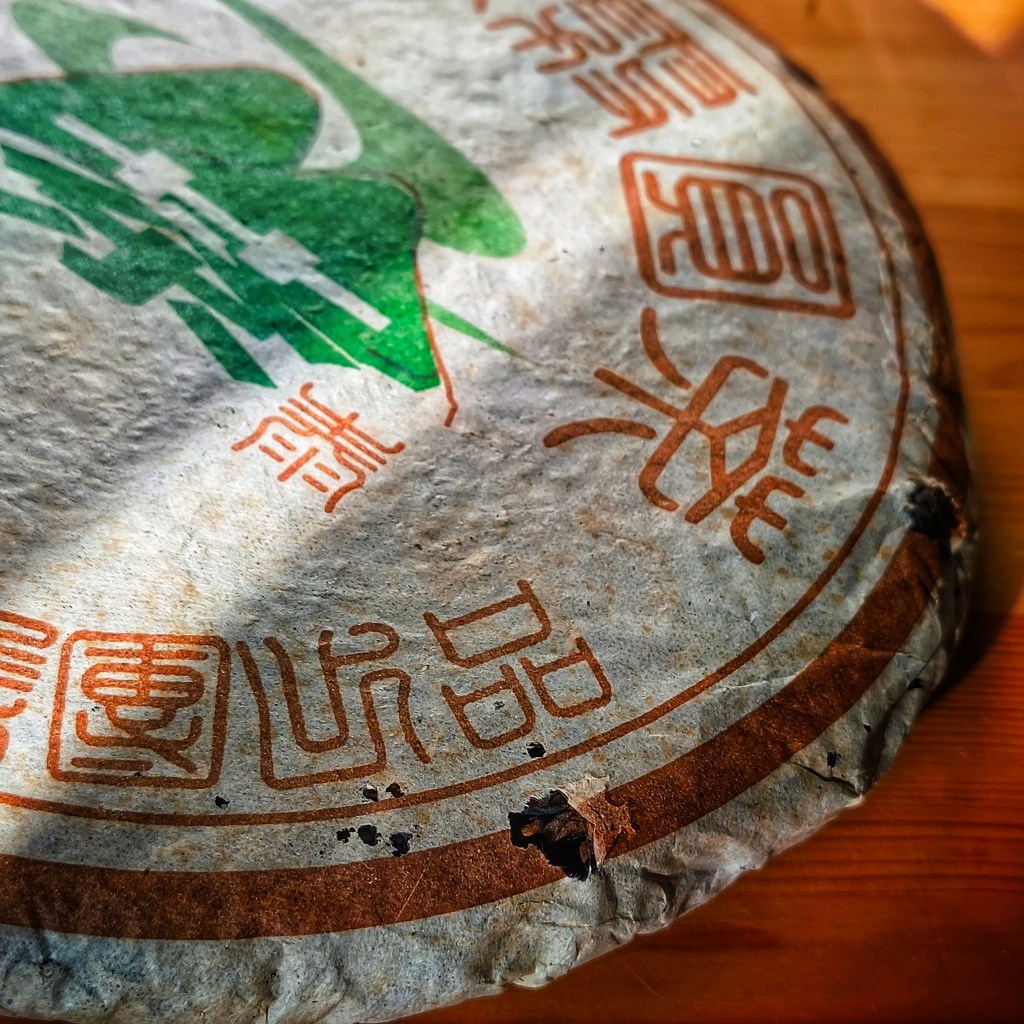
In recent years, Jinggu has had its big moments, times when even the cynics had to admit that yes, even from those mountains often relegated to Act Two of the Pu’er narrative, something remarkable could emerge. Like the Pu’er from Tang Fang Liang Zi by Farmer Leaf, especially the single tree series that reads like an elegant lithograph set by De Chirico; the 2017 Chawangdi or the 2016 You Shang from Chawang Shop, perhaps among the Western forerunners of Jinggu’s nouvelle vague, to the 2007 Shang Pin by Xi Zi Hao or the old relics from Changtai, old-school, decadent, like an old house with silk on the walls, with the scent of leather and creaking parquet.
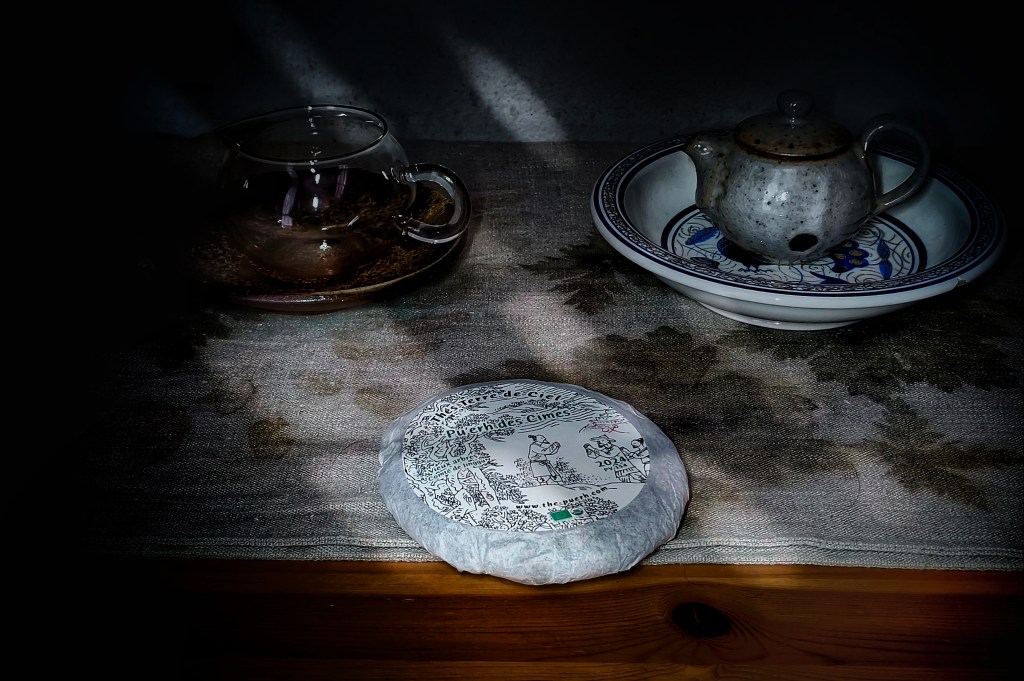
But today, I’ll focus on two other excellent sheng Pu’er by Thés Terre de Ciel, both from old-ancient trees.
TdC Spring 2024 Xiao Jinggu Puerh des Cimes
I’ve always had a soft spot for the Pu’er of Jinggu, for their remoteness, their distance from the inflated rhetoric about the primordial nature of its landscapes, for from the market wars over taste profiles and terroir cred. Jinggu teas owe nothing to expectation; they answer only to themselves.
This is one of those teas. The kind with no prefabricated image, no guiding archetype. Nothing to anchor your imagination, no Muse whispering interpretation in your ear, as Hesiod might have hoped. Just you and the leaf. No crib sheet. No narrative. Only the moment.
The leaves are twisted, dark green. The sip is viscous, with a round, sticky umami reminiscent of chicken broth from a market stall in Chongqing. There’s a sweetness too, unopposed and undistracted, a sensory monologue rich in subtext. The huigan lays itself across the tongue like a seamless silk blanket. Bitterness exits the discussion early.
The Qi is delicate, but it moves under your skin, subtly shifting your posture, your pace, your pulse. The salivation it provokes becomes a kind of gustatory capital. The sensation is almost organic-minimalist, like an alabaster vase with no sharp edges, revealing more intentions than it cares to admit. The intensity of the peach note approaches something like an orchestral delirium, building in a near-psychedelic crescendo, and that out-of-the-ordinary umami makes it feel less like a beverage, and more like a pre-dessert at L’Arpège.
TdC Spring 2023 Kuzhu Shan
This Pu’er from Kuzhu Shan seems like it emerged straight out of a William Morris wallpaper, drawn after two glasses of fine Vin Jaune. Alienated, eclectic, remote, saturated with organic vitality. The dry leaves exude hints of light tropical fruit, citrus, and wildflowers. As expected, this is not a tea that lingers in a labyrinthine dimension of complexity, but that’s not the terrain where Kuzhu teas show their hand.
The true opera magna takes place in the mouth, which becomes the theater for a clash and debate between a pronounced yet agreeable bitterness and a sweetness that follows quickly, almost antithetical to it. It’s a generative tension that drives this medium-bodied sip to evolve, to layer itself, each new sensory stratum tearing apart, cannibalizing the one laid down before it.
The tasting unfolds as a kind of sensorial acceleration, like a Baz Luhrmann film, abrupt cuts, frenetic pacing, a hyperactive montage, leading to a terribly refreshing, surreal sensation with an unmistakable note of tonic water.
It’s a Gin & Tonic stripped of its damnation, as Nick Carraway might say while struggling with his addiction. This is a vividly alive liquid, whose finish is so enduring it seems pointless to measure. It unwinds slowly on notes of ginger beer, candied lemon peel, and rhubarb, while your tongue’s receptors are still stunned by the mineral lash it dealt twenty minutes earlier.
Usually, when I drink a Pu’er, I think about its aging potential, its price-to-quality ratio, I imagine derivatives and equations, risk and return curves, asking myself whether it’s better to keep it for the medium or long term. I make a lot of projections, hypotheses, even metaphysical guesses.
But the truth is, this is one of the few teas where none of that matters. I drink it because it’s simply really good. Whether it lasts twenty years or disappears in two days, for once, I really don’t care.
In Sanmai, the harvest embodies collective power, it remains there, sedimented, like the slow burn of an inexhaustible cultural fire. It reemerges in the ritual act, with the tension that grows as the air’s humidity rises, escalating like a migraine that starts at the base of the skull and radiates to the eyes. Hope mingles with the fear that the rain might arrive at the wrong moment, transforming the river into a clay demon and the crumbling mountain into an army of rock.
Here, Mengsong seems to speak through the very stones of the houses. And what it says is not just a verb numbed by modernity, but an echo that comes from far away, from a larger world, perhaps lost, but still alive in the people. It kindles itself on the walls, becomes flesh, becomes identity. The fragile power of its tea is like the fire in Ella Fitzgerald’s voice resonating in the aorta. You cannot ignore it.
These are not odes nor exercises in writing. This is ground zero of the attempt to understand. To truly come into contact with a tea that hides in sensory detail, that, like its land, wears you down and demands understanding at the edges of perception.
This danzhu from Thés Terre de Ciel is a truly unexpected tea, unsettling in some respects. We are often accustomed to teas from Naka, Benglong, Bameng, with their floral, sometimes fruity, gentle characters. But Sanmai doesn’t play with gloves on. It is a clean, precise, yet powerful tea. The Qi is profoundly forest-like, dense, almost physical; it seems to influence every mechanoreceptor. You feel it in your hands, your legs, your stomach. It seeps into the nerve plexuses, as if the body were enhancing the perception of every distal extremity, of each of its boundaries.
The huigan is long, incessant. It lingers. The bitterness is there, but it doesn’t last. It retreats quickly, making way for a mineral, almost effervescent, electric sensation that settles on the sides of the tongue, along with a sweetness that makes no compromises. Salivation is continuous, rhythmic, like waves that come without pause. Like the crowd at Glastonbury, a constant flow. Every infusion up to the twelfth is a tactile theater, alive, dense, full. No drop, no faltering.
The question most of you are probably asking after the philosophical and ideological discourse of the first part is: how important can the implementation of a system based on rural architecture be in economic terms?
Quite frankly, I am not an expert in land finance, nor do I wish to replace those who work in that field. I’m a food technologist: I work with food, I analyze problems and find solutions related to it. By nature, I tend to understand why mechanisms jam and how to intervene to restore their proper function. So what follows is an analysis based on much of the literature I’ve explored over the past few years, not professionally, but driven by a genuine desire to understand and a deep personal curiosity. I’ve never liked pointing out problems and then standing back while others fix them, even when I had no idea where to start to piece things together. That’s why you won’t find ready-made solutions here, but rather some reference points for building your own awareness, an awareness that can only grow.
Before understanding how vital it is to support rural architecture and safeguard architectural cultural heritage, we must grasp how important the real estate market is for China’s economic growth.
China’s economic development has always followed a dual-track system. Without public housing, no “transformation” would have been feasible or even conceivable. In this model, the tracks are not parallel but sequential: public housing comes first, followed by the market. As a result, the health of the second depends entirely on the first. This is the main difference between China and Singapore, or China and the rest of the world and it explains why housing policy has had such a strong impact in China. It also helps us understand how the greatest forms of resilience, whether in the face of internal crises or external shocks, were triggered by shifts in the central government’s approach to real estate. First in 1990, with the provisional regulation regarding the granting and transfer of state land-use rights in urban areas; then the 1998 housing reform that allowed a huge number of families to acquire necessary goods, including homes, laying the foundations for the current urban middle class. Finally, the pre-2008 policies that prevented China from being swallowed up by the global financial crisis, such as the mandatory implementation of the “831” policy on land sold through public bidding, which brought hundreds of billions of RMB in land revenues to the central and local governments in just a few years.
The potential economic benefits of preserving rural ecology and traditional building go beyond increasing real estate value, with a possible 15–25% per-square-meter increase in value (Prince’s Foundation). Neighborhoods designed with traditional planning approaches also tend to maintain or increase in value during times of crisis (New Urbanism Report).
The link between China’s real estate crisis and the issue of rural architecture and place-based value, though seemingly distant, is actually a deep and structural connection. It touches the very foundations of the economy, society and the relationship between built space and capital. The key lies in how value is created through space. Modern China built its economic miracle on the urban real estate market; now, to overcome the crisis, it must find a new paradigm for value creation, one that could partially come from rural areas. To be clear, real estate speculation is a necessary evil*, albeit one that should be pursued with containment logic. But in rural contexts, this is often not the core issue.
In the article mentioned earlier, I highlighted some potential dangers generated by unchecked price speculation in the Pu’er market, such as a chain of farmer defaults that could cause banks and lenders to restrict credit in an effort to avoid adverse selection (i.e. funding risky projects). That said, there is often a mistaken perception that the essence of real estate lies solely in the buying and selling of land and homes. In reality, the core function of the sector is not so much direct investment, but its ability to generate credit. Any economic initiative can obtain financing if supported by adequate cash flows (as has been the case with Pu’er-related activities over the past two decades); however, the actual ability to secure capital largely depends on having tangible collateral. In this context, real estate plays a crucial role as an asset suitable to serve as a guarantee. Therefore, the fundamental function of the real estate market is to attribute value to real assets and give them liquidity, making them effective tools for activating financial circuits. Equipping villages with targeted credit logic, cultural rootedness, and non-speculative real estate enhancement can thus be a form of resilience in less prosperous times.
We also know that tourism in well-preserved rural Chinese villages (e.g., Hongcun, Xidi, Zhouzhuang, as well as traditional urban contexts in Yunnan such as Wengji, Nuogan, Shaxi) has led to significant increases in local GDP (China Statistical Yearbook, 2023). The use of native raw materials promotes agricultural biodiversity and increases productivity in mixed systems (agroforestry), while boosting employment in traditional crafts, if supported by local policies that are decoupled from the tea market. All of this fits perfectly within the problematic context of regions heavily reliant on a single crop, where workers often lack transferable skills and economic diversification is limited. When only one productive asset exists (like Pu’er), price volatility threatens not just income but also families’ access to credit, potentially leading to systemic financial exclusion. In this sense, rural architecture represents a form of territorial capital that generates tangible, enduring value, fostering access to local microcredit, creating jobs in restoration, craftsmanship, and tourism, and supporting integrated development. It serves as a catalyst for growth that respects cultural identity without exploiting or commercializing it.
* Speculation is a necessary evil:to increase the housing supply, real estate must be a profitable investment and that means accepting a certain level of speculation: those who build or buy to resell must earn a profit. Also, there is a need to make real estate more liquid, in a sense, it must become a tradable asset and form of collateral. It doesn’t matter whether housing prices are soaring or steadily increasing; what matters is that there’s a sufficient perception of that trend. Without this logic, no one would invest in housing on a large scale. If speculation is curbed too strictly (to protect the right to housing), it disincentivizes investment in the real estate sector. As a result, less capital is deployed, construction slows, employment drops and the economy suffers. Whether the State or the market seeks to ensure housing for all, it often does so through financial instruments like incentives, mortgages, subsidies, market liberalization or low interest rates. This leads to a dilemma: the more accessible you try to make housing, the more you expose it to speculative forces. Therefore, a certain degree of speculation must be acknowledged and managed but not entirely eliminated, otherwise the system risks coming to a standstill. And that is one of the key issues behind China’s current real estate short-circuit.
Cities, villages, neighborhoods as we have inherited them through the centuries are not mere institutions or simple names that evoke order and schematic boundaries. Rather, they are places that preserve the way of life of a civilization. In them, we experience time, space, and relationships with others, the “others” being women and men, once strangers to one another, who built spaces in which to live peacefully. These places are symbols of human relationships, compromises, unwritten laws and oral traditions, of evolution and change experienced side by side. Through architecture, rituals and religions survive. Not by chance, the word religion derives from relegere, to take note. Every cultural practice demands that attentiveness which architecture can teach. Over time, it has become a vehicle of proportion, memory, order, boundary, teachings on the use of light, shelter from the darkest nights, place of muffled sounds, thresholds and stairways that not only lead but instruct.
Rural architecture approaches the concept of classical architecture, as it is not merely a form of building that blindly pursues the essential functions of a structure, but rather a symbol of growth and the transitional phases imposed by history on a place’s inhabitants, an architecture that has grown over the centuries through inner coherence. Think of the Dai houses, with their classic two-story layout: living spaces and bedrooms on the upper floor, animals and farming tools on the ground floor. Roofs made of local stone or rice straw, and the use of wood from surrounding forests. These features do not simply create a picturesque image for an ethnographic reportage, but intelligent responses to a specific context.
This design ideology is not concerned with “looking pretty”: it is necessary, because it arises from a balance between nature, function, and humanity. In this sense, it is a fulfilled manifestation of what Frank Lloyd Wright called organic architecture, a principle he tirelessly sought to establish across Europe and America throughout the 20th century. What Western universities were trying to rediscover, Yunnan, and China as a whole, already had right before their eyes and under their feet. But as so often happens in the history of civilizations, the arrival of wealth and the imitation of foreign models shatter this ancient balance.
With the influx of money from the tea market, some villages changed their appearance, resulting in the construction of alien hotels, expanses of tiles in village centers, glass towers and sterile multi-story concrete buildings rising like imitative forms of globalization and economic development. But this is nothing more than replacing a dialogue with the environment with a monologue of vanity. To blindly and stubbornly surrender to this process is an act of desensitization to one’s own history. This is how the harmony between built and natural environments is dismantled, rendering a particular village into a generic, interchangeable place.
To those who accuse me of being a fanatical dreamer, just as Léon Krier was branded a nostalgic visionary, I respond that traditional architecture holds forms and anatomies capable of reflecting truly human interests, more so than modern architecture. Including economic interests.
Buildings, houses, factories, temples, everything in rural architecture responds to truth and real use, but not in a merely utilitarian sense. Today, modernist architectural projects are not designed to be inhabited, but merely passed through, they are meant to represent a transient place. They are theatrical props in an urban performance, with no reference to a broader meaning, a meaning that can reside even in the humblest dwelling. Modern buildings are often imposing, expensive, designed to elicit hollow opinions from critics with numbed vocabularies, who otherwise might look past them and judge them as they deserve.
And so Berlin’s Haus der Kulturen der Welt is known as “the pregnant oyster,” the UN building in New York as “the radiator,” Di Salvo’s brutalist buildings in Scampia, Naples as “the sails,” while for the monstrosity of Renzo Piano’s Pompidou Center, they didn’t even bother, just calling it by the name of the neighborhood it was dumped into. While classical forms represent agreements handed down through generations and originate from centuries of consensus, modernist ones require nicknames to identify themselves in their forced attempt to exist solely for a purpose, that of containment, but in iconic form. According to Krier, this need to nickname is nothing but an entry into the category of kitsch: the attempt, by an object devoid of authenticity, to obtain a label that justifies its existence, that makes it “mean” something. It is the staging of a rootless structure, forcibly grafted into a context to which it is alien, like a despised ex who, after years of silence, suddenly shows up, with unwelcome emotional exhibitionism, at your mother’s birthday party.
In this way, what is gained is not just improved material conditions, if that even occurs, but also the domestication of the sense of belonging: the institution of a “government of smoothness,” where every surface is polished, glossy, frictionless, where nothing invites you to stay. And really, why stay, if nothing is made to last and bear witness anymore and your land is transformed into just another urban cluster like all the others?
Let it be clear: it is impossible to demand perpetual amniotic preservation. But evolution is not destruction. One can build today according to ancient criteria, using modern technologies without sacrificing harmony, symbolism, or recognizability. Gilbert Keith Chesterton wrote that “Tradition is the democracy of the dead,” and that is essentially true. Abandoning it is not freedom, it is an amputation of collective memory. True modernity is that which recognizes itself as a chapter in an already begun book, not a blank page.
When we speak of rural architecture, as in the case of homes in Wengji, Shaxi or Nuogan in Yunnan, we are not referring to mere picturesque tradition. We are speaking of an organic spatial model, culturally rooted, formally legible, and humanly proportioned, one that creates value not through financial abstraction but through functional continuity (home-work-land), a form of identity authenticity (cultural and symbolic value of place), constructive ecology (local materials and techniques), and a lasting attractiveness much more resilient to external shocks (for tourism, craftsmanship, and quality agriculture).
Architecture and urban development must preserve the visible memory of a cultural identity, and to defend these principles is not conservatism, but the ecology of identity.