Tag: sheng

  • Tea as a contrast to immediacy and as an aid to living time. Viet Sun Thương Sơn sheng pu’er 2016

    Tea as a contrast to immediacy and as an aid to living time. Viet Sun Thương Sơn sheng pu’er 2016

    I think there is immense value in dwelling on the traditions that tie us to the past. We live in an age that has forgotten the importance of living time, of the slow maturation of ideas and things. Rather than living, we grope in a era that tends at times to reduce life to mere mechanisms of action and compensation, to power relations, to a set of derivations and summary assumptions. And yet, our daily experience recalls something much deeper: the desire for meaning, the search for truth, the will to give meaning to time and to recognize the sacred.

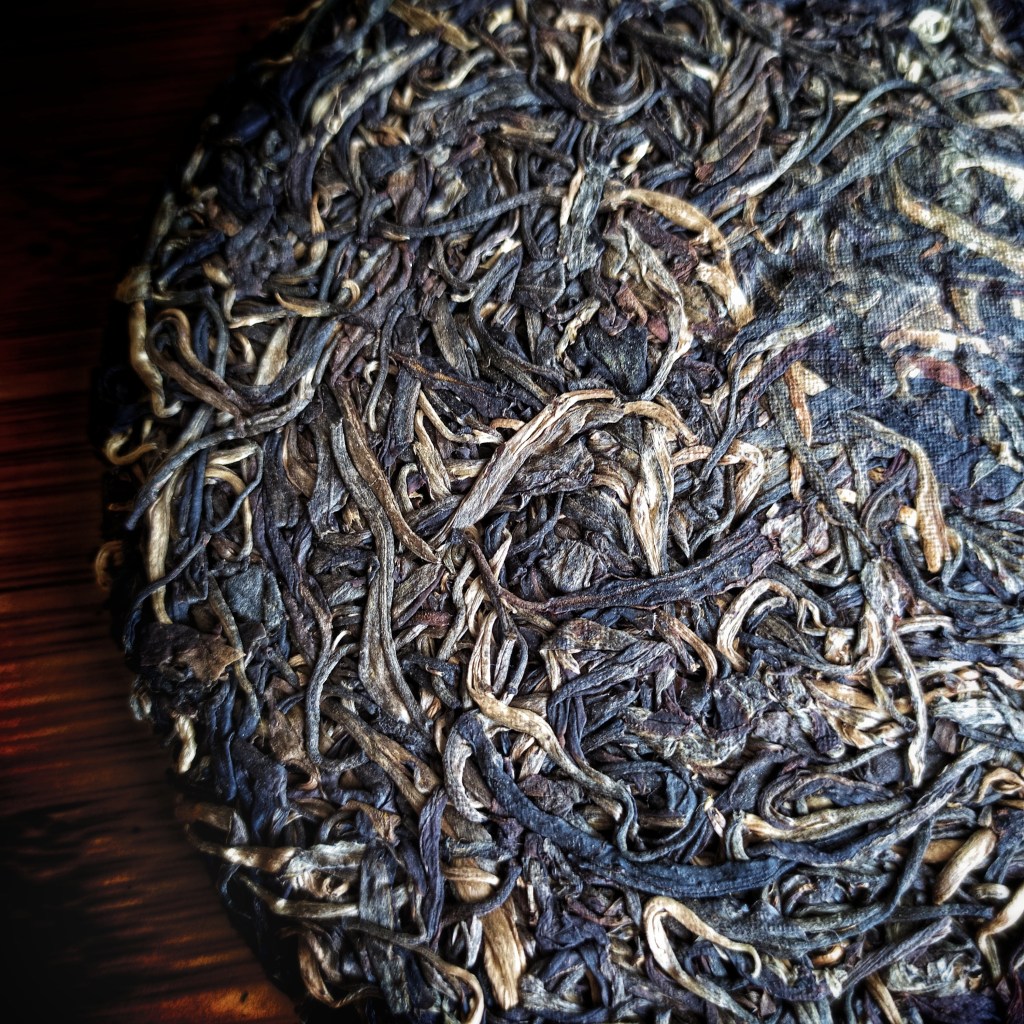
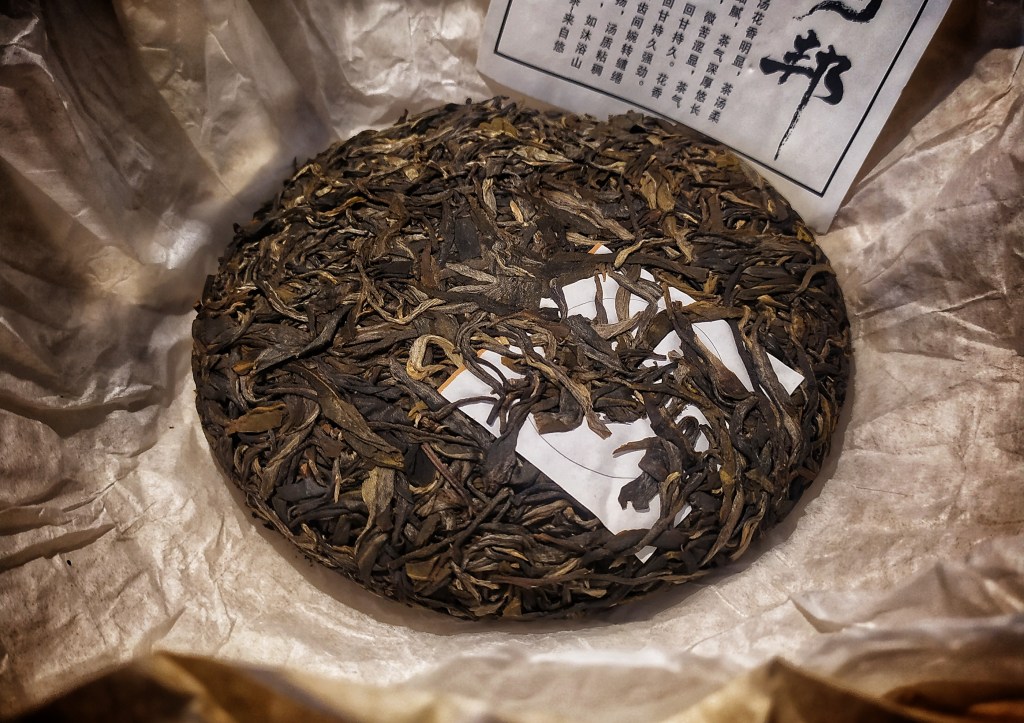
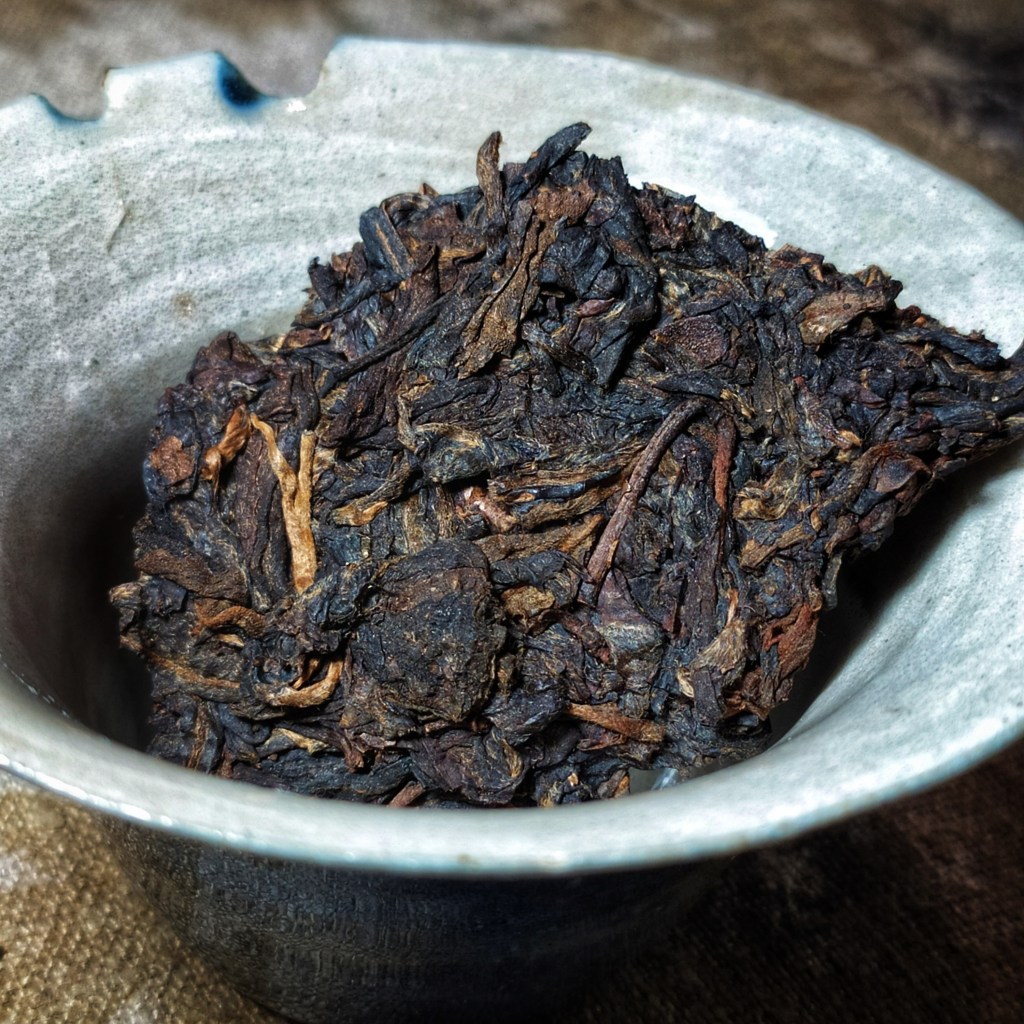
    This morning I reached back into my pharmacy, getting a 2016 sheng cake out of that mess, it comes from Thương Sơn, one of those places where the past intertwines with a vibrant and complex present, which seems to hold the secret to eternity. Here, ethnic and cultural plurality merge into a living mosaic, the rice paddies wrap the mountains like an emerald scarf, contrasted by the pink-purple waves of autumn buckwheat flowers, those flowers that are said to have been sent by the gods as a sign of recognition.


    Each leaf is a fragment of a narrative that has developed over centuries, Thương Sơn is rich in ancient trees that produce teas like this, whose aromas recall the cold winter with the spirit of an austere old father wrapped in his leather armchair, immersed in the cloud of an evening cigar.

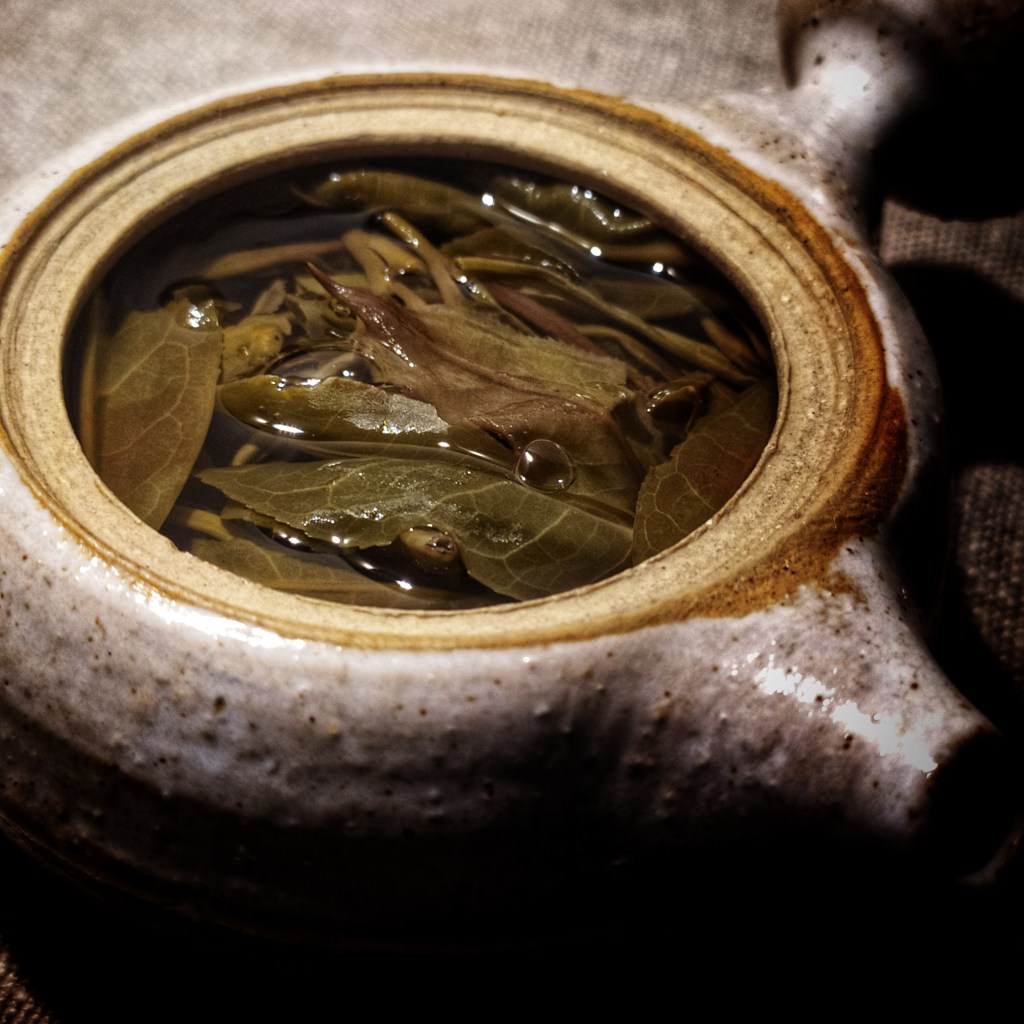
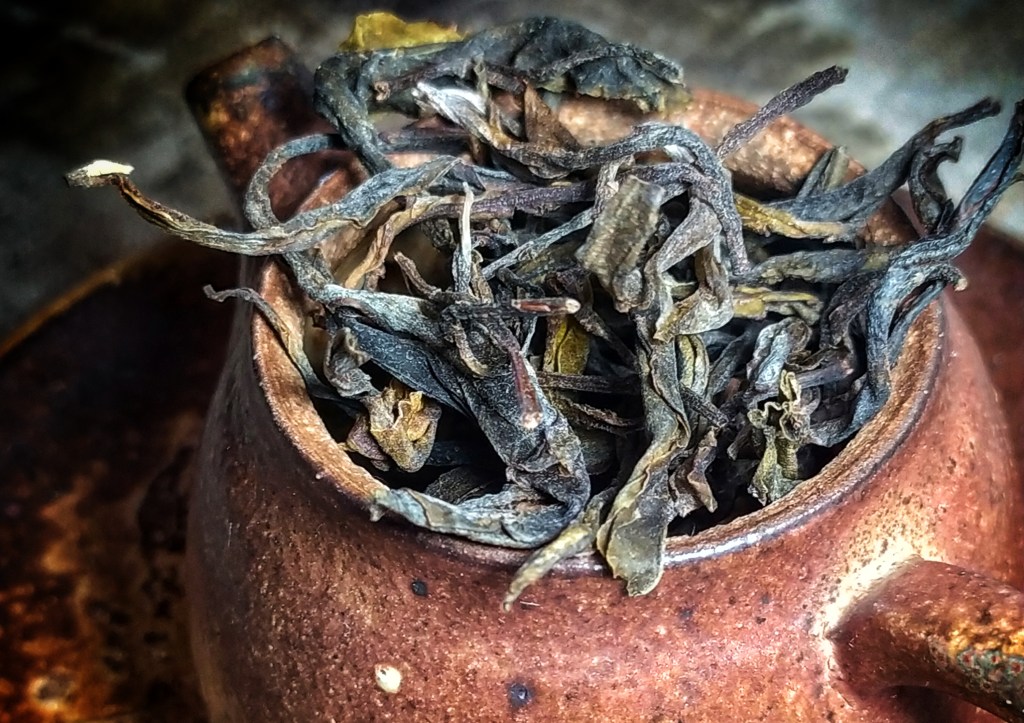
    The sip is enveloping, deep, mineral with hints of Montecristo cigar, leather, dried Moroccan plum, camphor and cloves, it is a constant reminder that true pleasure requires patience. The aromas then sublimate into a dimension of labdanum accords, apricot in alcohol, gentian liqueur and incense. The intense huigan and strong qi revive the image of the crazy and primordial harmony of places like this, so typical of traditional places, a cup we could define as an “accumulated wisdom”.

    Teas like these, places like Thương Sơn, through understanding the bond with their own tradition, with their own history, teach that there is an order, a truth that transcends human contingency, and a tea like this that ages is a trace of that truth, a witness, a collector of past eras, a contract between generations.

  • A mystical, primordial village that gave refuge to outlaws, tea merchants, heroic loggers and ghosts. Huang Cao Ba told with a 2023 old trees sheng pu’er

    A mystical, primordial village that gave refuge to outlaws, tea merchants, heroic loggers and ghosts. Huang Cao Ba told with a 2023 old trees sheng pu’er

    Huang Cao Ba is a village of less than 800 souls, a respectable number considering the average of the nearby ones. Although it lives on a simple economy, based mostly on the production of food to be consumed on site, on livestock and agriculture, it can boast a certain basic well-being and the historical prestige of having a thousand-year history of tea production, with most of the relatively contiguous gardens planted in the middle and late Qing dynasty (1636-1912).

    The red and yellow dirt roads on which Huang Cao Ba based much of his social life were the edges of a wild peak in whose forests the boys dreamed of being explorers and daredevils. You could smell the rice paddies that overwhelms you like an army of silk bundles, you could smell the mud, the green bamboo swaying in the wind broken by the spring rainstorm and every kind of subtropical exhalation.

    Before those houses built with stone and clay bricks with sloping tin roofs, there was a traffic of information and documents, exchange of words and silences in that village which was a post station during the Nanzhao reign on the “刊木古道” the ancient timber cutting road which was a significant link for the foreign and military policy, the culture and the economy of the reign, which ran from Dali through Jingdong, Zhenyuan, Jinggu to Pu’er.

    The vegetation consists of evergreen mountain broadleaf and mixed coniferous forests covering the centuries-old tea trees, so dense that the first exploration team was sent from Jinggu County only in 2001. Even its name derives from the cultural ethnocentrism of the first men, who, unable to penetrate it with the same ease they encountered in other villages, hastily dismissed it with what they could see from afar, as the land of yellow grass.

    A mystical, primordial village that gave refuge to outlaws and fugitives during the Tang and Ming dynasties, a village of Yi healers and shamans and tea merchants on the Tea Horse Road, heroic loggers and ghosts of fallen workers, It is from its old trees that the leaves of this TdC 2023 sheng come. The leaves are wrapped in scents of peach jelly, cut grass and rock sugar, mango sherbet and orchid.

    In the mouth it is delicately soft, translating the wild genesis of the slopes from which it comes, incredibly sweet and persuasive in the aromas of candied fruit, hibiscus, ripe apricot, then hints of walnut, vanilla and citrus peel finish a sip of excellent persistence.

  • Love for Country, Reconstruction and Tea. A few words about Yi Bang and Man Gong Village with a 2023 Gushu

    Love for Country, Reconstruction and Tea. A few words about Yi Bang and Man Gong Village with a 2023 Gushu

    What was the land of the emperor’s tea in the 18th century and a trading circle between Myanmar, Calcutta, Kalimpong and Sikkim in the 19th century soon became dust and ashes in the middle of the 1900. The refoundation of Yibang and its prestige started from that old road paved with mud and stone, the only thing that did not bend to human will, the connection with the Tea Horse Road, the bridge with its past.

    Many now predict the disappearance of our civilization in the “disaffection”, but in times in which remembering, thinking, writing poetry, praying, living together are barely advancing, there are still places where that duende resides, that thrill in which the call to the land comes to mind. That innate affection that associates us with a land, that binds us to a place, weaves bonds and founds a culture that we feel ours, of which we feel a part, of which we are heirs, children and parents.

    Tea works in this place as in those where there has been devastation as a material to give new form, the continuous permanence of what has been, something to live up to and to rebuild on the principle of belonging.

    In the village of Mangong, bamboo in those tribes of children was always in adequate supplies, because the canes that swayed in the April sky were a surprising threat to those young fighters painted in every color.

    While the young besieged the forest, each adult would bring his own tea to the threshold of an agreed upon house, chosen according to glances and silences in the first hours of light. They would settle under the roof and sometimes even on the edge of the mats that saw the drying of the collected leaves, to form a precise audience, drinking the essence of the forest. It was then that the conditions for a new hearth were created, which made those afternoon gatherings a sort of extension of the homes, an expression of those social situations that are possible only in places where the house and the forest are not yet different and opposing realities, but different verbal intonations of the same meaning.

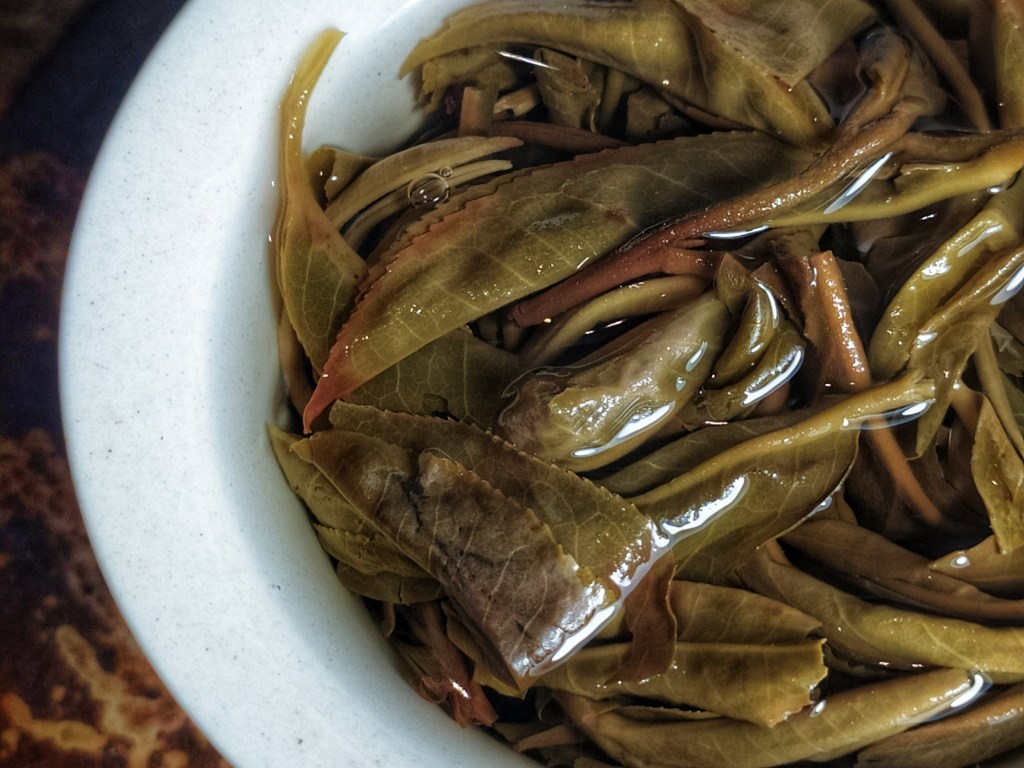
    This Meng Hai Yun He Tea Factory sheng pu comes from Mangong village, spring 2023, from centuries-old trees at 1300 meters above sea level. The notes of wild plum and orchid follow the exuberant sweetness of rock sugar and toffee, the sip is geographical, of great finesse despite the hot year, everything is refined, is in its place, the finesse in the cup reaches a level of purity that puts the language to the test. The sip is sweet, with good huigan, in which you are invested by the “vanitas” of the de Heem fruit, still intact and preserving its natural integrity. It is a tea capable of quieting every mind, of suspending every haughty soliloquy

  • The Battle of Điện Biên, the retreats, the ancient tea trees. A sip of historical consciousness with Viet Sun Tủa Chùa sheng pu’er 2024

    The Battle of Điện Biên, the retreats, the ancient tea trees. A sip of historical consciousness with Viet Sun Tủa Chùa sheng pu’er 2024

    More than 70 years have passed since the battle of Điện Biên, since the retreat, the rice fields dyed red, the pain everywhere. Our men arrived in that area on old Royal Air Cambodia “Caravelle” flown by Taiwanese pilots who shuttled between Bangkok and Phnom Penh. They jumped on with ever more heartpounding, more and more uncertain about the possibility of landing. They often did it at night where the quiet wasn’t interrupted by the clanking of clutches, the noise of the brakes of those metal carcasses or the dull bangs of the firing pins.

    It must have been those dense nights, tinged with that frightening absence of chromatism, one of those in which probably a Kerouac character would have screamed at that dark eastern wall or howled at the moon interrupting the silence and the monologue of the wind even though the tension could be cut with a razor. There wasn’t much hope to project into the future, it seemed that things weren’t made to last but simply to survive another day, where folk didn’t have time to become aware of their identity as a people because the land they inhabited was already a foreign land from the very beginning.

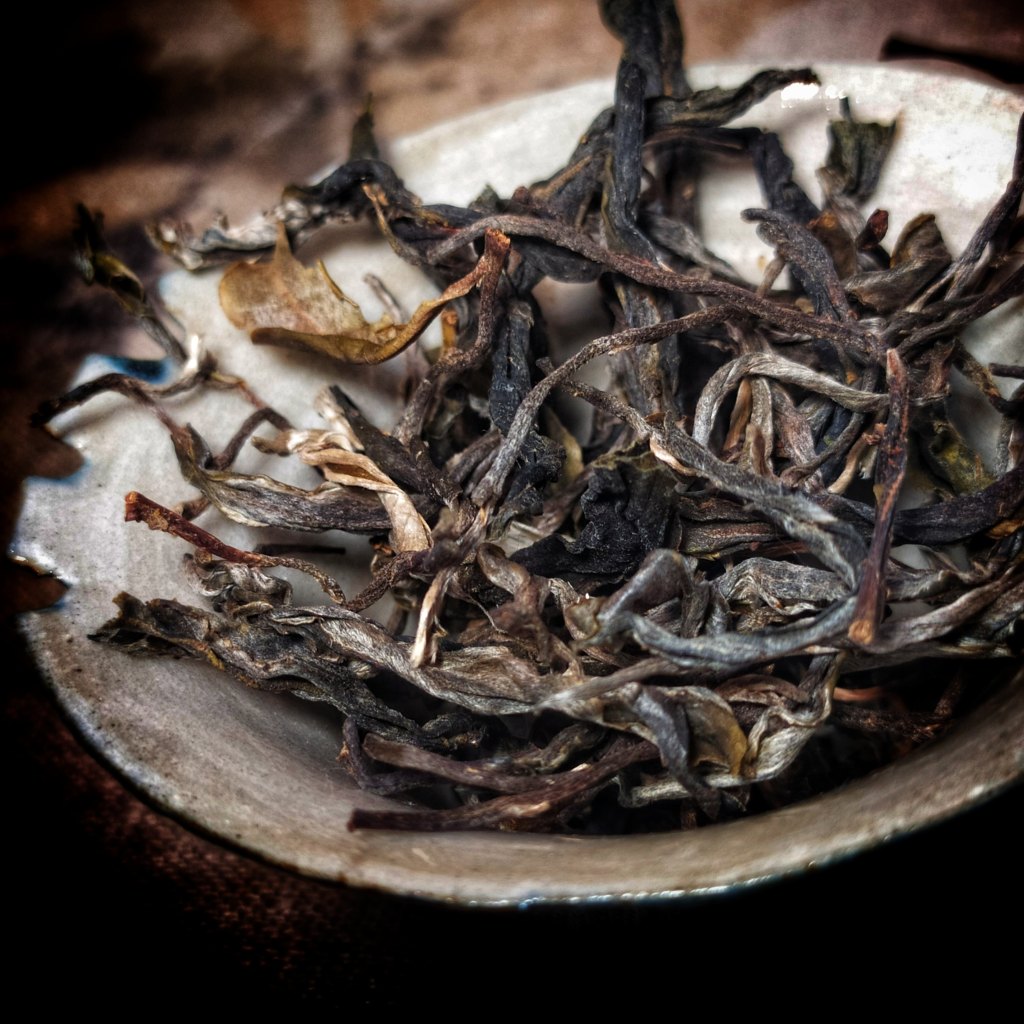
    Tủa Chùa is less than 100km from that war front, one of those mountain places where thunder strikes a sacred fear, where on humid days you can see nothing but misty trees and dark and wild slopes rising towards the sky. The tea in the photo comes from those peaks, from Xín Chải ancient trees, are leaves that recall that “suspended” of its land, capable of escaping every premonition; every other prefiguration and prediction, if there had been one, becomes irrelevant.

    This is a visceral, deep, unexpected sheng. It’s a place where faint hints of white peach, orchid and leather lie contracted, tones of tobacco and forest notes of undergrowth indulge but this is different every time because it seems in continuous change, a plot open in time, like an eternal improvisation. In the mouth it’s soft sweet and with a qi that alone could give meaning to the sip. The huigan takes control of the throat in an instant and every attempt at description from this moment seems a vain attempt by language to exhaust what is worth experiencing.

  • Making a true, authentic tea is sometimes a question of consciousness. Meng Tong Yin Shan Tea Factory Gǔ Xiāng sheng pu’er 2009

    Making a true, authentic tea is sometimes a question of consciousness. Meng Tong Yin Shan Tea Factory Gǔ Xiāng sheng pu’er 2009

    I happened to wake up this morning with a sense of nostalgia, that damned stinging feeling, that melancholic regret of what has passed or gone, or been lost. I headed to my “pharmacy,” that’s what I call the place where I keep that messy pile of leaves and ceramics that should appear to be a safe place for tea, but instead seems like the war front of a desperate need for order.

    I infused the leaves of a tea that had been sent to me some time ago by Moychay, a 2009 sheng from Meng Tong Yin Shan factory. Gǔ xiāng is its name, 古香, “the ancient fragrance”.

    Often we prefer not to delve into where the flesh hurts, pushed back to the surface by thought and the instinct of preservation, but I needed a tea that would anchor me to the present, that would satisfy my need to think, that would give sense to the moment. The sense, in its dual nature is able to indissolubly enclose the organ of sensitive experience and the intrinsic value, takes the ancient by the hand, and when there is truth, the authentic.

    Truth guides the authentic and the latter spontaneously translates into awareness of one’s vocation. Making a true, authentic tea is sometimes a question of consciousness and the need to resort to painful memories, it is not a question of ability but of understanding, of true, living style, of blood, an incorruptible visceral pact, symbol of the most ancient culture, of spontaneous creation, of generative power.

    Tea full of meaning is a tea that reminds us that this drink is not just form, it is not a mere concept, it constantly reminds us that expressing and evoking are different things. The aromatic traits also become gestures marked by an intention, they become an evocative act, we notice a development, the evolution of a melody that passes from one aromatic note to another, in which form and content emerge and subsist together.

    The ancient is distinguished from the old when the former had the opportunity to see the passing of time wrapped in the blanket of truth, of meaning, while the latter simply fades without leaving any memory, neither of itself nor of the intention that was at its origin.

    This is the reason why I chose this tea.

    Tea changes, it is a map of time and a saving substance, and like few others this Gǔ xiāng carries with it the traces of experience, of a changing form, in its ambivalence between notes of a fading freshness and those that place it ever more in a bygone era.

    From the leaves emerge scents of a winter countryside, mushrooms, undergrowth, camphor, surrounded by hints of cinchona and kola nut, nuances of dandelion root, tamarind and caramel wrapped in an unexpected, surprisingly strong blanket of vanilla. The scents of redcurrant, leather, moss on the trees, oak wood and orchid then become prevalent.

    The sip of medium softness, sweet but balanced by a light balsamic bitterness lowers the curtain on floral, woody tones, of angelica root, closing on aromas of vanilla pod and leather.

  • Gaoshan, the village between uncertainty and change. Bitterleaf “Vision” Gaoshan sheng 2023

    Gaoshan, the village between uncertainty and change. Bitterleaf “Vision” Gaoshan sheng 2023

    Gaoshan is a village in the Yiwu area, a place where about 100 families live, mostly Yi, more specifically Xiangtang. The first time I saw a photo of Gaoshan it portrayed a child under a table and a woman in her sixties with a basket of fruit in her hand, behind her house, she had a stern face sculpted by hardship and dark loose hair, without any hint of layers, as if it were cut with a razor. One of those people who seemed to have never changed their hairstyle in their life or residence.

    Every morning she fetched water from the well, collected wild herbs, walking tens of kilometers in that rippled gorge, where the road appears like a clay snake running through the forest.

    The photo collection also included the dense forest of tea trees and fruit trees, on a periwinkle-gray afternoon, the kind that precedes a storm. The boy, about five or six years old, was sitting on the floor under the large kitchen table, partially covered by the cloth drapes that were not long enough to hide him, but long enough to make him feel hidden.

    I believe that at the time neither the woman nor the child knew how profoundly their village would change in the next twenty-five years.

    Uncertainty and change are to Gaoshan as a bell tower is to its church, its teas are often among the truest in Mengla because they tell of their time without resorting to sweeteners or nefarious adornments, they are the fruit of the virtuous life of the settled person, who beautifies and sanctifies a place that is his, the natural result of having roots in the place that gave you the first dawn.

    The changing nature of this village can be found in this Bitterleaf Gaoshan sheng pu’er, where the aromatic fan seems to mark a new narrative trajectory every time we meet it in the gaiwan, the leaves are pervaded by a profusion of flowers in a wicker basket, but withered and in the process of changing clothes surrounded by a series of chiaroscuro, as only Rachel Ruysch would have imagined them, that battle of lights and shadows that package and give depth to the human experience.

    It is silky, complex, rich in notes of ripe fruit, such as white peach, mango, hibiscus, orchid, mineral sensations of wet lava stone, dried apples. From the first infusion you are enveloped by the honeyed and orchid sweetness typical of Gaoshan with a very nice huigan.
    The sip seems perfectly orchestrated in its essential elements but equally chaotic in its accessory elements, the way in which the aromas vary throughout the session creates a swing in which it seems to pass from one existential plane to another, from matter to concept, as in a mixture of science and spectacularization in which the result of the experiment is uncertain.

  • Metaphysics of Pu’er blend with Moychay 2022 Melting Reality sheng pu’er

    Metaphysics of Pu’er blend with Moychay 2022 Melting Reality sheng pu’er

    We live in an era where you can potentially know everything about a tea, the garden it comes from, the grower, the exact location of the trees, but the tea market has not always been like this. Blends were so popular in the past that there were few single-origin teas before the 2000s.

    Some of the greatest recipes to come out from the Dayi, Xiaguan and Rongshi factories or from the minds of pioneers like Ye Binghuai, Vesper Chan and Chen Huaiyuan who commissioned, produced or supervised them, were blends.

    But what can elevate a blend and bring the art of blending back to the forefront of consideration? I believe that when the condition of need and economy is overcome, the blend can become expression and genius, a journey into the unexplored, a domain without potential rules, a disorder channeled into the eternal overcoming of all the contradictions that compose it. But this is on condition that the raw material is of such extraordinary quality as to support the greatness of the intention.

    The blend is not a mere offspring of an uncoordinated material, it must be able to fuel the creation of other structures, of superstructures capable of capturing and interpreting the reality and the thoughts of those who create them, something also capable of escaping the premeditation and contingency of the possible and of making us forget those mixtures of leaves devoid of any persuasive power.

    The lack of rules and the impossibility of serving the leaves and erecting them as a symbol of a place brings technique and thinking to the limit and, as in art, to experiment the extreme ease of failure but also to the configuration of unique potential, since the technique can be exalted only where it manages to experiment its most radical impotence.

    In this Melting Reality, a Moychay 2022 blend, you can find that unexplored, that quality of the first time, of that reality so accentuated and exaggerated that it seems unreal. Like a Blanes painting the drink is stratified on more rural and dark tones of leather and maritime forest which alternate with other sweeter and brighter ones of gooseberry, dried figs, candied fruit and orange blossom as in a delicate play of lights.

    It is a liquor where the ephemeral and the real alternate, the light bitterness and medium softness integrate well with the good huigan and the hint of tamarind sauce that give bite and announce chaos in an incessant symphony of notes of candied cedar and honey, orange custard and cooked wheat.

  • Discussing the contradictory essence of tea with a pu’er from the ancient land of elephants. TdC 2014 You Le Ya Nuo village sheng pu

    Discussing the contradictory essence of tea with a pu’er from the ancient land of elephants. TdC 2014 You Le Ya Nuo village sheng pu

    I am of the opinion that tea, good tea I mean, should always be accompanied by a good argument. I also remain firmly convinced that it itself must partly be the reason and urge for the conversation, and partly guide it.

    If we could reconstruct a sort of symposium evening I often think about which tea I would offer, and the more time passes the more I would like such a reconstruction to materialize.

    Between a Yiwu pu’er who exalts himself in his expensive robe, one from Naka on the gentle banks of Mengsong in the throes of self-satisfaction and one from Laobanzhang born under the gaze of God on the happiest mountains of China, the pu’er of You Le I’m sure would find a place without resorting to excesses of violence.

    Those of You Le, the ancient land of elephants, are teas with a noble soul that still retain a “bourgeois” trait, that dignified self-sufficiency which, if well channeled, results in the most refined form of intellect.

    At a table tea deserves the space it’s due because some of the great events of history are poured into it, the extraordinary possibilities that humans have been granted from era to era are dissolved in it. Because tea is a trail of great epics and immense tragedies, of rhetoric, imaginative experiences and speculations, the history of entire peoples distilled into a cup.

    Under the action of its metamorphic nature, tea resolves prose into verse and verse into song, calms the most abysmal dissonances without the need to silence them, rather it legitimizes and composes them.

    Because from the hard ground from which its trees arise, an innocent stream of fragile ambiguity can always flow, even in the midst of that jianghu, which it foments and nourishes; between rivers and lakes it doesn’t fear contradiction and is able to make every truth “always also false” and every falsehood “always also true”.

    The thoughtfulness of this spring 2014 sheng from Ya Nuo village old trees holds up its mountain’s fame. The aromas arrive with orchestral precision, opening on notes of tobacco and plum, earthy nuances, resin and musk.

    The leaves recall the scents of an old library with notes of mahogany and leather armchair, then red dates, raisins and light mentholated hints. The contribution of aging is balanced, with integrated notes of leather and of an old cigar box. The sip is coherent, with good softness but with adequate agility, low bitterness, balanced and with an excellent huigan. The long aftertaste is yet another proof of a dress sewn by a great hand.


    The future will give it charm even though it is a tea that does not require eternity to be appreciated, but the aspiration is more than legitimate and a decade of waiting will, in the end, be a splendid meeting.

  • Discovering Y Tý: Comparison of two Viet Sun sheng pu’er from a Dao and a H’Mông village

    Discovering Y Tý: Comparison of two Viet Sun sheng pu’er from a Dao and a H’Mông village

    A place of magnificent waterfalls, azaleas and wild peaches, the mountains background seems to give every gesture an additional majesty, a primordial dignity.
    The small mud-walled houses of Y Tý stand in the green and golden colors of the rice fields, offering rural nuances to that tranquility typical of the “cloudy” land, located at more than 1700 meters above sea level. Pyramid roofs, stone fences and terraced fields are symbols of the will, minds and hands of many generations in the highlands, created to interact and converse with the nature of the mountains and rivers.

    The Y Tý market meets every week and is a cultural place of exchange for Hà Nhì, H’Mông and Red Dao. Most of the stalls are run by Hà Nhì women in black and dark blue dresses, i remember the shy face of a young mother and her little girl, lying obediently in a gray jute sash on her chest. Her hair is tied back and almost glazed due to the effect of the sun on her coal black hair, the vivid gaze with her head tilted to the side as if she were listening to the voices in the wind.

    Tourists are busy buying vegetables, red peanuts and Pạ Phì. The road covered in red earth dust is full of rattan baskets, worn enough to indicate actual use of their contents and well enough maintained to suggest respect for the contents themselves.

    Higher up in the mountains, the landscape unravels lively between the fog, between the sandy and rocky soils of the Dao villages surrounded by the wild bamboo forest and the more clayey and fertile soils of the H’Mông villages. Those mountains that protected the soldiers on their way to the front, towards the place where the Lũng Pô creek meets the silt-tinged waters of the Hồng River, up to A Mú Sung, where they fought and fell to protect the border.

    Here it is as if tea is able to fit in with culture as well as nature and can make use of both as it pleases. The landscape seems like the unconscious of the earth and the teas that derive from it are its liquid consequence.

    After a more romantic first part, I will talk in a more technical and boring way about how a territory with an enormous potential now demonstrated like Vietnam can have that complexity of landscapes, that dramatic discrepancy of soil composition that is often associated with great terroirs, such as France and Italy for wine and Yunnan and Taiwan for tea.

    Vietnam often is in conditions of high humidity and high temperatures during the year, such as to hypothesize a much faster maturation of the soil than, for example, northern Asia or some areas of northern Yunnan. But in the mountains many things can change, here at over 1800 meters we can have leaching, erosive, frost phenomena and extremely variable contents of the organic fraction from mountain to mountain or even in the same mountain at different elevation levels.

    We can also notice typical results of the meteorological conditions of these areas, such as the deeply yellow and yellow-red color of the soil, indicative of a condition of water saturation. The soil environment is reduced and, under these conditions, the iron is reduced to the ferrous state (Fe2+), the color of the soil becomes lighter and yellower, with gleying and mottling sometimes. The iron will be in a more soluble state and therefore more available for chemical reactions.

    H’Mông village has very old and tall trees growing on the slopes near the border with China, the climate here is wetter, there is more forest cover, resulting in darker green leaves than in the Dao village. This is due to the shade and the greater capacity of water retention, less leaching and greater content of organic substance, typical conditions of a soil richer in clay and organic elements, the presence of sand and silt in surrounding areas also suggests a clayey but not asphyxiated soil, with a good potential for oxidation of organic matters. The leaves of the H’Mông village express themselves with greater roundness in the cup, with a persuasive softness and with more animal and leathery hints, with less citrusy but warmer and more mature fragrances.

    The tea area of Dao village overcomes a wild bamboo forest, there are many old and ancient trees, the climate is sunny and dry, and the soil is rocky-sandy, which will result in a possible slower growth rate of trees, given the possible greater difficulty for the soil to retain water, nutrients, greater leaching of minerals, erosive phenomena and loss of organic substance and this conformation is in line with a lower maturity of the soil given a lower presence of water. The leaves of the Dao village reveal more mineral and rocky accords, more citrus and herbaceous, a less imposing and soft body, more agile despite the medium thickness.

    This is an example of how at a short distance, pedogenesis and transformative climate phenomena can change drastically, returning a vastness of results that cannot be found in most other areas of the world and how this complexity does not derive only from the altitude, therefore also translating into extremely different teas in an area of a few kilometers.

    Mixing together the leaves of the two villages you get a concert of the unlikely son of Emily Dickinson and Rory Gallagher, the romantic essence with its disciplined lyricism and the annihilating chaos, the sublime that is the basis of great things.

    The ambivalent aromatic essence of the leaves is initially dark, bringing back Bruegel’s Flemish nature in the almost primitive woodland scents, with memories of a bonfire extinguished in the rain, undergrowth and slightly animal smells.

    Then the texture of tropical fruit and candied hibiscus, tomato leaf, orchard hay begins to emerge, supported by counterpoints of medicinal herbs, wild flowers and saltiness on the skin. On the sip it shows fullness, with notes of white mulberry, linden, apricot and slightly herbaceous hints. It is never prosaic and the thickness is sized and juxtaposed with freshness and minerality and a medium-low bitterness, which make drinking agile and never tiring.

    The strong and relaxing and at the same time almost lysergic qi accompanies a persistent and very present huigan from the first cups.

    You can find much more information on the Viet Sun website

  • Discussing again about Yiwu and authenticity with a 2003 CNNP “Sheng Tai Gu Shu cha” via Camellia Sinensis

    Discussing again about Yiwu and authenticity with a 2003 CNNP “Sheng Tai Gu Shu cha” via Camellia Sinensis

    Almost 20 years have passed since the declaration of Yiwu as a “Special tourist village of Yunnan”, the program which aimed to attract more and more people to a city which was growing economically at a spasmodic pace and which was obsessively trying to make its authenticity perceived.

    Often this intention came into conflict with the reality of a territory profoundly transformed, by wealth, by the introduction of QS, by the architectural disharmony caused by evident asymmetries in the urban development and modernization plan. Shortly thereafter, the rapid and unsustainable rise of the pu’er business would have collided with the bursting of the bubble, raising not only doubts about the economic future of families but also questions about the true authenticity of Yiwu tea which until then had faltered.

    Those were years in which the vision was different, although not too distant from the current one, in which the importance of the object was provided by its price and not by its value, the meaning of tea was given by its correspondence to the useful; the forests, despite the already present distinction between them and the taidicha, were already utilitarianistically defined even before their understanding. While many farmers fought for their authenticity, just as many others built the stereotypes of heroic naturalism and “nostalgic” as a symbol of an identity that can be regained through tea, and clearly through its profits. “The truth” was not explored but a proud surrogate was created to be put on sale.

    For this reason, my opinion of many teas from the early 2000s is less enthusiastic than what is out there, many although not all were soulless teas, on which was placed a fake effigy of cults and traditions. Without the soul and its intention there could be no authenticity, because in this way the past becomes irremediably past, the mythologies that have passed through it become dull and irremediably dead languages, or in any case incapable of supporting that subtle kinship that exists between thinking and memory, between memory and identity and between identity and the authentic.

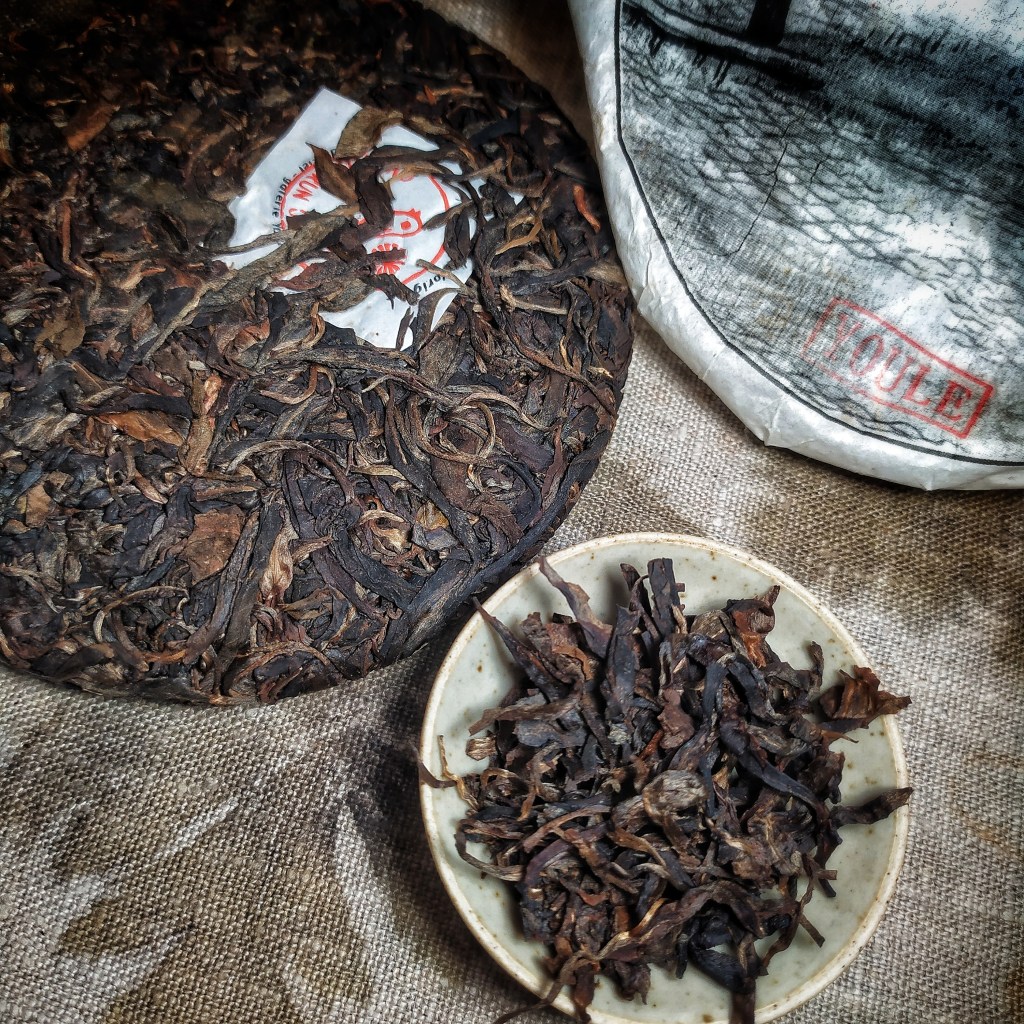
    This is a 2003 Yiwu pu’er “Sheng Tai Gu Shu cha” via Camellia Sinensis, in a CNNP label different from the typical “white and red zhong cha”, probably the result of an anonymous packaging from a small producer.

    One of the testimonies in a “unknown soldier” version of an attempted reconquest of “the authentic”, of the traditional taste that does not come to terms with the conventional. The leaves bring with them smoky notes, of vetiver and seasoned cedar wood perfumes. From the gaiwan come the smells of an ancient lutherie and those of an old wooden church.

    The aromas are reminiscent of dried flowers inside a book, evolving olfactorily towards notes of leather, virginia tobacco, incense, dried rose hip and pepper. The medium-thick sip ends on hints of tamarind, dried longan, dandelion root and medical herbs, fading into an ancient sweetness and granting a strong and focusing qi.