

We all know it: social networks always leave too much room for sensationalism. There’s endless space for anyone obsessed with sanctifying new brands and glorifying mind-blowing teas that promise an experience somewhere between spiritual awakening and a methamphetamine binge. A permanent pop-up of disposable enthusiasm. It’s the amusement park where anyone can feel like a prophet for a day, canonizing the newest square meter of the most remote village, where snakes, tigers, and giant beetles supposedly lurk ready to attack the tea pickers, only them, of course, not people practicing any other profession, before moving on without even bothering to stub out their cigarette in the ashtray of final verdicts.
Everything seems to shine, everything seems harmless, everything promises miracles, at least until you realize it was only a reflection, not the source. That’s life.
It has happened to me too: speaking too highly, too soon.
But there is one terrain, one terroir, on which I’m not willing to make the slightest concession: Tủa Chùa.
From a mountainous rear area near the Điện Biên Phủ valley, where in 1954 the decisive battle that ended French colonial rule was fought, this region has become an enclave capable of producing surprisingly accomplished Pu’er teas. Many areas once considered marginal and reactionary, such as Tủa Thàng, turned into revolutionary bases, as they combined geographic isolation with strong social cohesion. The karst plateau, with its steep mountains and paths invisible to outsiders, offered natural refuge to high-ranking officials of the Việt Minh. They took shelter in the homes of Hmong villages, protected by the population’s collective silence.
The inhabitants knew the land intimately, guiding men, weapons, and messages along unmarked routes, avoiding French patrols and keeping the mountain areas connected to the Điện Biên valley. All of this unfolded in conditions of extreme poverty, yet they provided food, places to rest, and intelligence on enemy movements, accepting extraordinarily high risks. In those mountains, silence was a form of resistance, and the geography itself seemed to have taken sides.
Now, back to the tea.
If I had to explain to someone what true mineral, botanical, ancestral excellence means, if I had to make them understand what these trees are capable of, and why Vietnam today not only looks Yunnan straight in the eye but openly challenges its borders, I wouldn’t hesitate for a second. I’d pour them this tea. No preamble, no rhetorical acrobatics, no captions.
The way this tea is evolving is sublime, truly the kind of harvest you get once every five years.
I’m sorry to say it won’t deliver the tragic depth of Marina Abramović’s gaze, the high priestess of emotional intensity descending upon us mortals to elevate us by staring into our eyes like a corneal topographer.
What it will give you is a perfect sip.
This is a sheng with an almost exasperated intensity, like an overexposed photograph that somehow works. It lingers on orchid notes, though not like Jingmai, those notes seem wrapped in a dense, almost brooding forest aroma, the kind currently fashionable to flaunt when talking about Guafengzhai, but here they feel more arrogant, they slide under your skin with a needle’s quiet, deliberate precision, an elegance that’s both unsettling and strangely pleasant.
On the palate it’s viscous, medium-bitter, with barely perceptible astringency. The huigan is quick, floral, so persistent it feels more like a reforming than a return.
This isn’t a tea for fragrance addicts or niche perfume obsessives.
The qi is the real point here.
It’s a tea for those who recognize the exact moment when something slips in and changes you.
You don’t keep drinking it just for the aroma, you do it because a part of you has already been pulled in, and now it wants to know what will happen if you keep filling the cup.
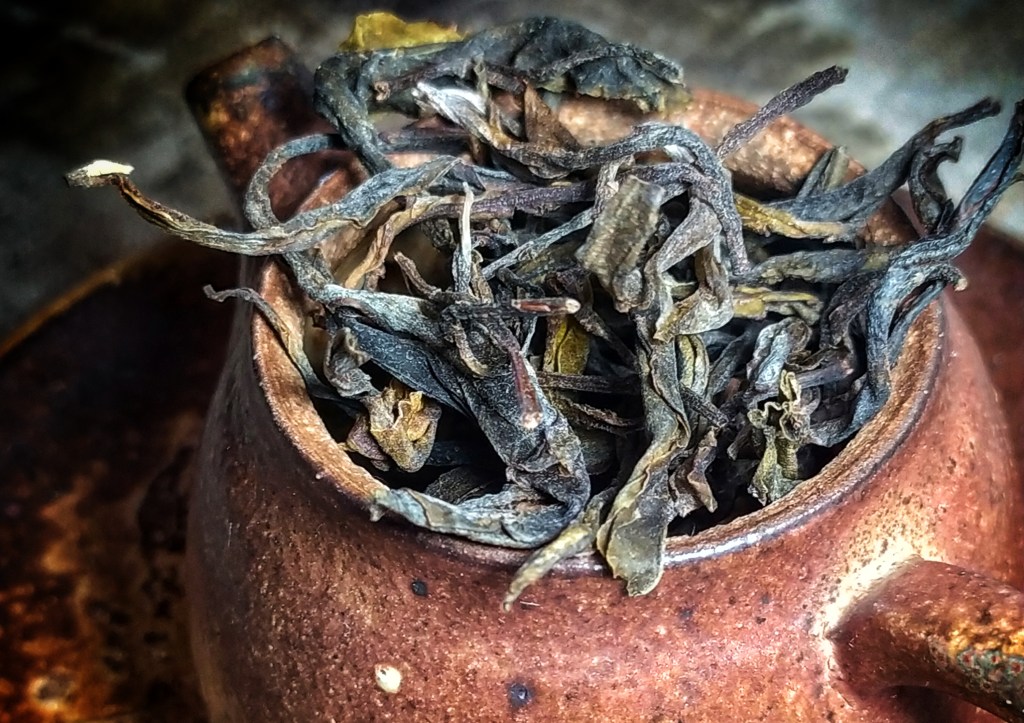
 Wild Harvested