
After talking about Mangfei, Yongde county, we travel along the G323 in a 2-hour journey through the pre-Western architecture of Heping village, passing Bangdong gardens, leaving Mangmai until we enter the wild forest to reach Xigui, the last village of the west bank of Lancangjiang.
The roads are unpaved and where it meets the asphalt this is covered with a patina of red clay dust, the architecture underlines the rural context and the mere functionality of the buildings. Tea plants define the extra-urban landscape sloping down to the river that separates them from the Xiushai forest on the opposite bank. Here the inhabitants catch the fish and take it to the local inn, while on the other side the foragers with weathered faces give no rest, they welcome the leaves between their rough palms with their shoulders anteroverted in their cotton shirts, with arched backs, bent by the severity of the years. They are intent on collecting the material of that mountain, between 700 and 1400 meters, and working it until the sun goes down, until it sets in Lancang and the river bank disappears, so that space and time in Xigui appear in their absolute.
The varieties are mainly Bangdong large-leaf and medium-leaf, with some small-leaf tree, which is a big difference from other Lincang teas. The forest, the plateau and the currents of Lancangjiang isolate the pedoclimatic context from the rest of the Linxiang district, making this tea unique.
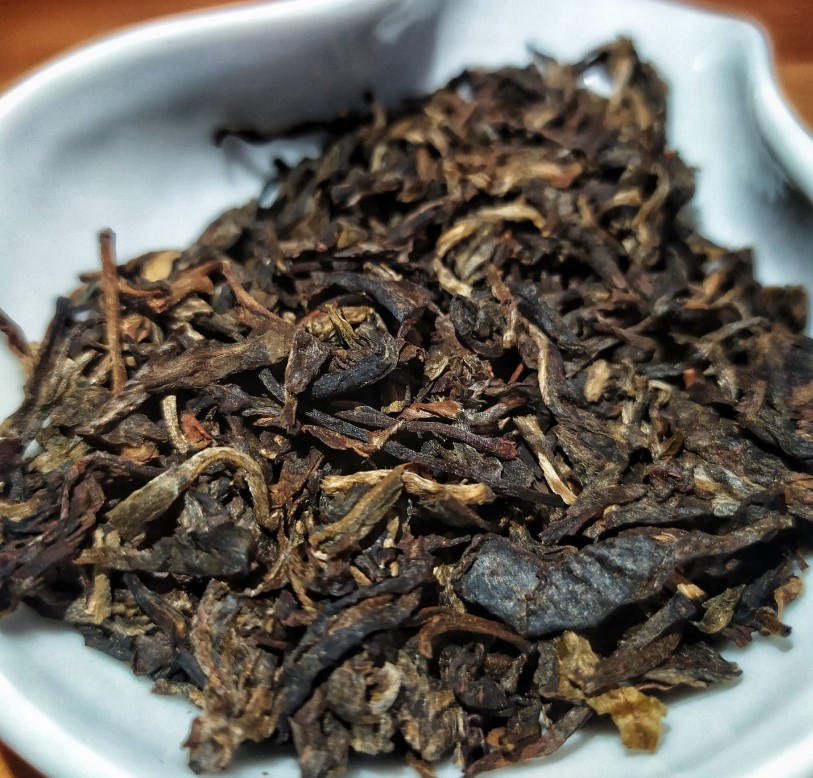
The 2007 Xigui pu from Zhaozhou comes from 200 year-old trees, which is almost the maximum age found in this area, and it is a tea that perfectly translates the character of this terroir, with its slopes, the soil rich in organic matter, the temperature range, the different biotypes. It denotes a composed exuberance rounded off by the years of aging, a sweetness that sets a soliloquy in a sensorial harmony where little space is given to bitterness and astringency, and like a good Xigui it shows a wild aromatic complexity that contrasts with an elegant and refined olfactory bouquet.
The wet leaves range from apricot jam to spices, reminiscent of nectarine peach, petrichor, medicinal herbs, leather. Accompanies a light note of camphor, followed by vanilla, mineral fragrances, sandalwood, undergrowth, orchard, acacia’s honey, mushrooms and black pepper. The orange liqueur appears dense already to the eye, in the mouth it is round and less multidimensional than other Xigui, the sweetness takes over almost immediately, a characteristic also provided by the 15 years of refinement. The sip is syrupy, dense, enveloping, with sweet and fruity aromas, with jasmine and herbs flavors. The sweetness re-emerges wrapped in citrus notes while the qi is precocious and invigorating.
 Wild Harvested