
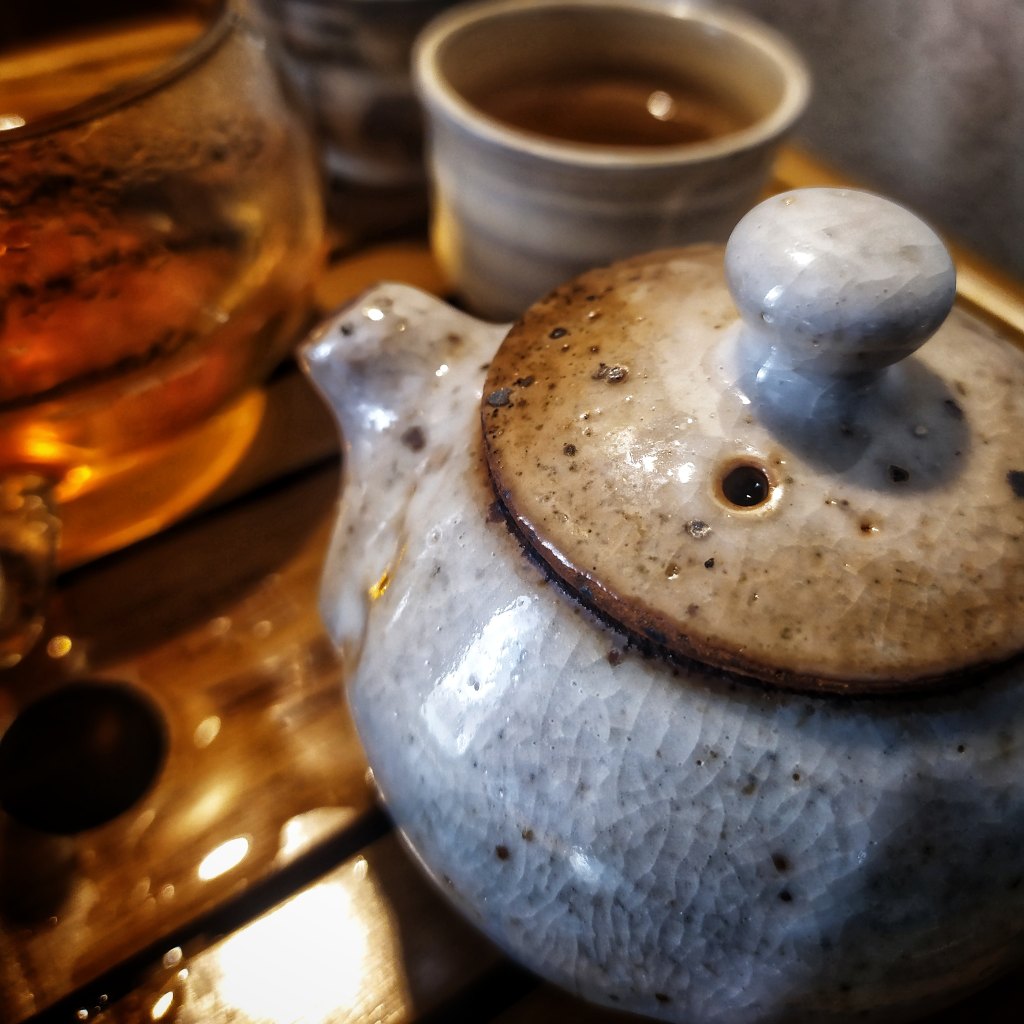
On a day when the cold morning breach seemed to have taken away even the most weak semblance of chromatism, and with this the already remote desire to conclude something at the end of a dull sunrise, I decided to make a tea session with this 2016 Sheng Pu from Nannuo in the hope of rejoin me with the part of the brain that welcomes the tactile sensations.
It was a greener puer in the past while today we can also found leaves processed with a longer period of withering, a shorter steaming, or a lower shaqing temperature but for a longer time, all factors that bring back to a more amber color than the pale yellow one to which history has accustomed us. But what does not change is its complexity wrapped in an introverted blanket, destricable only through the patience of the infusions, where the essence of tea seems to rest on one’s being, curled up in an aromatic profile that is shown in its becoming, revealing itself sip after sip in a sort of amniotic tranquility.
In the 1950s, while the country was raised from the rubble of the Republic of China and the families looked to the future with the losses of the civil war behind them, at the same time on Mount Nannuo the foundations were laid for one of the most important tea research centers in Banna.
Researchers such as Zhou Pengju, Cai Xitao and the team of the Nannuo Mountain Tea Research Institute contributed to identifying the area as one of the oldest in the tea cultivation panorama and to classify varieties such as the Nannuo Daye (Yunkang 10).
Through the fog, above the red earth and below the blue sky, the history of an entire territory is consecrated through the infused leaves that in those years of reconstruction appeared as balconies of the heart, as disenchanting voices of each of those 30 villages that live in the mountain.
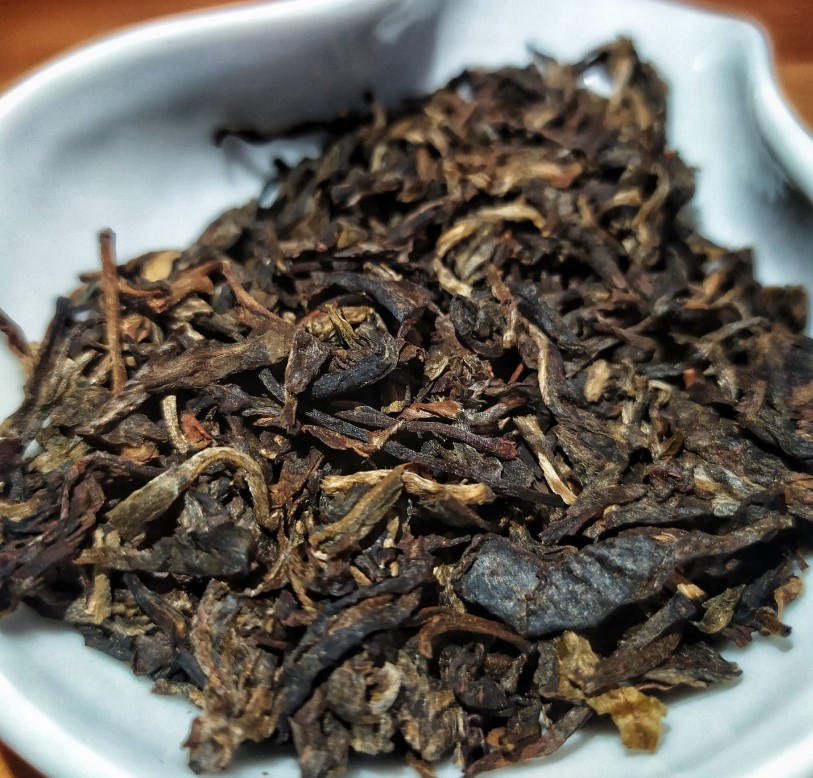
This @zhaozhoutea tea is the sheng pu “No.833” from the spring of 2016 from Nannuo gushu trees. It is not only a very representative sheng of Nannuoshan, but it is an example of an evolution of the way to make tea in this area, a historical and mnemonic study from a tasting point of view.
The wet leaves are extremely evocative, report the hints of a mountain caravan, with herbaceous perfumes, moss, wet rock, wild flowers and gooseberry. Inside it are perceived scent of bakery, lemon tarte, leather, white peach and thai mango. During the infusions, shades of tamarind, walnuts and quatre quarte cake appear while the tostated seeds crack on the wok.
The golden liqueur highlights nuances of evolution and a contemporary conception of leaf processing, with medium astringency and bitterness. On the palate there is a coexistence between the herbaceous flavors and the fruity- citrousy ones of peach and orange zest. Huigan is pleasant and balanced, integrated with other taste sensations, not predominant as a Naka sheng to bring a comparison. The finish is persistent and articulated on notes of gardenia, persimmons, apple and creamy aromas, closing a session that becomes proportionally sweeter to its prolonging.
 Wild Harvested