
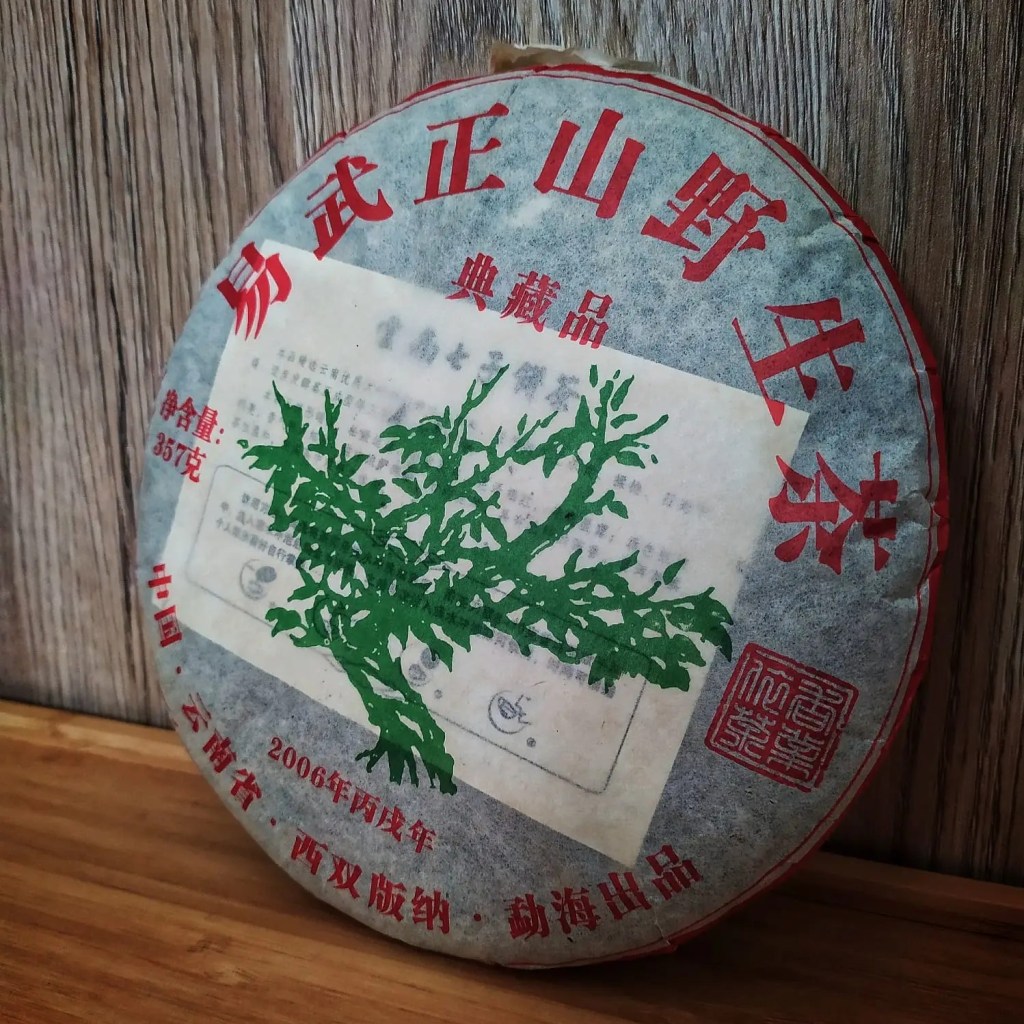
In the recent past of Pu’er we have often witnessed a forced association of tea with its most narcissistic and aesthetic-economic dimension, to then observe the deflagration of this concept by those who sought more the practicality of taste and pleasantness in its more utilitarian sense. Without recalling how much before and after the events of 2008 contributed to forging these factions, in front of certain teas we can remember how much Pu’er can escape mere sensoriality, from being a simple pleasure of the palate to rejoin its real aesthetic dimension, that sensitive incarnation that translates an idea, a territory, a community.
Teas like those of Yiwu manage to reconnect us with that part of ourself which, while searching for information, tends at the same time to suspend from practical sense, making us experience the sensible, the experience in its essence. This cake immediately brings to mind the selections of Mr. Ye Binghuai, the “Big green Tree”, whose story will probably be the subject of future posts, but it suffices to know that it made a good part of history among enthusiasts at the end of the 20th century, as well as having led many Hong Kong auctions with his ’99 selection.
The harvest dates back to 2006 from wild trees throughout the Yiwushan area, a sensory complexity achieved thanks to the assemblage of several mountain villages. Because from Mahei to Guafengzhai to Yiwu village we are witnessing a radical change in the composition of the soils, a pH that goes from 4.5 for the most acidic to 6.5, an altitude range that goes from the summit, above 2000 meters above sea level, to the 730 m of Nametian with its taidicha and xiangjiaocha, which in antithesis almost seem to offer a gateway to the compulsive modernism that previously struggled to take root among those camellias that looked like imposing bodies, lignified in their dynamism.
This wild tree puer comes from some of the shengtai areas that flank the mountain villages, leaves that when wet release scents typical of these places and quite similar to those of other vintages chosen by Ye Binghuai, notes of cedar wood, camphor and dehydrated longan, with an almost smoky, balsamic personality while advancing a memory of peat very similar to that of a good Mezcal rather than a Scotch.
Drinking proceeds in a calm and relaxed tone, one can perceive the scents of a pine forest after the rain, vegetal, musk, peach and floral as a background. Suggestions of banana leaves, Lemet in particular, the yucca cooked in water wrapped in banana leaves, together with spicy, woody and slightly smoky tones similar to those that Mizunara gives to Japanese whiskeys.
The liqueur is coherent, initially introverted, of a golden-amber colour, slightly lighter than expected but able to develop over time animal, musky and fruity aromas, almost of raisin muscatel, with a qi that gradually becomes evident and pleasant. The sip is juicy, thick, balanced in its medium bitterness and medium sweetness, of good persistance and ending on notes of charcoal-cooked tropical fruit.
 Wild Harvested
Leave a comment