
At a time when humanity still seemed willing to believe in something beyond the mere surface of things, the Muses sat upon Mount Parnassus. It was an age when people were aware that art was something more than just a string of provocations with fluctuating budgets, something more than what you can now sort “from most to least expensive”. The nine daughters of Zeus and Mnemosyne guided the hands of painters; their voices stirred the blood that fed the cante jondo, urged demons to move T-Bone Walker’s left hand just a little more, whispered the six sonatas for violin and harpsichord into the ear of Vienna’s young prodigy. Today, I fear they no longer sit anywhere. Presumably locked away in some post-industrial loft in Milan, gagged with tape labeled “reconstructed identity” or some other bullshit straight out of the Damien Hirst playbook.
Calliope, the one who once conversed with Cesare Pavese, has now ceded her place to seventeen seasons of some televised sobfest. Euterpe, on the other hand, is in despair, seeing a world that once resonated with the sublime tones of Giuditta Pasta now wander aimlessly with earbuds in, listening to some immersive composting sound experience, something for those who believe that rhythm is a new form of urban mysticism. Suffering is no longer catharsis, but mere reportage. Tragedy has become a type of therapy. Art is now a vehicle for delivering yet another saccharine confession that nobody asked for. The Muses have not been imprisoned by the market, but by contemporary philosophy itself, which has always denied their necessity.
And yet, now and then, one of them escapes. And when that happens, a Christone Ingram appears. Or a Jordan Casteel. Or a Jacopo Cardillo. Someone who doesn’t need to prove that their kind of expression deserves a higher, transcendent status, because people don’t need to convince themselves that it does. They simply know it. Instinctively. No massively inflated price tag is required to protect their importance, because no price would ever be enough.
Where once we invoked the austere beauty of Dreyer, or the sacred silence of Tarkovsky, today we exalt centrifugal narratives that refuse to come to any kind of conclusion, as if the unfinished were somehow more “true” than the completed. Perhaps I too am an asymptomatic carrier of this condition. I have a draft of a book sitting untouched in the upper left corner of my desktop for six months. I sometimes drink more than I should. I let Rory Gallagher depress me far too much. And I find myself sensing emotion in a throwaway work by Twombly.
Before the whisper of a Muse, before hearing the chords of Erato’s lyre move the soul, before Melpomene offers her sword to face the tragic, it now feels almost more honest to linger in the unformed, a sort of beta version of the present that will, one day, receive its necessary update. We live in an age that collects fragments. Isolated sentences. Reels. Reels of reels. Everything must appear as something short enough to scroll past, yet long enough to suggest continuation, even if that continuation never comes. And this, I believe, applies to everything in our lives.
And I believe it also applies to tea. Including the rare sparks of the extraordinary. It’s entirely possible that one of the Muses escaped into the Darjeeling region, slipping away for one spring from her confinement to the ruins of mythology, leaving strands of her robe in what this first flush has become today: the blooming of precocious talent, something you feel a desperate urge to consume, for fear that it may wither overnight.
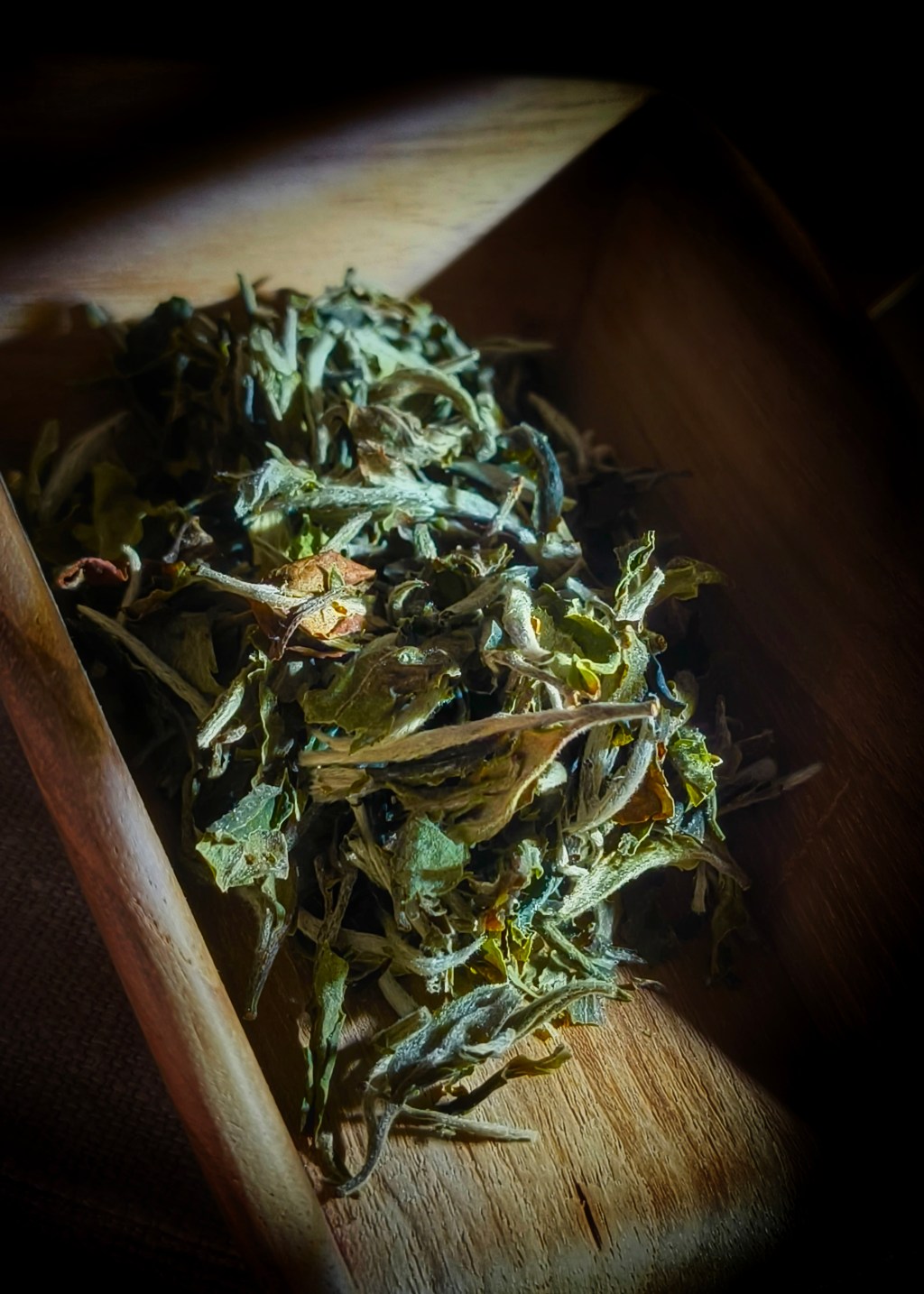
Muse is a sublime tea, the kind I come across only once every three or four years, because evidently nature does not wish to give more than that. It’s a tea whose wet leaves smell of bison grass, soft French nougat, myrtle leaf, and mulberry gelato. At first, it seems accommodating, then it leaves the coasts of Occitania and dives into deeper waves of sweetness: guava, golden kiwi, and frangipani, lined with vegetal chords of cactus, then aloe, like in an art deco perfumery in Silver Lake. In the end, everything contracts into something foreign, citrusy. Pomelo. Sharp. Precise. Almost hostile.
In the mouth, it’s soft, intensely sweet, but anything but commonplace. The flavors point to fig, vine leaf, traces of herb butter, something vaguely liqueur-like, maybe green acorn distillate, and then birch sap. It’s not a taste. It’s an image. Then it veers. Completely, into mulberry and grape.
For anyone who believes Indian teas lack Qi, they need to try this. The sensation is stunning, abrupt like a flood of adrenaline rushing through the vena cava, like that chill running down your spine when something truly significant happens. Like all great teas, it lingers. It stays with you for hours, like a text message at 3 a.m. you wish you’d never read. You can push it through ten infusions, fifteen, but the flavor never leaves your mucosae. Muse persists, like nails tapping softly on a taut drumskin, quieter and quieter until nothing is heard anymore and the noise of the street comes through the window, and yet you know that something is still resonating in that absurd chaos.
 Wild Harvested
Leave a comment