
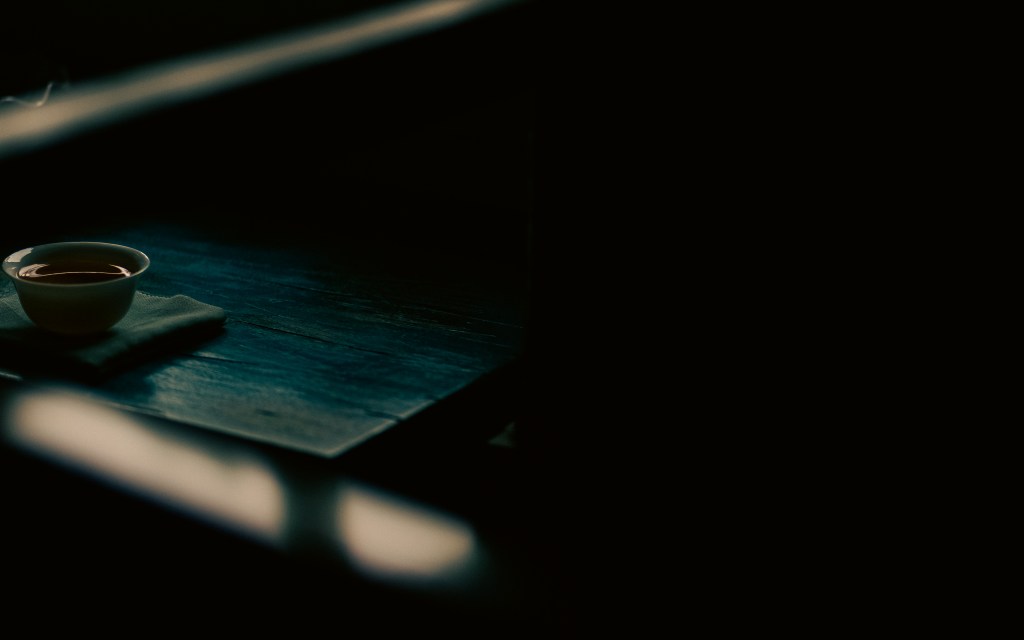
Friday never fails to ambush me with military precision, a shard of LED light that needles the cornea just as the blog-renewal alert detonates my hard-won, tax-season calm. I can’t remember the last time I lingered over a single tea. Perhaps the moment I proclaimed independence from performative tastings, a small act of mutiny against what Instagram has become: a midway of recycled meanings, its algorithms drifting steadily toward isolation and middling advertorial fodder, or maybe it was the darker undertow of existential unease.
Everything seems already said, about tea, about Pu’er, about teapots, each new sentence feels like drilling a dry well, an intellectual oil rush I quit long ago. Yet tea keeps seducing me. At dawn it steals into the room with the breath of damp undergrowth, commandeers my hands before I’m fully awake. That’s hyperbole, of course; most mornings begin with cold water in the face, then the office, the stench of burnt coffee and courtesy smiles fit for a character in Severance.
Still, tea moves me viscerally. In the sprawling, anarchic stack of cakes looming from the shelves, each sip is a small act of resistance against the world’s static. Writing has become a private necessity, a way to pry loose stories before premature cerebral rust deletes them.
I think of this while I pry open a modest 100g Gua Feng Zhai cake, one I’d assumed desiccated by the parched air of northern Italy, where the weather is as unstable as Liz Truss’s cabinet. The first scent summons an obstinate old man I met long ago: hunched, wrinkled, spirited, flashing the few teeth he had like contraband. He reminded me of my grandfather, another riverbank curmudgeon, though oceans apart. He’d abandoned Sheng Pu’er after seventy, blaming sorghum liquor for his rebellious stomach.
We spoke of tea, yes, but mostly of the fragments he’d salvaged from youth, like how his father, Yu Senior, served in the logistics rear in ’39 while Japanese forces chewed through Hunan and Jiangxi toward the lower Yangtze. The old man conjured red-rice paddies where the smell of bruised grass mingled with kerosene and swamp rot; his father boasted that once shook hands with Long Yun and claimed familiarity with generals of the Kuomintang. To him the terraces looked like mercury pools, with the rice stalks standing at attention like soldiers waist-deep in blood; he recalled drunken sprints in the forest, collapsing against girlfriends’ bellies, a bottle of rice wine sweating in the palm as they trudged home from the factory.
Decades later, after the collapse of the Great Leap Forward, granaries emptied and markets dwindled to skeletal queues. Yu and his brother waded waist-deep in the canal’s narrowest throat, hauling up níqiū, “those idiotic serpent-loaches,” he growled, for supper. Evenings they gutted fish on elm stools, washing them down with tea and sorghum spirit. His wife, seated a short distance away, bent fish-hooks into makeshift needles and embroidered fields of millet on the threadbare fabric, sewing with fishing line instead of thread.
His village, he swore, produced the bravest and the crookedest, the finest lovers and the wildest drunks. He spent his last working years at the Fangcun market; he was there when the Pu’er bubble burst, watching price charts bleed the same crimson as his father’s paddies. I listened, sipped, and took mental notes, half-inebriated on rice wine, as he tested my liver’s resilience, clutching the bottle’s neck with his hands swollen by bulging veins, mottled and capped by knuckles the color of mother-of-pearl.
“Just wait, this quiet leaf always finds its voice again, the way my wife does after a quarrel; she can’t sulk for long,” he would say, letting the words tumble into a laugh that instantly dissolved into a tobacco-cured cough, as if his lungs were plotting an orderly escape from the cage of his chest and the habit that ruled them. One hand stayed clamped to his breastbone, as though bracing it against the strain.
“Blame the sorghum liquor, and those stupid serpent-loaches,” he added. Certainly not the thirty Chungwas a day drilling through his alveoli. Smoke had become the grain of every anecdote, a reminder of his father, who smoked opium but never let it own him. That haze was now a curtain behind which to duck from his wife’s scoldings, the latest triggered after he’d wandered into the fields alone and lost his bearings. It wasn’t the first time, but previously he had always found his way back by following the river’s murmur.
Amid that swarm of cigarettes, tea, and wry marital sparring, I learned to trust time, to let what matters breathe, settle, and finally declare its meaning.
 Wild Harvested
Leave a comment