Category: Uncategorized

  • How Money Can Buy Your Taste. And Why You Should Buy Tea Anyway.

    How Money Can Buy Your Taste. And Why You Should Buy Tea Anyway.

    Universities are fascinating places to discuss how money cannot buy happiness. Perhaps because young people at that age are often strapped for cash and, at the same time, eager to prove that money can’t buy everything, not even that feeling, that harmony between duty and desire, between the passive acceptance of immediate pleasure and the attempt to avoid ephemeral satisfaction. The academies, until one secures a professorship, are also the venues where the idea of the hedonistic treadmill is strongly endorsed. This concept describes the human tendency to incessantly seek pleasures or material improvements without ever achieving lasting satisfaction. Even significant achievements, such as a career advancement, the purchase of a long-desired asset, or a personal milestone, generate an initial peak of satisfaction that nevertheless fades with habituation, returning the individual to their preexisting “set point” or “basal level of happiness.”

    I began to wonder, in conversation with colleagues, how one might temporarily yet continuously buy access to the upper floor of happiness, creating an emotional elevator that works on demand, but without the immediate dispersion typical of compulsive buying, and without short-term happiness eventually leading to long-term side effects. Honestly, I was very happy during my early university years, marked by precarious employment and mere subsistence, but I don’t think I’d want to return to those same conditions at this stage of my life. Yet I also don’t want, now that I’m aware of having greater purchasing power, to fall into the collector’s spiral, where happiness is repeatedly renewed and crumbles as one fills a substantial void or into the trap of social comparison, where one measures their value against others in a cultural context that celebrates material success. This phenomenon, as Festinger’s theory of social comparison suggests, has only made many people poorer and poorer. Then, for those of you, like me, who refuse to accept the reality proposed by Lykken and Tellegen, that 50%, and even more, of subjective happiness is hereditary, it becomes necessary to find something that rescues us from our desperate, ill-fated genetic inheritance of perpetual dissatisfaction. I would like to tell you that to govern happiness you must focus not on possession but on mastering your inner judgment; however, I am by no means the most spiritual person you’ll ever meet to be in a position to say that, and besides, I don’t feel like lying to you.

    If money cannot buy happiness, we have certainly noticed how it can at least purchase quality, or at the very least, the pretense of quality. I recall several studies, as well as numerous blind tastings, where it consistently emerged that wine, or tea, showed a positive correlation between price and quality, yet the relationship was always incredibly skewed. The most expensive product never ranked first, never. Now, in the Pu’er saga, we see how, as a common snack available everywhere, tea cakes priced at $1–2 per gram appear as if it were normal, as if quality resided only in those teas, and among the buyers of these cakes very few complain about the actual quality of these productions. Beyond the debatable nature of this phenomenon, there are reasons for it.

    The first is that these products do indeed embody quality, albeit not to the extent that justifies their exorbitant prices.

    The second, as trivial as it may seem, yet as current as a Rolex Submariner on a trust fund kid’s wrist, is that no one is willing to admit to themselves that they’ve burned through a third of their salary on a tea cake that didn’t overwhelm them with a mystical aura but was simply an excellent tea. This is the “sunk cost fallacy”, we recognize that it is irrational to persist in a failing project “because we have invested so much in it,” yet the pain or anger of admitting a loss paralyzes us, doesn’t it? When something is expensive, the link between price and pleasure becomes extremely strong; the price tag transforms into a vehicle for a symbolic narrative that promises a sort of redemption for the expense, an existential revenge. The more you spend, the more you believe you are accessing a “superior” pleasure, rarefied, almost transcendent, and this occurs even before the actual possession of the good, via dopaminergic anticipation.

    But the third, and most important, reason is that often the price demands attention. When you spend a lot, it is rare not to notice every smallest detail; every moment can become saturated with meaning. You’re willing to overdose on information just to testify that something is truly extraordinary. This happens even without resorting to selling your organs for a cake, but when you spend a lot, there is no doubt that even someone usually inattentive to every macro-detail would experience the situation differently. In short, both emotional and physical engagement reach their maximum.

    Tea in Asia is the apotheosis of agricultural art, and it is natural that people find far more to discuss about a Bi Yun Hao tea cake priced at $500 than about a Xiaguan tuocha costing $10. In the latter case, even if there were something worth discussing, the buyer might subconsciously suppress their thoughts, because it is socially expected that any good priced below a certain threshold has nothing to offer except a “daily squeeze” of repeated consumerism. Many believe that you cannot enter the elite with a ten-dollar purchase, right? But then, how can one leverage this perverse, consumerist vision to one’s advantage without selling both kidneys? Now I come to the point.

    What if we viewed price not as a determinant of the intrinsic quality of tea, but as a marker of a sacred boundary between the everyday and the consecrated moment, where money is not betrayed by the real quality (a quality that will never be proportional to the money spent in any case), nor idolized by those who have invested a fortune in what they consider the only way to achieve “true” pleasure? It would no longer be about chasing luxury or a social identity, but about intensifying the present regardless of other factors at play.

    To do this, there is no need to spend vast resources; it is enough to pay just a little more than what we consider “normal,” employing a critical yet functional hedonism in which that slight surplus serves as a cognitive bypass and taste criticism functions as a true tool in the search for real quality. Then, all that is needed is to unbox a tea cake and share it, with someone you love or with yourself on a difficult day, thereby consecrating the moment. And you can do this repeatedly, in a logic that transcends every commercial imposition.

    That “little bit more” translates into the symbolic gesture of surpassing the ordinary. If you think that isn’t enough, bear in mind that one aspect is the rational awareness of a cognitive bias, and another is overcoming it. It becomes akin to knowing about an optical illusion yet continuing to perceive it even after understanding the trick. Awareness of a bias triggers the analytical system, which is more laborious but corrective; however, it does not interfere with the creation of the bias itself—because biases are effects of evolutionary inertia, developed to survive in a context of cognitive sustainability, not to be right. Essentially, we live in a sort of metacognitive blindness, so why not exploit it.

    Let it be clear, this approach would not make extraordinary what is not, nor would it imbue something with an unreal quality it does not possess, but it would help remove many externally induced obstacles to accessing this generative mechanism.

    In addition, it would bypass what Byung-Chul Han defines as the “psychopolitics of consumption”, that is the colonization of emotions by the market, which transforms price into an indicator of sentimental intensity, a revealer of truth. Instead, a practice of ritualized happiness is built, as Bruckner would note, whereby a Pu’er tea cake becomes a pragmatic and positive fiction, an accessible simulacrum that does not promise the eternal happiness but guarantees a repeatable fragment of fulfillment.

  • Seven Essence Darjeeling Masquerade

    Seven Essence Darjeeling Masquerade

    I believe there are few people on this earth for whom I have ever felt even a modicum of envy, and I do not say this out of vanity nor from some absurd, ultraterrene awareness. I’m simply indifferent to the allure that possession exerts on people, the resonance of an echo of absence, the trace of a denied desire. Yet Bubble and Abhijeet have a rare, transcendent empathy when it comes to tea, a quality that is either innate or remains scarcely graspable, one that probably I don’t even have. Their autumn collection attests, indisputably, to their status as the Vaughan brothers of the Darjeeling terroir and to the perception that selecting leaves is a virtuous act, a testament to aesthetic discernment.

    The election of the proper material is not a mere sorting process; rather, within it dwells that lyricism, that aphonic language in which what resides is lifted from its ordinary form, unfolding into a dizzying array of aromas and scents where time contracts and expands with a diaphragmatic cadence. To select leaves is an invocation of the sublime, a re-creation of the universal tension between order and chaos, wherein the structural opposition of what is utilitarian and what lies beyond utility is drawn and maintained open, rendering tea not merely a beverage but a vehicle of meanings.

    Masquerade is a Darjeeling oolong produced from the AV2 cultivar, a tea with a dense liquor, a chromatic snapshot vibrating between ancient gold and dusty amber. The leaves exude the fragrance of rose and jasmine, of olive oil and fruit tart. The infusion is sweet, soft and persistent, with hints of pear, pistachio and dried apricot. It is a sip of freshness, capable of rejuvenating even those weary nights, illuminated by the flashing lights of police cruisers deployed in one of those torrid, sleepless nights.

    Notes of chlorophyll, subtly vegetal, along with hints of olive leaf and mango, evoke an introspective road movie, laden with trembling shooting of hands brushing against corn stalks and bodies staggering in the sultriness, a spiral of rural unrest and youthful rage, of adolescent fights in the badlands, where typically nothing was too dear but everything cost too much.

  • Rethinking Changtai’s Legacy: Are post-2004 Productions Really That Bad?

    Rethinking Changtai’s Legacy: Are post-2004 Productions Really That Bad?

    The postmodern saga of Changtai is a mélange of nostalgia and decadent retrospection—a journey that began as an escape route, full of fleeting glimmers and vibrant lights, from the state-dominated gloom of the ’80s, soon became a conceptual reimagining of State Road 9, with its kilometers of pitted asphalt and half-lit motel signs sliding anonymously past the car window. They were riding the Pu’er epic, where every tong was marketed as if it were the Rosebud of Citizen Kane, that elusive treasure everyone sought to understand and possess. Nowadays, according to many aficionados, the tale of Changtai resembles the narrative of Bas Jan Ader’s brazen, smiling bike ride right before his humiliating crash. “If you want Changtai, look for it before 2005…”—one of the most overused phrases of the past decade. But is that really true?

    Founded in ’99 in Yiwu by the will of Chen Shihuai, Changtai began selling its tea under the brand Yi Chang Hao, carving out a niche much like an indie rock band holding what seemed to be the perfect record, before the industry ruined everything. After YCH, they went on to produce numerous successful series sourced from single terroirs, such as Chen Hong Chang and Chang Tai Hao—exclusive teas crafted to last, to age like the finest Chateau Margaux. Yet, a few years later, something broke.

    The Pu’er market of the 2000s was not unlike the realm of contemporary art: suddenly, money flooded in, investors arrived, critics lost their impartiality by getting drunk with the artists, and everyone wanted a slice of the cake. Demand exploded, prices soared, tea was even planted at lower altitudes, and factories ramped up production. Pu’er was no longer merely a tea, it had transformed into a financial asset.

    In 2004, the factory reorganized as Changtai Tea Group, and with it came a change in approach: economies of scale took precedence, there was a greater reliance on plantation-grown material, more commercialized sourcing, less meticulously managed fermentations, and a reduced attention to detail. The overarching idea was to produce volumes, to churn out new batches for collectors who scarcely understood what they were buying—all while fierce competition for the best leaves intensified. Quality became diluted, much like a Warhol reproduced ad infinitum.

    At the onset of my own economic tragedy, when I first began acquiring cakes, I, too, partly embraced this notion.

    Comparing a Yiwu from ‘99 with one from 2006 felt like plunging from one metaphysical plane into another. The former was silky, layered, opulent and clear, while the latter was sparse, tediously sober, its complexity shackled by an almost ascetic organoleptic austerity and a finish that fizzled out too quickly, like a film abruptly cut before the climax. Yet over the years, I questioned whether this was universally true for all Changtai teas and how much weight these few general observations really carried—perhaps too cursory to be definitive. Thus, I granted them another degree of judgment.

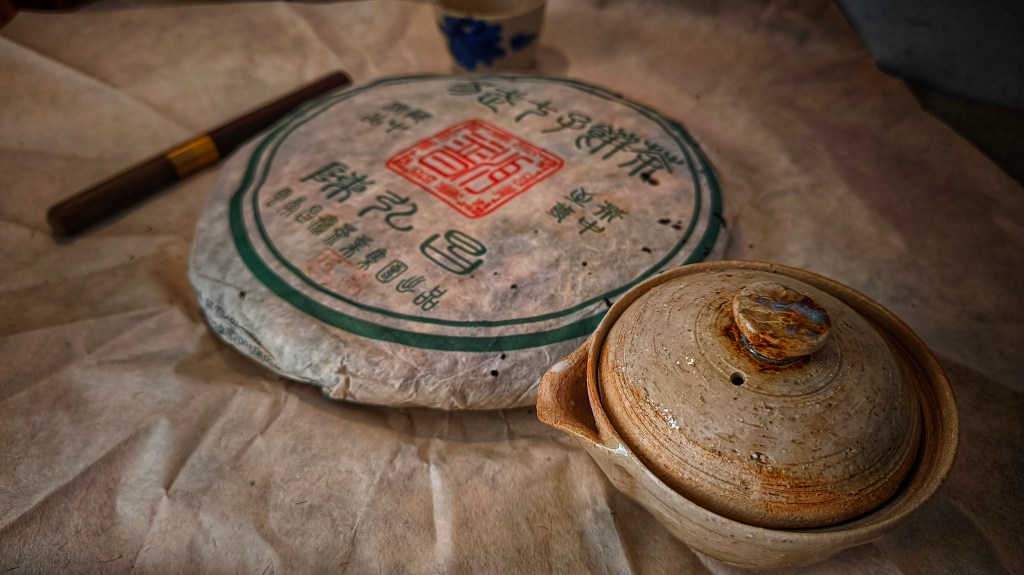
    I compared dozens of Changtai cakes each year—an obsession, really—and indeed, something had shifted, at least in trend. However, about five years ago, as I revisited that graveyard of samples I had set aside, I was stunned. The productions between 1999 and 2003 were undoubtedly remarkable, but those of 2005 and 2006 were not so far removed from their predecessors. I mean, hundreds upon hundreds of grams tasted in blind comparisons over ten years, two epochs that were supposed to be worlds apart and with an extra zero in the price tag, should have belonged to entirely different existential planes. But they weren’t, or at least not as much as public opinion, and my own mind, insisted. Production had indeed changed; however, certain elements of those iconic batches survived the onslaught of serial reproducibility, escaping the cynical, clinical gigantism of enormous, hypertrophic factories. Although these later productions underwent adaptations that created some detachment from their predecessors, cakes like the one in the photo, and others from 2005 and 2006, cannot, simply by that fact, be equated with the banality of a uniform proliferation, the child of that industrial era so often lamented.

    This supposedly inglorious decline was cemented when a course correction was made, delineating a sociological divide between tradition (what peoples craft for themselves) and folkloric reproposition (destined for mass consumption), which, though appealing, remains distant from the truth that governs the opus traditum, the craftsmanship of remote ancestry. But how much truth lies in all of this? How much tradition truly remained in Changtai after 2004?

    What shocked me most was the disparity in storage conditions among the various references, a factor that skewed the objectivity of judgment far more than any real qualitative gap. The cakes from the end of the last century through 2003 are genuinely of a high caliber, achievements that later productions can hardly aspire to match. In the 2003–2005 period, I found no absurd differences, certainly not enough to justify the price differentials from one year to the next. Often, excessively humid aging had irreparably ruined even excellent signatures—like a ’99 Yi Chang or a Mr. Wang Red Chang Tai Hao—trivializing their brilliance.

    Therefore, I believe that the environment in which these cakes have spent their lives is far more important than determining whether a 2005 Chen Hong Chang measures up to one from 2000, and that much of their economic and organoleptic value lies precisely there—in the climate, in the place in which they have dwelled—probably more than in the origin of the leaves, which counts for nothing compared to a twenty-year period spent in a humid warehouse, left to sour and reduced to nothing more than a basement squeeze.

    Moreover, finding well-preserved cakes to make such comparisons has become increasingly rare. Therefore, my modest piece of advice—if you haven’t sampled what you intend to buy beforehand—is to drink; take 2005 cakes without prejudice, provided they come from a reliable source. It is not entirely true that quality plummeted drastically after 2004; these issues emerged slightly later, and I may expound on the reasons in a subsequent article. In any case, if you are lucky, you’ll have secured a small masterpiece at a quarter of the price—one that, with high probability, isn’t a fake. If things don’t go your way, you’ll have gained a daily drink that is surely better than having burned a fortune, blindly thinking you’d closed a deal for a Romanée-Conti that, in reality, tastes like an old fisherman’s boot; or worse, a counterfeit, because the seller’s reliability wasn’t factored into the equation.

  • The Liquid Reflection of Civilization. Seven Essence Darjeeling Epilogue

    The Liquid Reflection of Civilization. Seven Essence Darjeeling Epilogue

    Years ago, I met a professor, one of those old, gruff Labour men, fond of humanity provided it was kept at a safe distance. He lived in permanent exile from pragmatic reality, an outcast who had sought refuge in erudition, guardian of a nation that had ceased to exist before he was even born.
    He listened to Mahler after his Darjeeling, but would only play it if the tea had truly satisfied him, perched on that Danish Art Nouveau oak stool with its black leather seat, with his fingers gripping the keys like ash roots burrowing into earth.

    Epilogue by Seven Essence brings him back to me, sitting in his study poised within the hypothetical temporal sliver between Hope’s Regency style and Ruhlmann’s Art Deco.
    He never chained tea to a fixed hour, nor did he treat it as a prelude to elitist drunkenness. To him, it was the liquid echo of ancient civilizations and their highest reasoning.

    The mahogany, varnish, sweet potato, petrichor, rye bread and cask notes, all wrapped in a cloak of earthy minerality, bring back that room drowning in bound pages and an excess of ebony. Watching it in the cup, I recall our conversations about Vermeer — the tea shines, releasing a warm light, as the one that illuminated the flesh-like surface of the Girl with a Pearl Earring, a radiance both earthly and sacred.

    The sip is rounded, neoclassical, sober yet embracing, with a warm, exuberant body, full of pepper, cocoa, violets and autumn fruit. The sip ends with a sugar cane sweetness almost severe, like the curtain closing on a Powell or Pressburger finale, those directors who knew how to grasp the soul of things without succumbing to sentimental drift.

    Epilogue reminded me of those cultured, discursive forays and how drinking tea itself is politics: a good, human politics that forces us to admit our dependence on the earth, on history, on the cultures of those far from us, in another time or place.
    Every cup is a choice. Drinking good tea is an act of resistance.

  • Neo-Noir Infusion: Drinking Time in a 2007 Banzhang Cake

    Neo-Noir Infusion: Drinking Time in a 2007 Banzhang Cake

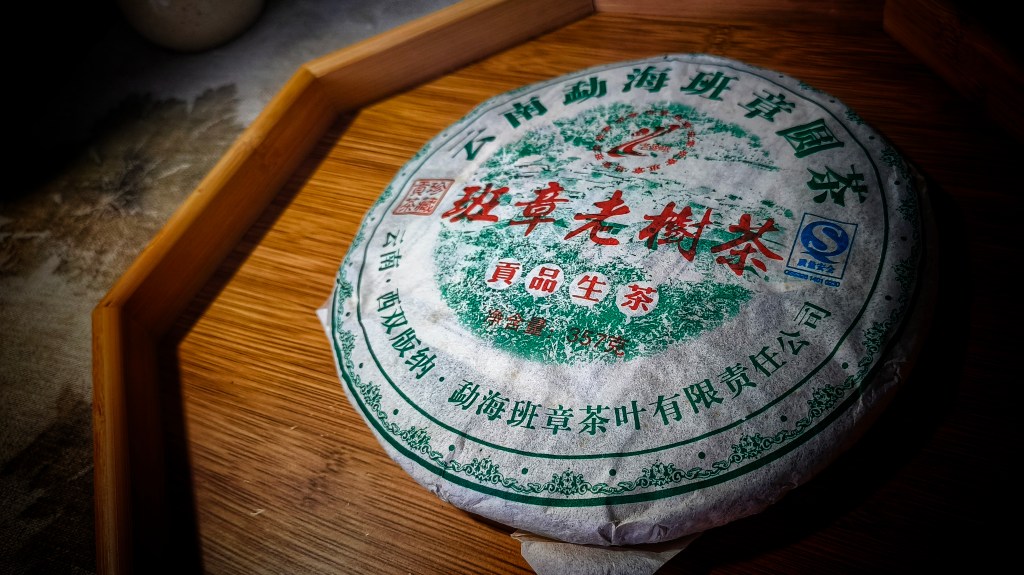
    Lao Man Er, a brand many are likely familiar with, produced this cake in 2007 using old trees leaves from the Banzhang area. I doubt it includes LBZ or Lao Man E, and I equally doubt there is a significant share of XBZ, but there is something intriguing here. Beyond the brands and trends, there are things—or teas, in this case—that offer a window into a space and time distinct from our own, tempting those caught in the compulsion of favoring only a preferred label to look elsewhere.

    With its undeniable urban bohemian verve, it teaches the perfect balance of wet and dry storage, revealing mature yet still vibrant aromas woven into a humid structure, neither weary nor depleted by the damp condensation of some Taiwanese basement.

    Through earthy undertones interwoven with hints of leather seats from an old E-Class and cognac-soaked cork, it conjures a muggy, far-from-perfect night inside a car, where buildings seem to jostle against each other to stay upright. What emerges is a metropolitan Erebus seen through the hyperreal cornea of Richard Estes, with the visual cortex overexposed to those nocturnal images of smoke and decay, a flickering interplay of light and shadow in the neo-noir outskirts of Hong Kong.

    The leaves evoke the metallic sheen of a puddle on warm asphalt, the dry sweetness of tobacco, a distant echo of spices and herbal tinctures. They also bring to mind fermented fruit, aged pomelo peels, the scent of old haberdashery furniture, and the leather-bound books of a forgotten bookstore hidden in the alleys of a city that never sleeps.

    The sip feels like a 35mm frame, with each scent of time etched into it, like a latent image forming on film, one catches a glimpse of a past spent in some chipped underground warehouse, as well as a more recent existence in a better-exposed shop in Guangdong, when notes of chestnut, dried plum, figs, and kombucha come alive, only to give way to a faint yet persistent huigan, dissolving slowly and gradually like the last cigarette left burning, like the night retreating at dawn.

  • A Theatrical Infusion of Desire and Disorientation. Seven Essence Darjeeling Autumn Caprice

    A Theatrical Infusion of Desire and Disorientation. Seven Essence Darjeeling Autumn Caprice

    Seven Essence Caprice is the whim that comes from that land pushed to the edge of the sky, it’s the tea you wished you could offer to the stranger you met every morning on the subway, with that porcelain skin not exactly free from subtle traces of time, those perfectly arranged marks that made her attractively real and weave memories of encounters that never happened in your mind. But you never came up with the right words, only the absurd idea of the right tea to offer her, and that tea is this.

    The leaves, once wet, declare themselves on tones of magnolia, mango pulp and tomato. Then come marine notes with a Mediterranean accent-hints of salicornia, caper, green olives, and herbs butter. The extraordinary complexity reverberates in the mouth with aromas of millefeuille, white peach and cactus leaf to close a theatrical sip, sweet and at the same time salivating and refreshing.

    These notes are the orchestral delirium that connects Akita Tonburi with horseradish cream to the hysteria of strawberries with rose jam and frozen cherry blossoms at Eleven Madison, they are the trigger for a ecstatic dance in the middle of those buildings on the upper west side that stand like giant soldiers at the service of the stock market and you are leaning against the wall, rolling your tongue on the palate, trying to retrieve those aromas of mango, green plum and wild strawberries. Caprice is the highlight of the day before you disappear into the usual pre-war urban coffee shop between 6th Avenue and 8th Street, with late Art Deco interiors mixed with a sober mid-20th-century functionalism, with the reek of scrambled eggs and burnt fat in the air, the typical late-night aroma that smells of debt, perdition and broken promises useful for detoxing from the unbridled luxury of Caprice.

    It’s difficult to write about a tea like this without it seeming like an act of submissive flattery, I assure you that it’s not a simple narrative, but with some teas you don’t witness a simple act of tasting but rather a controlled hallucination, designed for those who seek disorientation and sudden revelation in taste, they are a sensorial vertigo, a chase in a context of constant perceptive tension.

  • The Last Sip Before the Wrong Choice. Seven Essence Darjeeling Patois

    The Last Sip Before the Wrong Choice. Seven Essence Darjeeling Patois

    I’ve often tried Seven Essence teas in recent months, and I’ve observed how they are able to construct a language that oscillates between lyricism and the most material pleasure, weaving a plot of formal innovation and human depth. I believe that Patois is no exception.

    Patois comes from the frozen AV2 buds of the autumn harvest. In that gaiwan, where the trembling light of yet another winter morning filters through, you can find a liquor that seems like liquid gold with shades of amber, giving off a disarming note of salty pistachio once the ceramic is heated. It’s one of those teas where, while you drink it, you find yourself absurdly in another place, torridly hot, watching the noisy and oscillating fan on the ceiling of a hotel room overlooking the bay, with curtains too heavy and the atmosphere influenced by the neurotic light of a neon sign now three-quarters off. And you, accustomed to the notes of green mango, basil, and wild thyme, wonder if the person still lying next to you thinks you’re crazy or is also feeling the liquid move in their mouth, soft as avocado melting on the tongue, with an aroma of magnolia and gooseberry jelly that enters the retronasal cavity like a promise.

    Teas like this are not for those who seek comfort in the warm steam of the broth your mother made when you couldn’t stand, nor the embrace of hot coffee the morning after a night out clubbing. Patois is the tea for those who stubbornly try to remember what they’ve never experienced, for those torn by nostalgia for a film that was only staged inside their mind.

    Patois is the tea Jay Gatsby would drink after a night staring at the green lighthouse, if only he were a tea person. It’s the sip that accompanies the suspended interlude before making the wrong choice. Patois is not for the faint of heart or hypochondriacs of disaster; it doesn’t comfort or warm. It leaves you there, feeding on that aphasia pregnant with suspension, which accompanies the gaze toward the trace of a Venetian coquetry-style perfume that you wish had been put on for you, but is now on the coat of someone who is too far away, fit to seduce someone else.

  • Echoes of Tea Lyricism Part 1: “Bay Meng Yu and The Rise and Fall of the Nannuo Shan Tea Factory”

    Echoes of Tea Lyricism Part 1: “Bay Meng Yu and The Rise and Fall of the Nannuo Shan Tea Factory”

    The Instagram story from a few days ago about Bai Meng Yu and the radical mid-century shift in the mechanization of tea production in Nannuo has gotten more attention than I thought, and I thank you so much for that. So on this chilly morning, drinking a 2003 Nannuo sheng, it seems conceivable that I would be talking to you about pu’er, about a historic change in its production. But no, or at least not really.

    This is because the factory I will talk about did not exactly produce pu’er, in the 30s there was a different concept than the modern one, not all mountains produced pu’er tea and consumed it with the same frequency. The tea produced was mainly sundried green, a sort of primordial maocha. Let’s remember that the era was still that of the ancient pu’er, few mountains managed to have a pseudo-continuous production, often interrupted by internal conflicts, and the price of a cake was extraordinarily high, while the production volume remained exceptionally low. At the time 800 cakes were a big deal and satisfied almost all of Hong Kong’s internal demand. Production was mostly attributable to private family brands where tea was sometimes just a collateral part of their farm, often focused on rice, soy, sorghum and other grains. The period is that of brands such as Jingchang Hao, Fuyuangchang Hao, Songpin Hao, Tongqing Hao and others. But what was pioneering and unprecedented on such a scale was the establishment of Nannuo’s first factory in Shi Tou Zhai.

    Bai was born Bai Liang Cheng, later nicknamed Meng Yu and Lian Fu, in 1893. He was a Muslim of Hui ethnicity and lived in Shadian before undertaking business trips to more than 20 provinces across the country in 1936 and 1937 to analyze the tea market, and finally to conduct studies in Japan and India on processing technology. Upon his return to Menghai, he was put under the spotlight by the Yunnan provincial government. It was early 1938, and the provincial institutions were determined to invest in the creation of the Yunnan Si Pu District Experimental Tea Factory, appointing Bai Meng Yu as its director. He had always been impressed by Nannuo, had a special predilection for that mountain, and when he took over the project he opened a branch there. He was among the first to understand the historical, cultural and geographical complexity of that mountain, of that place that was and would be the cradle of tea lyricism for centuries.

    Bai’s vision was not only about productive efficiency but also about building a sense of community, a sense of responsibility that transcended mere economic considerations. He persuaded local farmers to plant over 100,000 tea trees, establishing a lasting resource of socio-economic value. This initiative was not just a pioneering agricultural operation, but an act of cultural preservation and reconstitution, a pact that would bind generations, establishing deep roots both in the soil and in the spirit of the community.

    There he set up a hospital for the staff, a basketball court, housing for the workers, entertainment rooms and a building for the autonomous production of energy. What was innovative was the particular form of conservative design chosen for the construction, the modern plant was built directly on the summit, designed not to detonate any part of the mountain; the loading system and the vertical structuring of the work were reminiscent of those of the old wine presses on Etna: the fresh tea was weighed on the upper floor, dried and sent to the first floor for the rolling phase through a gravity system with trapdoors located on the work surfaces and on the floor. The final drying took place in the sun, in the shaihong style. Since each phase progressed from top to bottom, the process could be significantly accelerated and the workload per individual worker substantially reduced. At that time, the factory had fewer than 60 workers and could produce more than 20 tons of tea per day.

    The factory was officially operational in January 1941, mainly producing black tea and maocha whose leaves were sourced only from Nannuo farmers, mainly sold to Hong Kong, Myanmar, India as well as locally. In this way, it not only secured the province the precious foreign exchange it desperately needed, but also laid a solid foundation for the future mechanized production of quality tea, probably before Menghai, Dali, Fengqing, Mengku, and not only in Yunnan but also beyond the country’s borders, leaving an imprint that would echo in the global tea landscape.

    The narrative surrounding the procurement of the tea processing machinery is instead shrouded in an almost epic aura, worthy of a time when industrial progress was rarely seen in those parts. The machines are believed to have been imported from the United Kingdom, shipped by sea to Myanmar, transported by land to Jingdong and through a grueling pilgrimage of trucks and mules to their destination.

    There is, however, another version of the facts, more prosaic and less romantic, of those who think that the machinery was more likely purchased in India, in Calcutta, where Bai had been some time before and where many companies selling such equipment were based, such as Marshall, Sons & Co. and Brown & Co. but above all the Ceylon Tea Machinery Company and that of Sir William Jackson, a Scotsman whose mechanical genius had revolutionised the tea industry, who worked for his brother’s company in Assam, the Scottish Assam Tea Co. His inventions included the Excelsior, probably the first rolling machine, as well as the Victoria, Venetian and Britannia driers.

    What is truer, however, regardless of the version of the story, is the enormous human effort that made the installation of the equipment on the mountain possible. 10 carts were involved, each pulled by 3 oxen under the supervision of 15 workers to reach the top of the construction site, advancing in all conditions for 2km a day, cutting down trees, breaking rocks, building drainage systems and closing ditches. For six exhausting months the men worked tirelessly, challenging that harsh and previously inaccessible land, completing an unexpected and anachronistic work.

    But right in the middle of a major plan to modernize and expand markets, the Japanese army invaded southern Yunnan. The Burmese highway was bombed by enemy planes and traffic was paralyzed. Tea destined to Myanmar, a key hub, could no longer be transported, and teahouses and factories soon began to cease production and convert many of their plants to war production facilities. The crisis congested the entire nation and Bai decided to take an active part in the conflict. He helped build a reception center in Jinghong, organized the construction of dozens of bamboo rafts to help soldiers deployed across the border return home. Together with other officials, he trained tea factory workers, turning them into guerrilla fighters against the Japanese occupation, ensuring that each of them was armed and financing their equipment. However, the climate became even more incendiary and the economy collapsed even further towards the beginning of 1948, the Nannuo factory closed permanently and Bai Meng Yu was forced to leave Menghai, moving first to Myanmar and then to Chiang Mai, where a large community of Chinese Muslim immigrants resided, dedicating his last years to literary activity until August 1965, year of his death.

    After the founding of the People’s Republic of China, the government organized its restoration and reconstruction in 1953 and the following year it was merged with the Fohai Tea Factory (the predecessor of the Menghai Tea Factory), with which Bai had a strong rivalry at the time and whose director was Fan Hejun, another cornerstone of the tea industry during the last century. The Nannuo Factory remained under the leadership of Yang Kai Dang until 1994.

    With the reform and opening of markets, tea production and sales were liberalized. Private tea factories emerged, while state-owned ones struggled to keep up. By the early 2000s, the Nannuo Factory was gradually ceasing production amidst the turbulence of an industry undergoing profound and unimaginable changes at an unprecedented speed. A glorious era that had paved the way for modern tea was now fading.

  • Seven Essence Darjeeling Scorsese red

    Seven Essence Darjeeling Scorsese red

    This was the last tea of 2024 and the first of the new year. It was a tough, exhausting year. Dealing with the pain of loss, with the sense of emptiness, of being unmoored from the warmth of everyday life and the luxury of the habit of affection, I believe is the greatest thing that nature can ask a human being to face. For the first time in ten years, tea was not at the center of a significant moment, it was a palliative, something secondary, the translation of the search for a cure.

    What had always fascinated me about tea and its aging, its ontological tension between existing in the moment and thriving in a higher dimension, its transitory nature suspended between being and dissolving, the form and its annihilation, from that moment also applied to human life in a cruder and crueler way than I had ever experienced.

    This tea, the @sevenessenceofficial Scorsese was a companion, a ferryman between the days that followed one another without apparent sense. Sipping it is like tasting the truth, it is like watching a painting by Francis Bacon come to life, built with one brushstroke of flesh and blood after another.

    With that note of Sacher and cinnamon, of burley tobacco, of wenge, of leather and smoke, it initially presents itself as a dark and gloomy shot governed by soft lighting, with a corner set up for a sweet Christmas, all mistletoe and songs, in a untidy apartment plastered with references to art deco in the hallucinatory New York seen through the alienated and feverish gaze of Travis in Taxi Driver.

    When the world seems too hard, when losses pile up and the weight becomes unbearable, tea I believe offers a refuge, which is a greater blessing than we are often granted. It is not an escape, but a return to what is essential, and in its cheering sip pervaded by the aromas of condensed milk, apricot, vanilla and chocolate is what this tea embodies, it is like us, it resists, it keeps us standing, it appears in our lives like diegetic music, as that stranger who suddenly puts on a swing piece in a now-dimmed room in the middle of a bad night, convincing us to give life a dance once again.

  • Climate crisis, Darjeeling and Sublime. Seven Essence Darjeeling summer Ochre

    Climate crisis, Darjeeling and Sublime. Seven Essence Darjeeling summer Ochre

    Despite the climate crises, landslides and hydrogeological disasters that have brought the Himalayas to their knees in the last decade, some corners of this land continue to surprise, returning results beyond the imagination, overcoming difficulties and uncertainties.

    Ochre is a Darjeeling tea, created using the AV2 cultivar, with golden leaves, twisted like the enigmatic smile of Klimt’s Judith, pleased in her languid gaze.
    Born from a thirsty summer, now the umpteenth, it reveals notes of cocoa, malt and buckwheat, then grants aromas of grilled beetroot, cherry brownies and maple syrup.

    Just like in Judith, in this tea lives that something that seduces but leaves a sense of uneasiness, showing that power, which was once attributed only to art, to evoke ambivalent sensations.
    Klimt transformed Judith’s heroic gesture, the killing of the Assyrian general Holofernes to free his people in an act that sublimates partly as a hedonic symbol and partly as a manifesto of an uncertain era and it is in these terms that Ochre places itself.

    The spring harvests are now the children of continuous cycles of drought and violent rains, an alternation of moments of climatic inactivity and destructive floods and in front of the intensity of teas like this I ask myself what and how much we risk losing, and the answer is things like these.

    The sublime is linked to terror, and terror is all the more terrible when linked to the worst fear for man, that is, loss. It takes us beyond the sensitive abyss and is the intersection between a sense of anguish that manifests itself as a shiver and that Laetitia as Schiller described it, that dazzling sense of bliss.

    And in part teas like these bring us back to this condition, to the fear that things like these may one day not be there or exist in such a different proportion that we forget what was there before.

    In its softness, in its caramelized, buttery and lactic aromas, this tea is an encounter between pleasure and meaning, between sensorial beauty and contemplative introspection, transforming its aromatic expression into an experience not only of taste, but of eternal beauty.