
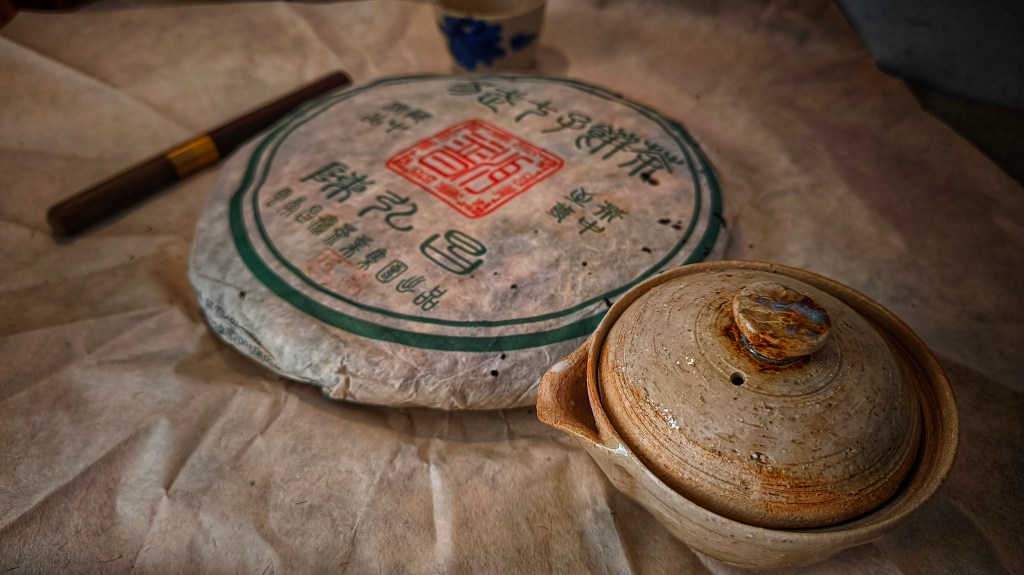
The postmodern saga of Changtai is a mélange of nostalgia and decadent retrospection—a journey that began as an escape route, full of fleeting glimmers and vibrant lights, from the state-dominated gloom of the ’80s, soon became a conceptual reimagining of State Road 9, with its kilometers of pitted asphalt and half-lit motel signs sliding anonymously past the car window. They were riding the Pu’er epic, where every tong was marketed as if it were the Rosebud of Citizen Kane, that elusive treasure everyone sought to understand and possess. Nowadays, according to many aficionados, the tale of Changtai resembles the narrative of Bas Jan Ader’s brazen, smiling bike ride right before his humiliating crash. “If you want Changtai, look for it before 2005…”—one of the most overused phrases of the past decade. But is that really true?
Founded in ’99 in Yiwu by the will of Chen Shihuai, Changtai began selling its tea under the brand Yi Chang Hao, carving out a niche much like an indie rock band holding what seemed to be the perfect record, before the industry ruined everything. After YCH, they went on to produce numerous successful series sourced from single terroirs, such as Chen Hong Chang and Chang Tai Hao—exclusive teas crafted to last, to age like the finest Chateau Margaux. Yet, a few years later, something broke.
The Pu’er market of the 2000s was not unlike the realm of contemporary art: suddenly, money flooded in, investors arrived, critics lost their impartiality by getting drunk with the artists, and everyone wanted a slice of the cake. Demand exploded, prices soared, tea was even planted at lower altitudes, and factories ramped up production. Pu’er was no longer merely a tea, it had transformed into a financial asset.
In 2004, the factory reorganized as Changtai Tea Group, and with it came a change in approach: economies of scale took precedence, there was a greater reliance on plantation-grown material, more commercialized sourcing, less meticulously managed fermentations, and a reduced attention to detail. The overarching idea was to produce volumes, to churn out new batches for collectors who scarcely understood what they were buying—all while fierce competition for the best leaves intensified. Quality became diluted, much like a Warhol reproduced ad infinitum.
At the onset of my own economic tragedy, when I first began acquiring cakes, I, too, partly embraced this notion.
Comparing a Yiwu from ‘99 with one from 2006 felt like plunging from one metaphysical plane into another. The former was silky, layered, opulent and clear, while the latter was sparse, tediously sober, its complexity shackled by an almost ascetic organoleptic austerity and a finish that fizzled out too quickly, like a film abruptly cut before the climax. Yet over the years, I questioned whether this was universally true for all Changtai teas and how much weight these few general observations really carried—perhaps too cursory to be definitive. Thus, I granted them another degree of judgment.
I compared dozens of Changtai cakes each year—an obsession, really—and indeed, something had shifted, at least in trend. However, about five years ago, as I revisited that graveyard of samples I had set aside, I was stunned. The productions between 1999 and 2003 were undoubtedly remarkable, but those of 2005 and 2006 were not so far removed from their predecessors. I mean, hundreds upon hundreds of grams tasted in blind comparisons over ten years, two epochs that were supposed to be worlds apart and with an extra zero in the price tag, should have belonged to entirely different existential planes. But they weren’t, or at least not as much as public opinion, and my own mind, insisted. Production had indeed changed; however, certain elements of those iconic batches survived the onslaught of serial reproducibility, escaping the cynical, clinical gigantism of enormous, hypertrophic factories. Although these later productions underwent adaptations that created some detachment from their predecessors, cakes like the one in the photo, and others from 2005 and 2006, cannot, simply by that fact, be equated with the banality of a uniform proliferation, the child of that industrial era so often lamented.
This supposedly inglorious decline was cemented when a course correction was made, delineating a sociological divide between tradition (what peoples craft for themselves) and folkloric reproposition (destined for mass consumption), which, though appealing, remains distant from the truth that governs the opus traditum, the craftsmanship of remote ancestry. But how much truth lies in all of this? How much tradition truly remained in Changtai after 2004?
What shocked me most was the disparity in storage conditions among the various references, a factor that skewed the objectivity of judgment far more than any real qualitative gap. The cakes from the end of the last century through 2003 are genuinely of a high caliber, achievements that later productions can hardly aspire to match. In the 2003–2005 period, I found no absurd differences, certainly not enough to justify the price differentials from one year to the next. Often, excessively humid aging had irreparably ruined even excellent signatures—like a ’99 Yi Chang or a Mr. Wang Red Chang Tai Hao—trivializing their brilliance.
Therefore, I believe that the environment in which these cakes have spent their lives is far more important than determining whether a 2005 Chen Hong Chang measures up to one from 2000, and that much of their economic and organoleptic value lies precisely there—in the climate, in the place in which they have dwelled—probably more than in the origin of the leaves, which counts for nothing compared to a twenty-year period spent in a humid warehouse, left to sour and reduced to nothing more than a basement squeeze.
Moreover, finding well-preserved cakes to make such comparisons has become increasingly rare. Therefore, my modest piece of advice—if you haven’t sampled what you intend to buy beforehand—is to drink; take 2005 cakes without prejudice, provided they come from a reliable source. It is not entirely true that quality plummeted drastically after 2004; these issues emerged slightly later, and I may expound on the reasons in a subsequent article. In any case, if you are lucky, you’ll have secured a small masterpiece at a quarter of the price—one that, with high probability, isn’t a fake. If things don’t go your way, you’ll have gained a daily drink that is surely better than having burned a fortune, blindly thinking you’d closed a deal for a Romanée-Conti that, in reality, tastes like an old fisherman’s boot; or worse, a counterfeit, because the seller’s reliability wasn’t factored into the equation.


Leave a Reply