
Almost 20 years have passed since the declaration of Yiwu as a “Special tourist village of Yunnan”, the program which aimed to attract more and more people to a city which was growing economically at a spasmodic pace and which was obsessively trying to make its authenticity perceived.
Often this intention came into conflict with the reality of a territory profoundly transformed, by wealth, by the introduction of QS, by the architectural disharmony caused by evident asymmetries in the urban development and modernization plan. Shortly thereafter, the rapid and unsustainable rise of the pu’er business would have collided with the bursting of the bubble, raising not only doubts about the economic future of families but also questions about the true authenticity of Yiwu tea which until then had faltered.
Those were years in which the vision was different, although not too distant from the current one, in which the importance of the object was provided by its price and not by its value, the meaning of tea was given by its correspondence to the useful; the forests, despite the already present distinction between them and the taidicha, were already utilitarianistically defined even before their understanding. While many farmers fought for their authenticity, just as many others built the stereotypes of heroic naturalism and “nostalgic” as a symbol of an identity that can be regained through tea, and clearly through its profits. “The truth” was not explored but a proud surrogate was created to be put on sale.
For this reason, my opinion of many teas from the early 2000s is less enthusiastic than what is out there, many although not all were soulless teas, on which was placed a fake effigy of cults and traditions. Without the soul and its intention there could be no authenticity, because in this way the past becomes irremediably past, the mythologies that have passed through it become dull and irremediably dead languages, or in any case incapable of supporting that subtle kinship that exists between thinking and memory, between memory and identity and between identity and the authentic.
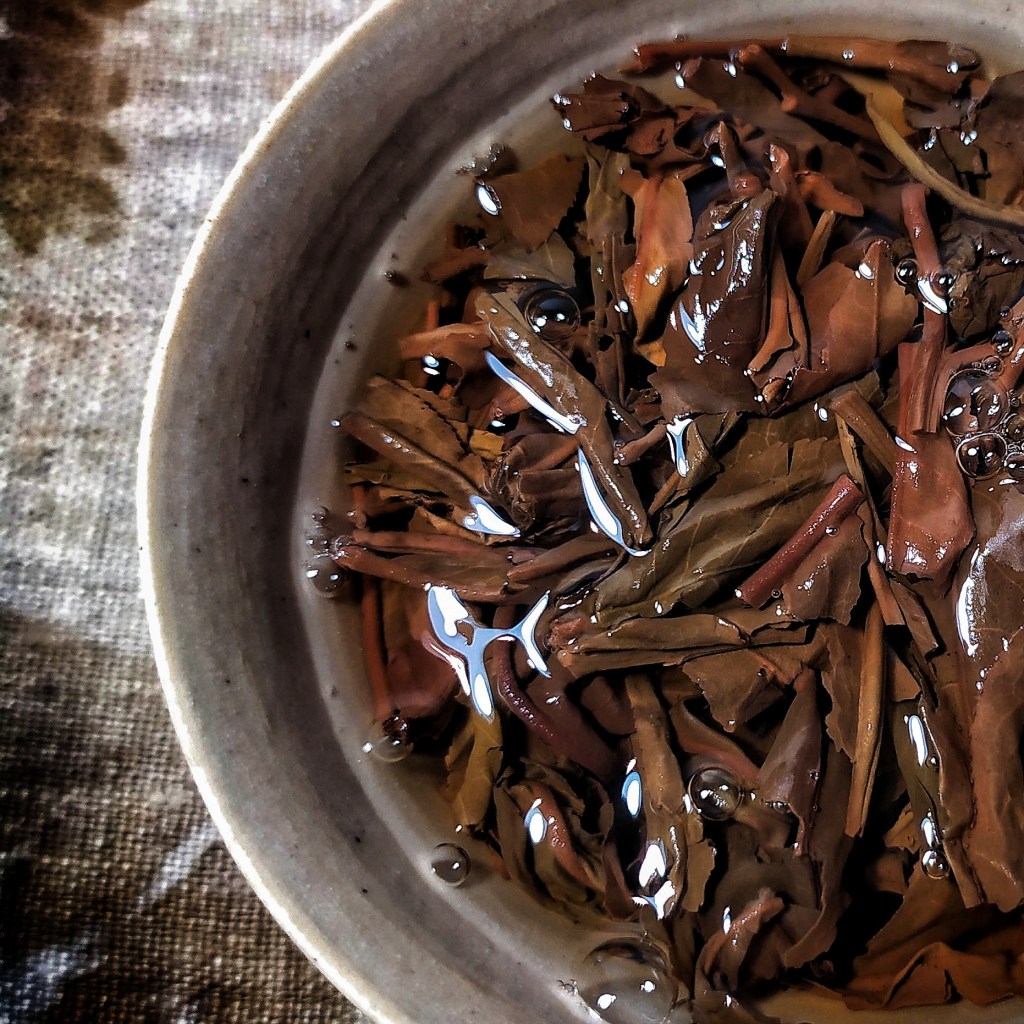
This is a 2003 Yiwu pu’er “Sheng Tai Gu Shu cha” via Camellia Sinensis, in a CNNP label different from the typical “white and red zhong cha”, probably the result of an anonymous packaging from a small producer.
One of the testimonies in a “unknown soldier” version of an attempted reconquest of “the authentic”, of the traditional taste that does not come to terms with the conventional. The leaves bring with them smoky notes, of vetiver and seasoned cedar wood perfumes. From the gaiwan come the smells of an ancient lutherie and those of an old wooden church.
The aromas are reminiscent of dried flowers inside a book, evolving olfactorily towards notes of leather, virginia tobacco, incense, dried rose hip and pepper. The medium-thick sip ends on hints of tamarind, dried longan, dandelion root and medical herbs, fading into an ancient sweetness and granting a strong and focusing qi.
 Wild Harvested
Leave a comment