
I am of the opinion that tea, good tea I mean, should always be accompanied by a good argument. I also remain firmly convinced that it itself must partly be the reason and urge for the conversation, and partly guide it.
If we could reconstruct a sort of symposium evening I often think about which tea I would offer, and the more time passes the more I would like such a reconstruction to materialize.
Between a Yiwu pu’er who exalts himself in his expensive robe, one from Naka on the gentle banks of Mengsong in the throes of self-satisfaction and one from Laobanzhang born under the gaze of God on the happiest mountains of China, the pu’er of You Le I’m sure would find a place without resorting to excesses of violence.
Those of You Le, the ancient land of elephants, are teas with a noble soul that still retain a “bourgeois” trait, that dignified self-sufficiency which, if well channeled, results in the most refined form of intellect.
At a table tea deserves the space it’s due because some of the great events of history are poured into it, the extraordinary possibilities that humans have been granted from era to era are dissolved in it. Because tea is a trail of great epics and immense tragedies, of rhetoric, imaginative experiences and speculations, the history of entire peoples distilled into a cup.
Under the action of its metamorphic nature, tea resolves prose into verse and verse into song, calms the most abysmal dissonances without the need to silence them, rather it legitimizes and composes them.
Because from the hard ground from which its trees arise, an innocent stream of fragile ambiguity can always flow, even in the midst of that jianghu, which it foments and nourishes; between rivers and lakes it doesn’t fear contradiction and is able to make every truth “always also false” and every falsehood “always also true”.
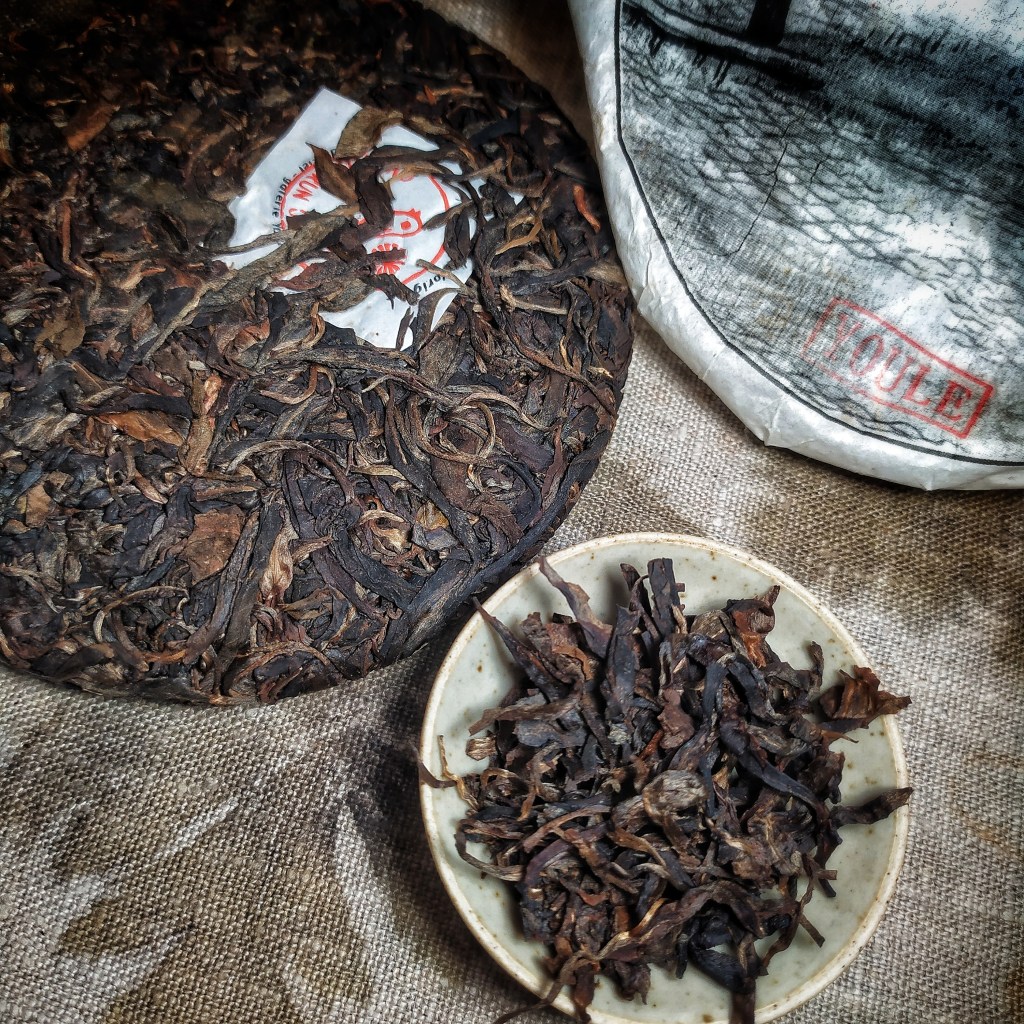
The thoughtfulness of this spring 2014 sheng from Ya Nuo village old trees holds up its mountain’s fame. The aromas arrive with orchestral precision, opening on notes of tobacco and plum, earthy nuances, resin and musk.
The leaves recall the scents of an old library with notes of mahogany and leather armchair, then red dates, raisins and light mentholated hints. The contribution of aging is balanced, with integrated notes of leather and of an old cigar box. The sip is coherent, with good softness but with adequate agility, low bitterness, balanced and with an excellent huigan. The long aftertaste is yet another proof of a dress sewn by a great hand.
The future will give it charm even though it is a tea that does not require eternity to be appreciated, but the aspiration is more than legitimate and a decade of waiting will, in the end, be a splendid meeting.
 Wild Harvested
Leave a comment