
Huang Cao Ba is a village of less than 800 souls, a respectable number considering the average of the nearby ones. Although it lives on a simple economy, based mostly on the production of food to be consumed on site, on livestock and agriculture, it can boast a certain basic well-being and the historical prestige of having a thousand-year history of tea production, with most of the relatively contiguous gardens planted in the middle and late Qing dynasty (1636-1912).
The red and yellow dirt roads on which Huang Cao Ba based much of his social life were the edges of a wild peak in whose forests the boys dreamed of being explorers and daredevils. You could smell the rice paddies that overwhelms you like an army of silk bundles, you could smell the mud, the green bamboo swaying in the wind broken by the spring rainstorm and every kind of subtropical exhalation.
Before those houses built with stone and clay bricks with sloping tin roofs, there was a traffic of information and documents, exchange of words and silences in that village which was a post station during the Nanzhao reign on the “刊木古道” the ancient timber cutting road which was a significant link for the foreign and military policy, the culture and the economy of the reign, which ran from Dali through Jingdong, Zhenyuan, Jinggu to Pu’er.
The vegetation consists of evergreen mountain broadleaf and mixed coniferous forests covering the centuries-old tea trees, so dense that the first exploration team was sent from Jinggu County only in 2001. Even its name derives from the cultural ethnocentrism of the first men, who, unable to penetrate it with the same ease they encountered in other villages, hastily dismissed it with what they could see from afar, as the land of yellow grass.
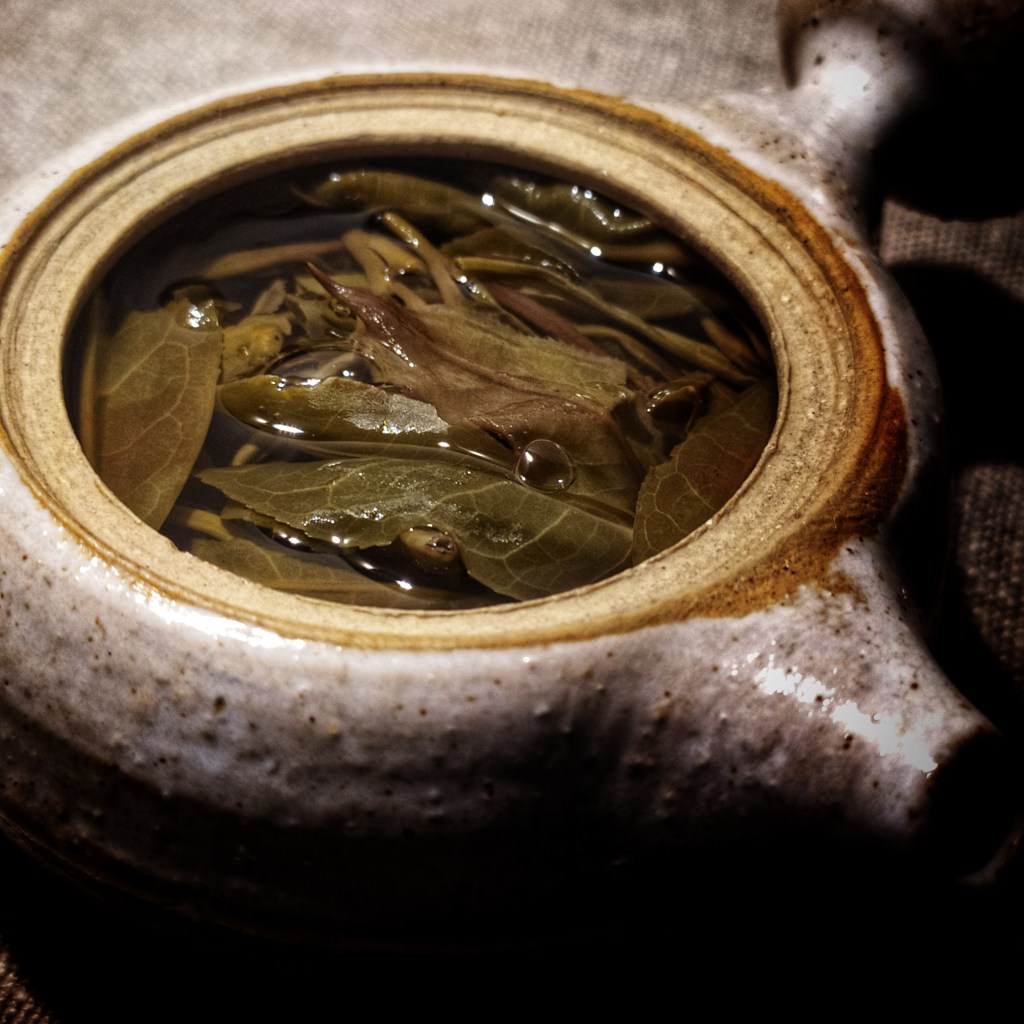
A mystical, primordial village that gave refuge to outlaws and fugitives during the Tang and Ming dynasties, a village of Yi healers and shamans and tea merchants on the Tea Horse Road, heroic loggers and ghosts of fallen workers, It is from its old trees that the leaves of this TdC 2023 sheng come. The leaves are wrapped in scents of peach jelly, cut grass and rock sugar, mango sherbet and orchid.
In the mouth it is delicately soft, translating the wild genesis of the slopes from which it comes, incredibly sweet and persuasive in the aromas of candied fruit, hibiscus, ripe apricot, then hints of walnut, vanilla and citrus peel finish a sip of excellent persistence.
 Wild Harvested
Leave a comment