
Cities, villages, neighborhoods as we have inherited them through the centuries are not mere institutions or simple names that evoke order and schematic boundaries. Rather, they are places that preserve the way of life of a civilization. In them, we experience time, space, and relationships with others, the “others” being women and men, once strangers to one another, who built spaces in which to live peacefully. These places are symbols of human relationships, compromises, unwritten laws and oral traditions, of evolution and change experienced side by side. Through architecture, rituals and religions survive. Not by chance, the word religion derives from relegere, to take note. Every cultural practice demands that attentiveness which architecture can teach. Over time, it has become a vehicle of proportion, memory, order, boundary, teachings on the use of light, shelter from the darkest nights, place of muffled sounds, thresholds and stairways that not only lead but instruct.
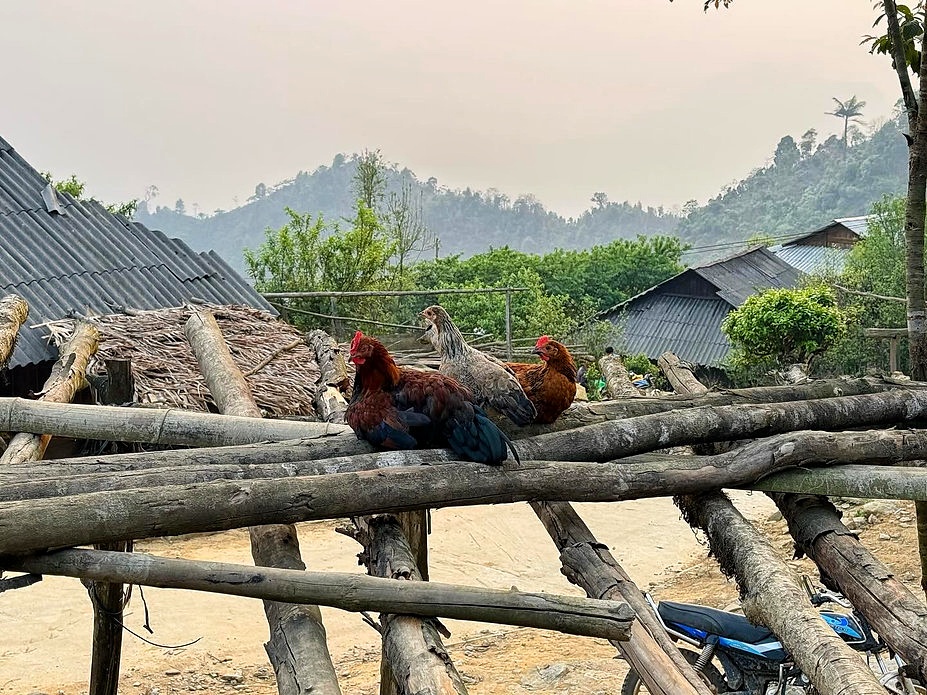
Rural architecture approaches the concept of classical architecture, as it is not merely a form of building that blindly pursues the essential functions of a structure, but rather a symbol of growth and the transitional phases imposed by history on a place’s inhabitants, an architecture that has grown over the centuries through inner coherence. Think of the Dai houses, with their classic two-story layout: living spaces and bedrooms on the upper floor, animals and farming tools on the ground floor. Roofs made of local stone or rice straw, and the use of wood from surrounding forests. These features do not simply create a picturesque image for an ethnographic reportage, but intelligent responses to a specific context.
This design ideology is not concerned with “looking pretty”: it is necessary, because it arises from a balance between nature, function, and humanity. In this sense, it is a fulfilled manifestation of what Frank Lloyd Wright called organic architecture, a principle he tirelessly sought to establish across Europe and America throughout the 20th century. What Western universities were trying to rediscover, Yunnan, and China as a whole, already had right before their eyes and under their feet. But as so often happens in the history of civilizations, the arrival of wealth and the imitation of foreign models shatter this ancient balance.
With the influx of money from the tea market, some villages changed their appearance, resulting in the construction of alien hotels, expanses of tiles in village centers, glass towers and sterile multi-story concrete buildings rising like imitative forms of globalization and economic development. But this is nothing more than replacing a dialogue with the environment with a monologue of vanity. To blindly and stubbornly surrender to this process is an act of desensitization to one’s own history. This is how the harmony between built and natural environments is dismantled, rendering a particular village into a generic, interchangeable place.
To those who accuse me of being a fanatical dreamer, just as Léon Krier was branded a nostalgic visionary, I respond that traditional architecture holds forms and anatomies capable of reflecting truly human interests, more so than modern architecture. Including economic interests.
Buildings, houses, factories, temples, everything in rural architecture responds to truth and real use, but not in a merely utilitarian sense. Today, modernist architectural projects are not designed to be inhabited, but merely passed through, they are meant to represent a transient place. They are theatrical props in an urban performance, with no reference to a broader meaning, a meaning that can reside even in the humblest dwelling. Modern buildings are often imposing, expensive, designed to elicit hollow opinions from critics with numbed vocabularies, who otherwise might look past them and judge them as they deserve.
And so Berlin’s Haus der Kulturen der Welt is known as “the pregnant oyster,” the UN building in New York as “the radiator,” Di Salvo’s brutalist buildings in Scampia, Naples as “the sails,” while for the monstrosity of Renzo Piano’s Pompidou Center, they didn’t even bother, just calling it by the name of the neighborhood it was dumped into. While classical forms represent agreements handed down through generations and originate from centuries of consensus, modernist ones require nicknames to identify themselves in their forced attempt to exist solely for a purpose, that of containment, but in iconic form. According to Krier, this need to nickname is nothing but an entry into the category of kitsch: the attempt, by an object devoid of authenticity, to obtain a label that justifies its existence, that makes it “mean” something. It is the staging of a rootless structure, forcibly grafted into a context to which it is alien, like a despised ex who, after years of silence, suddenly shows up, with unwelcome emotional exhibitionism, at your mother’s birthday party.
In this way, what is gained is not just improved material conditions, if that even occurs, but also the domestication of the sense of belonging: the institution of a “government of smoothness,” where every surface is polished, glossy, frictionless, where nothing invites you to stay. And really, why stay, if nothing is made to last and bear witness anymore and your land is transformed into just another urban cluster like all the others?
Let it be clear: it is impossible to demand perpetual amniotic preservation. But evolution is not destruction. One can build today according to ancient criteria, using modern technologies without sacrificing harmony, symbolism, or recognizability. Gilbert Keith Chesterton wrote that “Tradition is the democracy of the dead,” and that is essentially true. Abandoning it is not freedom, it is an amputation of collective memory. True modernity is that which recognizes itself as a chapter in an already begun book, not a blank page.
When we speak of rural architecture, as in the case of homes in Wengji, Shaxi or Nuogan in Yunnan, we are not referring to mere picturesque tradition. We are speaking of an organic spatial model, culturally rooted, formally legible, and humanly proportioned, one that creates value not through financial abstraction but through functional continuity (home-work-land), a form of identity authenticity (cultural and symbolic value of place), constructive ecology (local materials and techniques), and a lasting attractiveness much more resilient to external shocks (for tourism, craftsmanship, and quality agriculture).
Architecture and urban development must preserve the visible memory of a cultural identity, and to defend these principles is not conservatism, but the ecology of identity.
Note: The photo was taken by Steve Shafer
 Wild Harvested
Leave a comment