
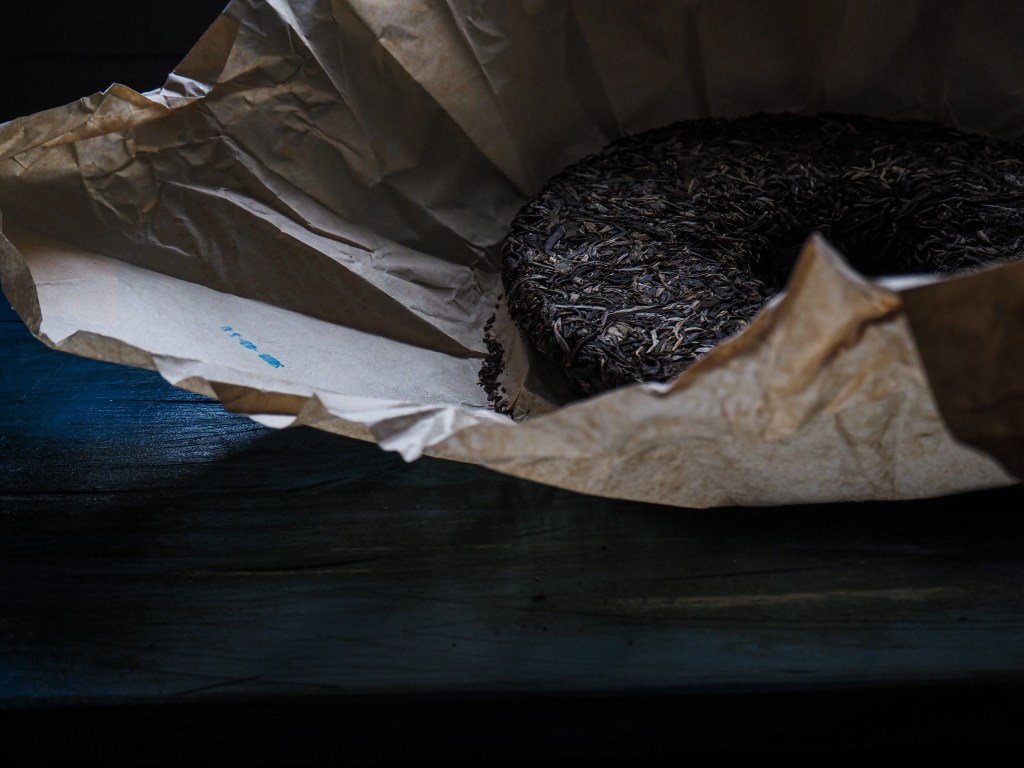
Honestly, I’ve been looking for a topic worth an article for quite some time now. For the past few weeks my Instagram feed has once again been clogged with photos of old factory cakes and boutique brands whose teas easily cost more than a gastroscopy.
As I write this it is Sunday, and even though I don’t particularly care, somewhere in the nave of the church inside my head a patriarchal voice keeps echoing, suggesting that, just this once, I should not be as caustic, or, how shall we say, corrosive toward other people’s ideas.
I still haven’t decided whether to listen to it.
In any case, I often hear people refer to pre-2005 teas, or generally anything produced before the Pu’er speculative bubble burst, as a sort of baseline, a ground zero from which to build one’s knowledge. They are often accessible; sometimes you can find 15- to 20-year-old material at relatively reasonable prices, even if occasionally it feels like drinking a decoction of your own sweaty shirt, baptized by the humidity of Taiwan’s western coast. And this is the first principle of my disagreement. A logistical criterion (access) is often mistaken for an epistemic one (understanding quality). The fact that something is accessible does not make it instructive; it only makes it easy to build a theory around it.
Act I: the baseline.
A “baseline” serves to calibrate sensitivity, language, and critical measure; it should therefore be built on samples that clearly represent key variables (raw material, processing, storage style), not on what the market makes convenient to buy in terms of quantity and price. One still hears the fairy tale that sheng from the 90s and up to 2005 were intrinsically sublime, but this is not always true, often it is simply mediocre tea swallowed at great expense, only to discover that it is worth little more than a drunken lost bet, and its chaqi will not save you from the terrible judgment of the Sabbath.
For clarity: chaqi exists, even if it lacks a clear and unified scientific explanation, but it cannot be what motivates a purchase. Tea discourse often turns mystical, full of “energy” and “vibrations”, frequently because a shared vocabulary for describing quality is missing. Chaqi may be a real, even if subjective, experience, but used as an argument it is often an easy escape hatch. As proof, it amounts at best to a personal impression elevated to a criterion.
00s factory teas mainly teach an industrial profile: standardization, blending, productive compromise. It is one of the worlds of Pu’er, but not the qualitative world of Pu’er in any absolute sense. That alone is enough to produce a distorted baseline. You grow accustomed to the “factory taste” as a norm and judge everything else as deviation.
Act II: storage.
We know quite a lot about storage in general principles, very little about real reproducibility, and almost nothing about comparability between storage environments when data are lacking. There are physical principles, but also an absurd number of uncontrollable variables and complexities, and the whole discussion often dissolves into a broth of anecdotes and mysticism. Whenever I hear conversations about storage invoking names like Kunming, Taiwan, Malaysia, and Hong Kong, I feel as though I am witnessing an Allan Kaprow performance: no one understands what is happening, but everyone has been sufficiently involved that no one can criticize it.
Storage undeniably influences a Pu’er’s development and quality over time, one need not summon a climate physicist to admit this. Yet its impact is decisive even after only three years. At 17–20 years or more, especially with wetter storage, many differences in raw material and processing compress into a potentially generic profile. This always happens, it is biochemistry, though this does not mean all aged Pu’er tastes the same. Storage is excellent for understanding style and for objectifying a general aromatic dimension, but weak as a baseline for intrinsic quality.
Act III: aging.
I come from the world of wine. Twelve years ago, before I began studying what Pu’er actually was, that’s where my free time went, along with a credit card financed by badly paid jobs. Among the initiates of the Bacchus sect one thing is clear: aging is not simply getting old, and aging “without collapse” is not the same as aging “with depth.” The same, frankly, applies to Pu’er.
Seeing vendors raise the price of unsold Pu’er after a single year already gives me gastritis. But when people identify “aging success” as merely avoiding decay, I feel certain dendritic networks in my brain quietly die. Aging, in the sense of maturation, cannot mean only that bitterness softens and edges round off. Aging is not mere attenuation. Quality, in its dynamic and evolving sense, implies aromatic layering, structure, intensity, huigan, persistence, and a clean transformation not excessively dictated by storage.
Act IV: prices.
Tea was once conceived to be stored, not immediately consumed. Even my goat Violette understands this. And Violette knows that if the grass was poor when cut, aged grass remains poor grass. Watching her, one easily understands that the essence of mediocre things is marked in a subtle, almost existential way.
For years, until roughly 2010–2012, the Pu’er market priced time itself. Primitive, but effective. Now high prices follow expectations of material and origin, desirability, trust, social value, intentions, and all the things Tony Blair might have said to sweeten a policy for his electorate. In short: narrative.
I have never spent fortunes on old cakes. Not out of moral superiority, but suspicion. Or perhaps because I am not spiritually elevated enough to perceive what the fetishists of granny Pu’er claim to see. I see the risk of fakes, uncertain origin, possible smells of basements sublet for ransom kidnappings, people in windowless humid rooms swapping wrappers while smoking, selling rubbish for four-figure sums, and speculation about batch reputation formed long before the moment of consumption yet already determining the purchase price. A book on the economization of modern art would explain half the Pu’er market.
In some cases 80s–90s cakes have been among the most meaningful Pu’er I have ever tasted. More often, however, they have earned me a night on the couch and a bitterness in the mouth, the kind reserved for layoffs and extortion, lasting until morning.
Act V: historical-economic context.
During the bubble, observers noted raw-material shortages and flows of maocha from border regions into Yunnan, with consequences for average quality and perceived authenticity. Combined with heavy herbicides and chemical fertilization spreading, drastic pruning, and new low-altitude, high-density plantations expanding since the 80s, it is reasonable to conclude that the Pu’er boom pushed toward compromises in material quality and left a large quantity of mediocre tea that has now reached us. This was not mysterious; it was the predictable behavior of a market convinced it had found an eternally appreciating good.
Factories are logistical machines. When demand rises and high-grade material is scarce, sourcing widens and more ordinary leaf is used. The result is not necessarily bad tea, but tea designed to be reliable, purposeful, not memorable for a few thousand obsessives like me. This baseline represents a supply-chain compromise, not a qualitative summit.
Look around: a great deal of old Pu’er still circulates, even in Europe, at crazy prices. Ask when you last heard someone speak negatively about those exact teas. Never. Either people lie, or they submit to the mechanisms already described here, or here. In perhaps 20% of cases the tea is genuinely good.
And here lies the curious point: often we are not drinking what survived because it was the best, but what survived because it was abundant or left aside in who knows what conditions. Or widely counterfeited.
Act VI: the disciples.
Other people’s opinions are initially valuable and eventually dangerous. Understanding quality requires experience directed toward objective judgment, not passive adherence to an ideology. Accumulating recommended tastings is not enough. Today the idea of quality in Pu’er resembles a permanent biennale: much celebration, occasional sterile condemnation, and little critical sense. Direct experience is replaced by informal hierarchies, mediated tastings, questionable reviews, preferences learned before tasting. It is not deliberate deception but cognitive economy: easier to recognize a judgment than to form one. Thus a community of interpreters emerges rather than drinkers, a voyeuristic party rather than a participatory community.
Act VII: philosophy.
Early in my Pu’er journey, drinking old teas often irritated me. As soon as one session ended something better appeared: rarer, more expensive, a batch from the cellar of some semi-mythical Mr. Someone had to be tried. The hyper-specialized vendors were like dealers in a 1970s novel, not selling a product but the possibility of never stopping.
It reminded me how, when I was younger, I had a vague idea that my sentimental education might be the result of a permanent structural dissatisfaction typical of the young middle class, a bohemian depression, vaguely Marxist at its origin, the kind felt by those who know they might not truly have it but choose to appropriate it anyway as a social role. A collective suffering based on the impossibility of reaching the next level, something to be simply accepted. Pu’er was exactly the same: happiness and remorse, desire and correction, like a nun who ardently longs for carnal sin and then runs to confession.
There was certainly repeatability and reliability in each cake, but reliability is not always positive when it becomes leveling. Small productions often vary within the same batch; that variation is the character of craftmanship, not a conscious and unconditional pardon of flaws, but an acceptance of random error and the human element. I had believed that, at least in a product like Pu’er, originally laden with symbols, people were not seeking serial reproducibility and technical anonymity. Factory Pu’er reduces uncertainty, avoids surprises, and allows a judgment consistent with what has already been said. It does not become a baseline because it explains Pu’er, but because it stabilizes the drinker’s experience. Yet there are those who consciously desire exactly this, and even appreciate it. Another shot fired at the memory of Walter Benjamin.
To escape the warm amniotic comfort of sterile criticism, a possibility exists: constructing a baseline “by matrix” and not by category. One learns nothing from merely drinking “good” teas. One learns only by comparing comparable ones.
Pu’er is a system of four macro-variables: material, processing, storage, and time. Evaluate them all at once and draw conclusions, it is like reading tarot, not tasting tea. A baseline built on old factory cakes fuses all variables. Excellent for consumption, poor for understanding.
Taste relatively green-processed samples from different regions of the same year. Try modern “honged” or “oolonged” shengs meant for early drinking: they act as reagents, revealing what happens when processing dominates leaf. Then compare teas from the same vendor or producer, stored similarly for 5–8 years and again for 12–20. Only then you will begin to see what time actually does. At least three of the four parameters should remain fixed.
Okay, it is not romantic, no mountain sages, no mythic wrappers, no secret Malaysian cellars guarded by tigers. But the differences become legible.
And here the strange thing happens: once you see the variables separately, much of Pu’er’s narrative evaporates, not because it was false, but because it was not knowledge. It was the socialization of taste.
 Wild Harvested
Leave a comment